

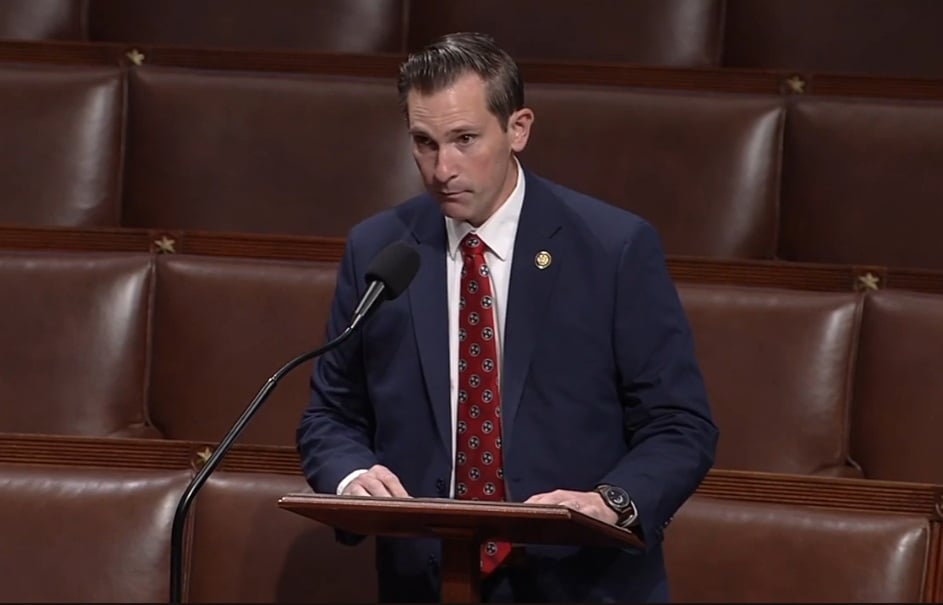
- Rep. Matt Van Epps announced four of his amendments were included in the House-passed FY27 NDAA, which passed 216-212 on July 21, 2026.
- One amendment raises the military death gratuity from $100,000 to $165,000 with a cost-of-living adjustment, while another targets aging Fort Campbell infrastructure.
A congressman whose own military career started at Fort Campbell has had four of his ideas written into the bill that funds and governs the entire U.S. military for the next year.
Rep. Matt Van Epps, a Tennessee Republican representing the state’s 7th District, announced Wednesday that four of his amendments were included in the House’s version of the Fiscal Year 2027 National Defense Authorization Act, the sweeping annual legislation that sets policy and authorizes funding for the Department of War, the current name for the Department of Defense. The House passed its version of the bill Tuesday by a narrow 216-212 vote, sending it toward a conference process with the Senate, which passed its own version out of committee in June but has not yet brought it to the floor.
The most personal of Van Epps’ four provisions updates what the military calls the death gratuity, a lump-sum payment made to the families of service members killed in the line of duty. That payment has stood at $100,000 since 2006, a figure Van Epps has previously noted has lost roughly a third of its purchasing power to inflation over the past two decades, and the version now included in the NDAA raises it to $165,000 while adding an automatic cost-of-living adjustment so future payments keep pace with inflation going forward. That final number represents a scaled-down version of what Van Epps originally proposed. His standalone HONOR Gold Star Families Act, introduced in March 2026 alongside Republican Rep. Jen Kiggans of Virginia and Democratic Rep. Jill Tokuda of Hawaii, had called for doubling the gratuity to $200,000 and applying the increase retroactively to cover families who lost loved ones in Operation Epic Fury, the U.S. military’s operation against Iran earlier this year. Van Epps, a West Point graduate and Army veteran who deployed to both Iraq and Afghanistan, introduced that original bill as his first piece of legislation after winning a special election, and has said the change is overdue given that $100 in 2006 carried the buying power of roughly $160 today.
“I am proud that core provisions of my HONOR Gold Star Families Act made it into the FY27 NDAA. For the first time in nearly two decades, this legislation updates the military death gratuity by increasing the benefit for survivors from $100,000 to $165,000 and indexing future payments to inflation through a cost-of-living adjustment. This legislation will provide greater financial support to the families of fallen servicemembers who have sacrificed so much,” Van Epps said.
A second amendment targets a problem much closer to home for Van Epps’ district, which includes Fort Campbell, the sprawling Army post straddling the Tennessee-Kentucky border and home to the 101st Airborne Division. Van Epps said much of the base’s water and wastewater infrastructure is more than 60 years old and in need of significant maintenance, a concern he tied to a broader nationwide problem rather than a Fort Campbell issue alone.
“The fact of the matter is that aging water and wastewater infrastructure has become a growing concern for readiness and quality of life. Much of Fort Campbell’s utility system is more than 60 years old and requires significant maintenance and modernization to reduce the risk of service disruptions. Should a major disruption occur, it could affect everything from mission execution to the health of military families,” Van Epps said.
Van Epps cited a 2024 Congressional Budget Office report finding the four military services carry a combined $50 billion in deferred maintenance across their installations, with the Army and Navy alone accounting for 70% of that backlog. His amendment directs the Department of War to formally evaluate the condition, cost and operational impact of aging utility systems across all military installations and rank the highest-risk projects for future investment, essentially forcing the Pentagon to produce a prioritized repair list rather than continuing to address failures on a case-by-case, reactive basis.
“My amendment directs the DOW to evaluate the condition, costs, and operational impacts of these systems across all military installations. Once that is done, the Department of War will rank the highest-risk projects and provide recommendations for prioritizing future investments,” Van Epps said.
“This data-driven roadmap for modernization will ensure installations like Fort Campbell receive appropriate attention before infrastructure failures degrade military readiness,” Van Epps said.
The remaining two amendments push in a different direction, aimed at speeding up how quickly new technology reaches troops and how prepared defense contractors are for a major conflict. One amendment directs the Department of War to identify and address the bureaucratic barriers that prevent promising prototype technology from research institutions from transitioning into full production programs, an issue Van Epps tied specifically to innovation happening inside his own district at Vanderbilt University and Tennessee’s Oak Ridge National Laboratory.
“Too often, groundbreaking research and development from institutions like Vanderbilt University in my district or Tennessee’s Oak Ridge National Lab take far too long to reach the battlefield. It doesn’t help to have the best scientists, engineers, and innovators in the world, only to have their breakthrough discoveries stifled by bureaucracy,” Van Epps said.
The final amendment would require major defense contractors to submit plans outlining exactly how they would rapidly scale up production capacity during a national emergency or major conflict, a requirement Van Epps tied directly to how quickly modern wars burn through munitions.
“This amendment will help ensure our nation can meet the demands of any future conflict. Recent events in Ukraine and Iran have shown how quickly modern conflicts consume artillery rounds, precision-guided munitions, air defense interceptors, and other critical systems. That is why I introduced an amendment requiring major defense contractors to outline how they would rapidly increase production capacity during a national emergency or major conflict,” Van Epps said.
None of these four provisions is law yet. The House and Senate still have to reconcile their competing versions of the NDAA through a conference committee before a final bill can reach the president’s desk, a process House Armed Services Committee Chairman Mike Rogers acknowledged will require further negotiation even after Tuesday’s close House vote.