

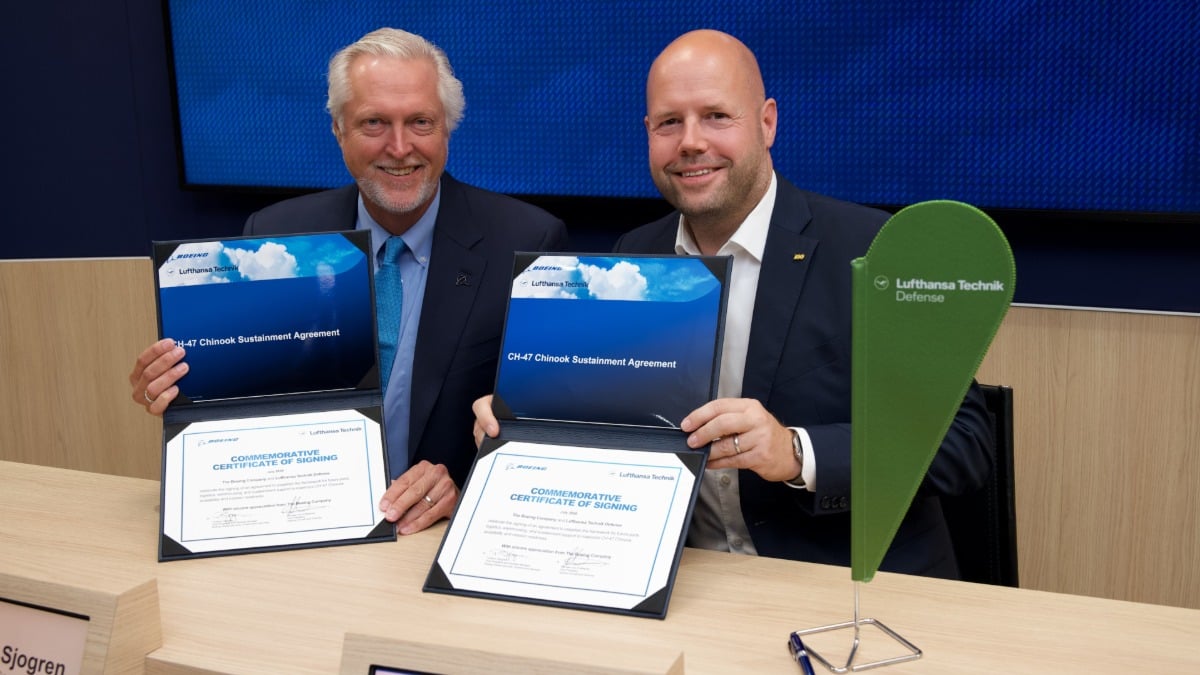
- Boeing and Lufthansa Technik Defense signed an agreement on July 22, 2026 at the Farnborough Airshow to establish parts logistics for Germany's new CH-47F Block II Chinook fleet.
- Germany is buying 60 Chinooks worth roughly 7 billion euros to replace its aging CH-53G fleet, with deliveries expected to begin before the end of 2027.
Boeing and Lufthansa Technik Defense signed an agreement Wednesday at the Farnborough International Airshow to establish general terms for sustaining Germany’s new CH-47F Block II Chinook heavy-lift helicopters, laying the groundwork for a network of parts warehouses across the country to support the aircraft once they enter Luftwaffe service.
The Bundeswehr selected the CH-47F Block II in 2022 to replace its CH-53G Sea Stallion fleet, helicopters that have flown for the German military for nearly five decades and are set for full retirement by 2030, and Germany’s parliamentary Budget Committee gave final approval to buy 60 of the aircraft in 2025, in a deal worth roughly 7 billion euros funded through the country’s post-2022 special defense fund created to rebuild the Bundeswehr into a more credible fighting force.
The tandem-rotor Chinook, powered by twin turboshaft engines producing roughly 4,800 shaft horsepower each, can carry more than 12 tons (26,455 lb) of troops, vehicles or cargo, and Germany’s version will come equipped with air-to-air refueling probes and extended-range fuel tanks, letting crews fly longer missions when paired with tanker aircraft, a capability the current CH-53G fleet lacks and one NATO planners see as increasingly important for rapidly reinforcing the alliance’s eastern flank. Production of the first German airframe began earlier this year at Boeing’s facility in Ridley Park, Pennsylvania, with deliveries expected to start before the end of 2027 and continue into the early-to-mid 2030s, with most of the fleet based at Holzdorf in Brandenburg alongside a smaller contingent at Laupheim in Baden-Württemberg.
None of that hardware matters much if the parts to keep it flying can’t reach the right base at the right time, which is exactly the gap this week’s agreement is meant to close. Under the deal, Lufthansa Technik, through its Lufthansa Technik Logistik Services subsidiary, will combine its decades of experience in time-critical spare parts logistics with Boeing’s knowledge of the aircraft itself to build what the companies describe as an agile network of parts warehouses supporting the CH-47F’s operating bases throughout Germany. Lufthansa Technik will also handle the supply of what the industry calls consumables and expendables, everyday maintenance items like filters, seals and fluids that get used up and replaced routinely rather than repaired, for the German Chinook fleet, a role that keeps routine maintenance moving without requiring every part to be shipped in individually as needed.
Torbjorn Sjogren, Vice President and General Manager of Boeing Global Services, Government Services, framed the agreement as central to keeping the fleet flying once it enters service.
“This agreement marks an important step forward in ensuring sustained readiness of the German CH-47F Chinook fleet across different bases,” Sjogren said.
“By combining Boeing’s sustainment expertise with Lufthansa Technik’s logistics and MRO capabilities, we will establish a resilient solution to maximize aircraft availability,” Sjogren said.
For Lufthansa Technik, the deal marks new territory entirely. Michael von Puttkamer, Senior Vice President of Special Aircraft and Defense at Lufthansa Technik, pointed out that the Chinook will become the first rotary-wing aircraft ever added to the company’s maintenance, repair and overhaul portfolio, a notable shift for a business built primarily around commercial and VIP fixed-wing aircraft servicing.
“This agreement is a significant milestone, making the Chinook the first ever rotary-wing aircraft to join Lufthansa Technik’s MRO portfolio,” von Puttkamer said.
“With our tailored parts logistics expertise, we will make a significant contribution to ensuring the high level of operational readiness that is essential for the sovereign German sustainment of the U.S.-procured Chinook fleet. The resilience of the parts supply chain is key to this endeavor, and with our industry-leading logistics concepts, we are confident that we can reduce spare-parts-related downtime to a minimum,” von Puttkamer said.
Even though the Bundeswehr is buying the Chinook through the U.S. government’s Foreign Military Sales program, Germany has consistently pushed to keep as much of the maintenance and logistics work as possible inside the country rather than depending entirely on shipments back to the United States, a strategy that reduces how long an aircraft sits grounded waiting on parts and keeps specialized technical jobs and expertise based in Germany. This week’s Chinook agreement builds directly on that same model, extending a partnership Boeing and Lufthansa Technik Defense established in autumn 2025 when they signed a comprehensive sustainment program for the German Navy’s P-8A Poseidon maritime patrol aircraft, another U.S.-built platform now serviced primarily by German industry rather than shipped overseas for major work.