

- The U.S. Air Force Life Cycle Management Center published a Request for Information on July 17 seeking a ground-based launcher for cruise missiles and drones.
- Responses covering eleven technical attributes are due by August 7, 2026, with no commitment yet to purchase any system.
The U.S. Air Force Life Cycle Management Center’s Command, Control, Communications, and Battle Management Directorate at Wright-Patterson Air Force Base in Ohio published a market research notice this week seeking industry information on a new ground-based launcher built to shoot down both cruise missiles and drones ranging from small commercial-style quadcopters up to large, fixed-wing unmanned aircraft, all from the same system.
The notice is what the government calls a Request for Information, a formal but non-binding way for the military to survey what industry can actually build before committing to a real purchase, and officials were explicit that this step commits the Air Force to nothing beyond gathering information. What makes this particular request notable is its scope. Rather than asking for a system tuned to just one category of threat, the Air Force wants a single ground-based launcher capable of engaging Unmanned Aircraft Systems across all five weight classes the military uses to categorize drones, ranging from Group 1 aircraft weighing 20 pounds (9 kilograms) or less up to Group 5 systems weighing more than 1,320 pounds (599 kilograms), alongside actual cruise missiles, a considerably faster and more dangerous class of threat that flies more like a small, precision-guided airplane than a slow-moving drone.
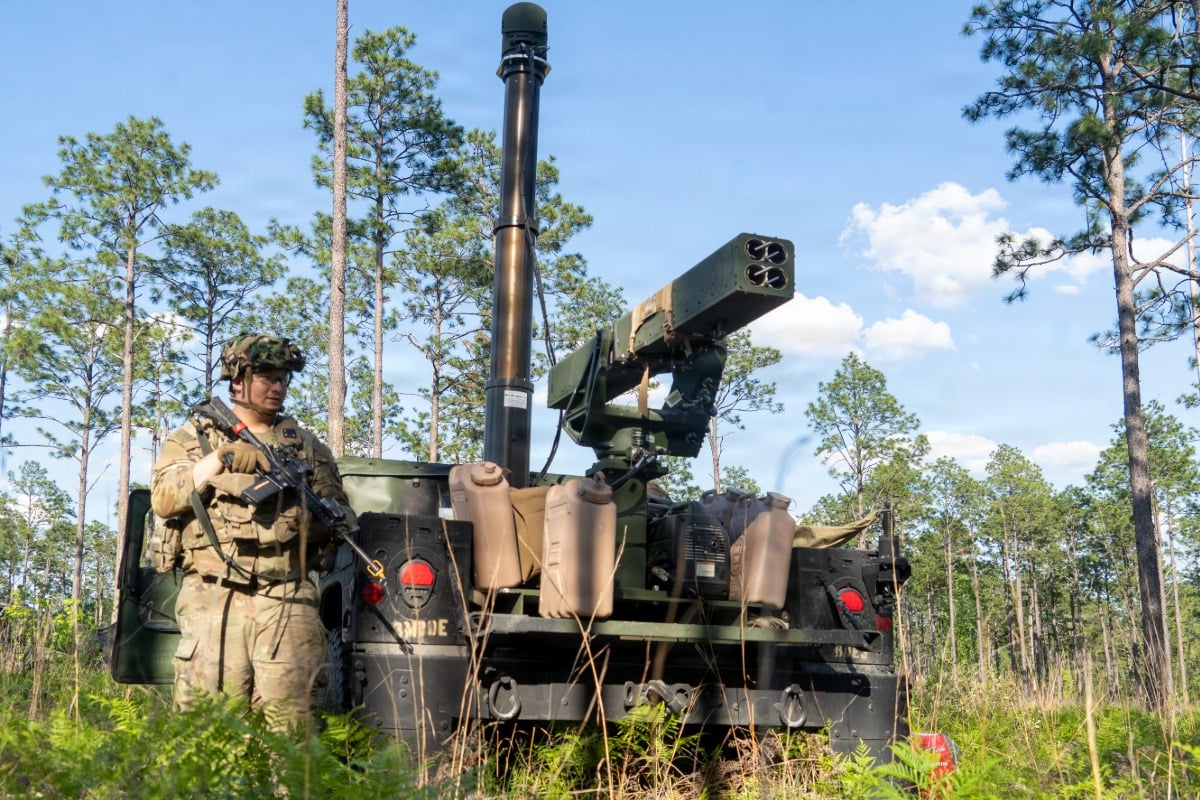
That combined requirement reflects a hard lesson the Air Force has absorbed watching conflicts play out from Ukraine to the Middle East, where adversaries have increasingly mixed cheap, mass-produced drones into the same attack waves as more sophisticated cruise missiles specifically to overwhelm air defenses built to handle only one threat type efficiently. British forces have already faced exactly that combined threat firsthand, deploying a short-range counter-drone system called Rapid Sentry to Kuwait and other Middle Eastern locations this year specifically to protect bases against Shahed-style drones and other threats launched from Iran, using missiles fired from a ground launcher holding four rounds mounted around an electro-optical guidance unit.
The Air Force’s new request lays out eleven specific technical attributes it wants industry to address, covering everything a real system would need beyond just the weapon itself. Vendors must detail what type of munition their system fires, what kind of sensors it carries to spot incoming threats, and whether it includes a laser illuminator to help guide munitions or confirm targets. The request also asks for hard performance numbers, including the system’s total firing rate across every magazine it carries and how deep those magazines actually run, since a launcher that can only fire a handful of rounds before needing to reload becomes far less useful against an attack designed to overwhelm defenders through sheer numbers. Beyond the weapon’s raw capability, the Air Force wants to know how easily the system integrates into existing command and control networks to rapidly share sensor data and cue weapons onto targets, what a realistic price point per system would look like, how easily the whole setup can be transported and repositioned, how many personnel it takes to operate, and whether it includes automated diagnostic testing to confirm the system is actually ready to fire before an operator needs it.
This request builds directly on a broader push the Air Force has been running for months to close gaps in how it defends its own bases. The service’s newly established Point Defense Battle Lab published a pair of related requests for information back in March, one focused on detecting small drones and another focused specifically on kinetic, hard-kill systems capable of physically destroying them, following an earlier November request asking industry whether ground-based systems could fire guided Hydra-70 rockets using the Advanced Precision Kill Weapon System guidance kit against drone swarms. Separately, the Air Force has been developing what it calls the Counter-Air Missile Program, aiming for a weapon priced under $500,000 per unit that could be produced at a rate of at least 1,000 per year, explicitly designed to give air bases an affordable way to intercept threats without burning through far more expensive traditional interceptor missiles built for shooting down enemy fighter jets.
The stakes behind this kind of base defense buildup go beyond any single overseas deployment. A RAND Corporation study prepared for U.S. Air Forces Europe examined the growing cruise and ballistic missile threat facing American air bases across the continent and explored whether the Air Force itself should field its own ground-based missile defenses rather than continuing to rely primarily on Army-operated systems, a roles-and-missions question that has quietly shaped how the Pentagon divides responsibility for protecting airfields for decades. The new Ground-Based Launcher request notably cites Joint Publication 3-01, the military’s foundational doctrine on countering air and missile threats, alongside a 2023 Pentagon policy memo governing how the Defense Department operates unmanned aircraft systems within U.S. airspace, a detail suggesting the Air Force is thinking through how a system like this might eventually need to operate not just overseas but potentially on American soil as well.
Industry has until August 7 to respond, and nothing in the notice guarantees any of this actually becomes a fielded weapon system. But the sheer breadth of what the Air Force is asking for, a single launcher expected to credibly handle everything from a small commercial drone to a supersonic cruise missile, captures just how much the threat picture facing American air bases has changed, and how badly the service believes its current defenses were never built for the war that threat picture now describes.