

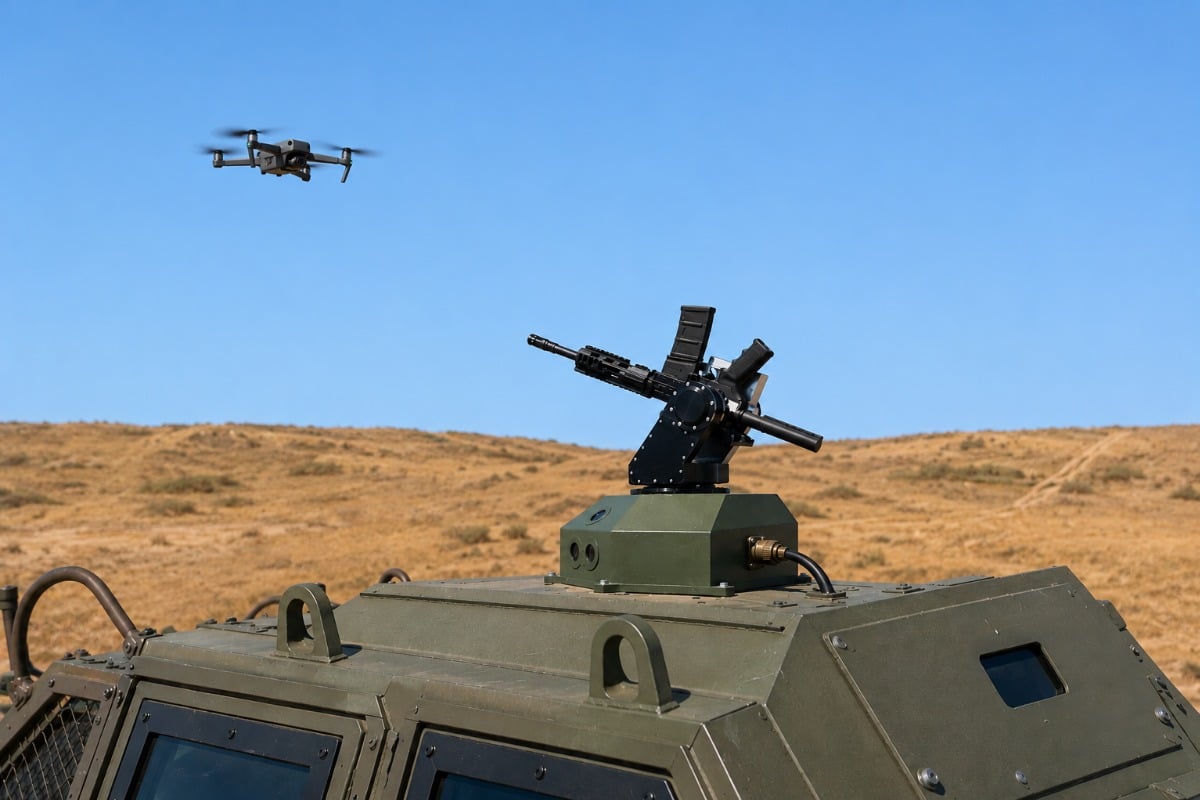
- Axon Vision announced the launch of ForceField, an AI-powered counter-drone system built to protect moving military forces from FPV drone attacks.
- The system is specifically designed to counter fiber-optic-controlled FPV drones, which cannot be stopped by traditional electronic warfare jamming.
Axon Vision, an Israeli defense technology company, announced Thursday the launch of ForceField, a new protection system designed to shield tanks, armored vehicles, and troops on the move from first-person-view drones, the cheap, remote-piloted aircraft that have become one of the deadliest threats facing ground forces in modern combat.
First-person-view drones, commonly called FPV drones, let an operator wearing video goggles guide a small aircraft directly into a target with a level of precision that has made them devastatingly effective and devastatingly cheap compared to the vehicles, personnel, and infrastructure they destroy. That combination has driven surging global demand for dedicated protection systems, a demand sharpened further by the rise of fiber-optic-controlled FPV drones, a newer variant that trails a thin physical cable back to its operator instead of relying on a radio signal, making it effectively immune to electronic warfare jammers that work by drowning out or disrupting radio frequencies. Since there is no wireless signal to jam on a fiber-optic drone, a defending force needs a fundamentally different way to spot and stop one, and that gap is exactly the problem ForceField is built to close.
ForceField runs on what Axon Vision calls its EDGE AI technology, artificial intelligence systems the company has spent several years developing and refining through programs with Israel’s Ministry of Defense, and the system compresses an entire engagement into three steps the company describes as detect, understand, and respond. It starts with passive threat detection, meaning the system watches for incoming drones using sensors that only receive signals rather than actively broadcasting radar or other signals that could reveal the protected force’s exact position to an enemy, a design choice that matters enormously for a moving convoy or dug-in position trying to avoid detection in the first place. Once ForceField spots a threat, its AI layer analyzes and classifies it in real time before handing the engagement decision to what the company calls Man-on-the-Loop control, a setup where a human operator supervises the system and retains the authority to intervene or halt an engagement, rather than letting software make the final call to fire entirely on its own.
The neutralization piece works through what Axon Vision calls an integrated kinetic response, meaning the system fires an actual physical projectile at the incoming drone rather than relying purely on jamming or lasers, and it does so using standard weapons and ammunition already common in military inventories rather than a proprietary interceptor a unit would need to source and stock separately. That design choice addresses a persistent complaint from military logistics planners across NATO and allied forces, who have watched counter-drone programs repeatedly get bogged down by the cost and supply chain burden of specialized, single-purpose interceptor munitions that compete for shelf space and budget against everything else a unit needs to keep fighting. Axon Vision built ForceField for rapid integration onto existing vehicles and platforms without requiring engineers to dig deep into a platform’s core electronics, and the system can operate independently, without needing continuous communications links back to a command post or reliance on external detection networks, letting it function as a self-contained protective bubble around whatever vehicle or position it rides on.
Axon Vision said it completed ForceField’s development following a series of live-fire trials conducted in scenarios designed to mirror real combat conditions, including tests where the system intercepted actual FPV drone targets, demonstrating its ability to detect, track, and neutralize aerial threats in real time rather than only in simulation. The company’s modular approach also gives customers flexibility beyond the full package, since Axon Vision plans to offer the underlying detection and EDGE AI layer as a standalone component that other manufacturers can integrate with weapon systems they already build, rather than forcing every customer to adopt the complete ForceField solution wholesale.
Neri Zin, CEO of Axon Vision, framed the launch as a turning point in what kind of company Axon Vision is becoming.
“ForceField is the result of years of investment in the development of operational EDGE AI technologies,” Zin said. “We believe this solution marks a significant milestone in Axon Vision’s evolution, from a company that supplies EDGE AI capabilities to system manufacturers and defense programs to one that develops and markets complete operational solutions built on the same core technologies. This step broadens our product portfolio, strengthens our position in the defense market, and opens new opportunities in a global market with substantial growth potential.”
The company, founded in 2017 by veterans of elite Israeli military technology units, went public on the Tel Aviv Stock Exchange in a listing that raised roughly $26 million to fund product development and international expansion, and it has since built a strategic cooperation agreement with Leonardo DRS, the U.S.-based defense electronics subsidiary of Italy’s Leonardo, signed in late 2025 specifically to pursue AI-enhanced counter-drone systems for the American defense market. That partnership has already produced concrete results, including a roughly $350,000 order Leonardo DRS placed with Axon Vision in January for demonstrator systems now undergoing evaluation with U.S. defense and homeland security customers, and Axon Vision separately announced in the spring that its related EDGE ClearSky drone detection system had completed operational evaluation with an unnamed defense force testing it against a broad range of FPV drone threats.