

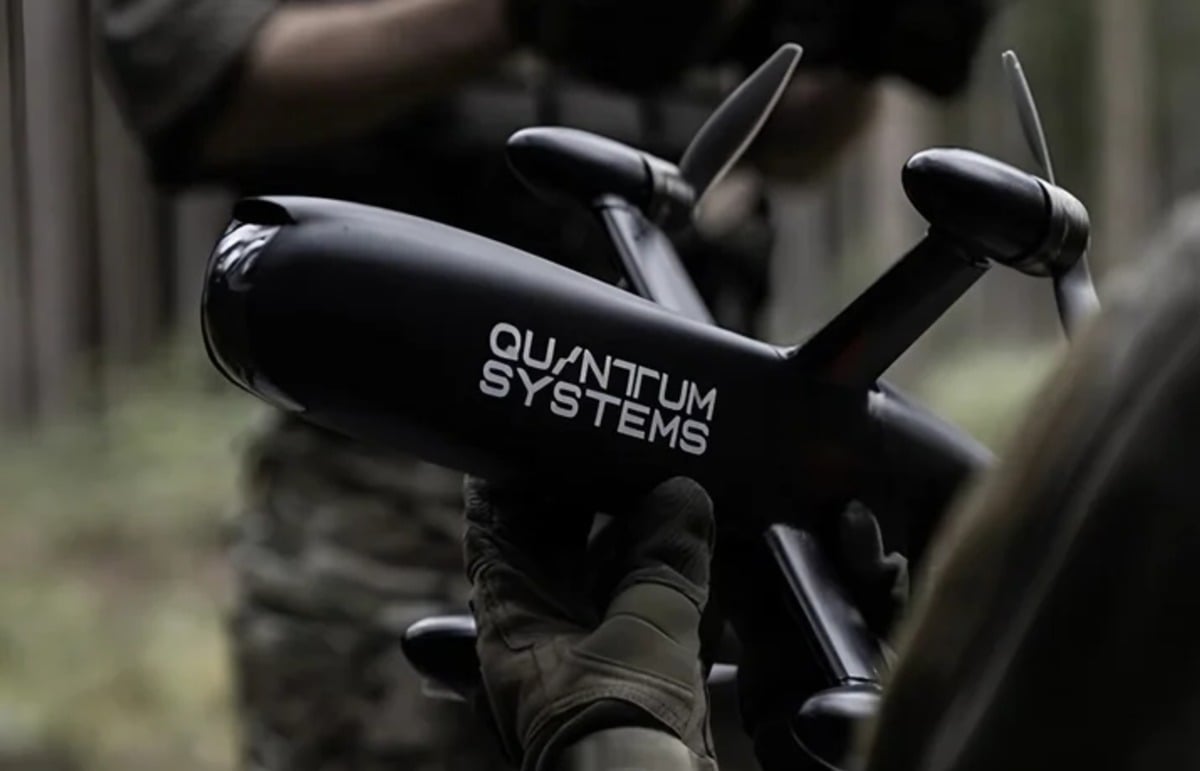
- Japan's ATLA selected German drone maker Quantum Systems for its Counter-UAS Proof-of-Concept Program under the agency's Early Acquisition Program.
- The selection expands Quantum Systems' presence in the Indo-Pacific and follows the company's development of the Jäger interceptor drone for Ukraine.
Japan’s military procurement agency has handed a German drone company a foothold in one of the most urgent defense priorities in the Indo-Pacific: figuring out how to shoot down enemy drones before they hit anything.
Quantum Systems, a German unmanned aircraft maker, announced Wednesday that Japan’s Acquisition, Technology and Logistics Agency, the defense ministry’s procurement arm known as ATLA, selected the company to take part in Japan’s Counter-UAS Proof-of-Concept Program, an evaluation track under ATLA’s broader Early Acquisition Program built to fast-track promising interceptor drone technology into the hands of the Japan Self-Defense Forces.
A counter-UAS system, short for counter-unmanned aircraft systems, is technology built specifically to detect, track, and destroy hostile drones before they can strike a target, a mission that has become one of the fastest-growing priorities across nearly every modern military since Russia’s full-scale invasion of Ukraine turned cheap, mass-produced drones into one of the deadliest weapons on the battlefield. Japan’s push into this space reflects growing concern over drone threats from multiple directions at once. Russia has scaled up production of its Geran-2 attack drone, based on Iran’s Shahed design, while Japanese officials have pointed to China’s development of similar long-range strike drones and North Korea’s stated plans to build its own mass-production capability for one-way attack aircraft, a combination that has turned drone defense from a theoretical concern into what Japanese officials now describe as an immediate security priority.
That urgency shows up clearly in how fast ATLA has been moving on related interceptor drone efforts this year. Japan’s Defense Minister, Shinjiro Koizumi, disclosed at a press conference in early July that a separate but related interceptor drone acquisition effort launched by ATLA in early June had already drawn proposals from 38 companies, with the agency aiming to sign a procurement contract by late August and begin delivering systems to the Ground Self-Defense Force as soon as September, an unusually compressed timeline for a defense procurement process that typically stretches across years rather than months. Japan’s draft budget for the current fiscal year set aside roughly 277.3 billion yen, close to $1.9 billion, specifically to strengthen the country’s unmanned systems capabilities, underscoring how much financial weight Tokyo is putting behind this shift.
Quantum Systems, founded by military veterans, has spent recent months developing a compact interceptor drone called Jäger specifically to help Ukraine counter Russian drone attacks, moving from the start of development to an operational demonstrator in roughly six months, a pace the company has said reflects lessons learned working directly alongside Ukrainian forces. Jäger launches vertically on four electric motors before a rocket booster carries it to an altitude of several thousand meters in seconds, after which it switches to quiet electric propulsion to close in on its target, reaching a top speed between 365 and 405 kilometers per hour (227 to 252 miles per hour) with an effective engagement range of about 25 kilometers (15.5 miles). Quantum Systems has kept the interceptor’s cost in what the company describes as the low four-figure euro range, a price point designed to make it economically viable to use one drone to shoot down another rather than burning through far more expensive traditional air defense missiles that can cost hundreds of thousands of dollars per shot.
In June, Quantum Systems unveiled the Pulse P19 at the ILA Berlin air show, a multi-role aircraft that can fly either piloted or fully unmanned and was designed specifically to counter long-range kamikaze drones, combining onboard radar and an electro-optical camera system to detect and identify targets before a ground-based human operator authorizes an engagement. The company has also signed a cooperation agreement with Airbus Helicopters to explore integrating counter-drone interceptors onto the H145M military helicopter, part of a broader strategy of embedding counter-UAS capability across as many platforms as possible rather than relying on any single dedicated system.
Martin Karkour, Chief Revenue Officer at Quantum Systems, framed the Japan selection as validation of demand the company is seeing well beyond Europe.
“Our selection by ATLA reflects the growing international demand for interoperable counter-UAS capabilities,” Karkour said. “Participating in ATLA’s programme allows us to contribute our operational expertise while deepening long-term industrial and defence cooperation. We look forward to further strengthening our long-term partnership with one of the Indo-Pacific’s most important defence innovators.”
Japan’s interest in diversifying its drone defense suppliers carries an added layer of urgency tied to broader questions about the reliability of American-supplied weapons systems. A roughly month-long U.S. military campaign against Iran earlier this year strained American missile stockpiles enough that outside analysts warned of a near-term shortage, raising questions in Tokyo about whether deliveries of Tomahawk cruise missiles Japan has already ordered from the United States might face delays. Both U.S. Secretary of War Pete Hegseth and Koizumi have publicly denied any delivery problem, but Koizumi has separately signaled that Japan intends to keep developing more of its own domestic missile and drone defense systems regardless, a hedge against depending too heavily on any single foreign supplier during a future crisis.