

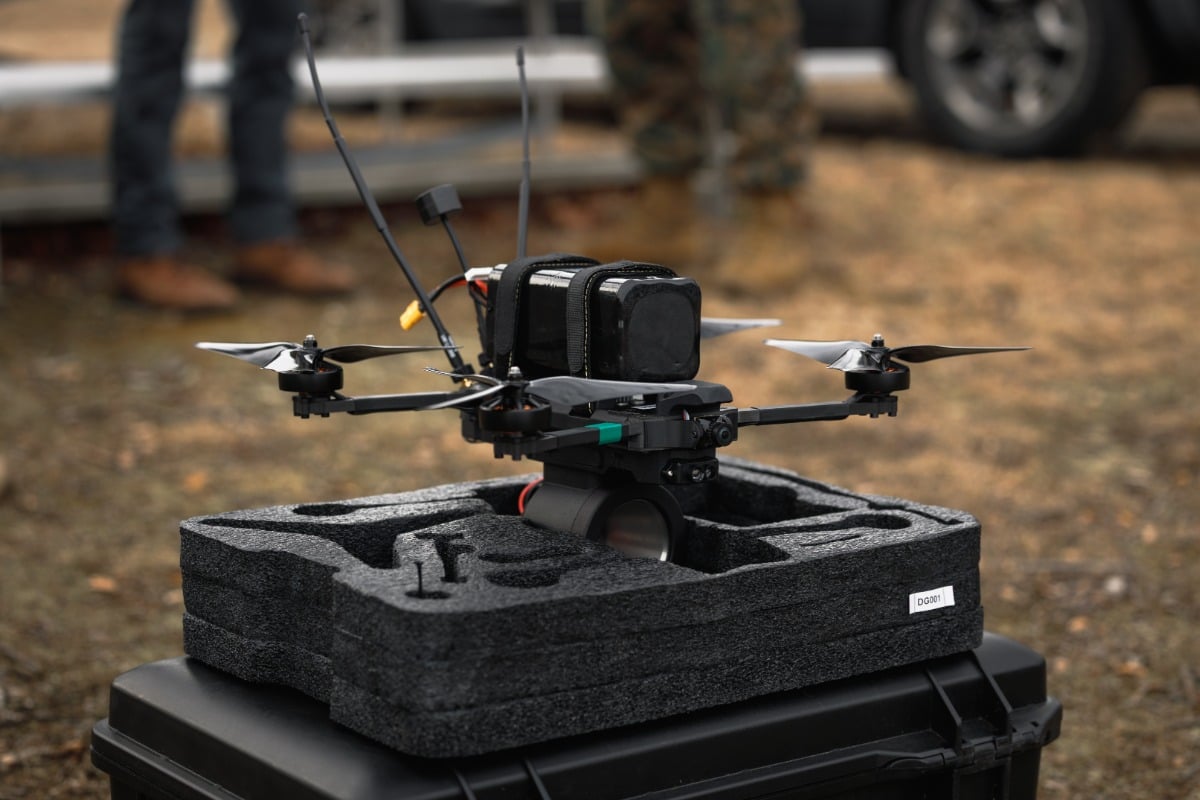
- Neros Technologies won a Department of War contract worth up to $500 million to supply first-person-view attack drones to the U.S. Army, the Wall Street Journal reported.
- The Pentagon separately awarded AeroVironment a $500 million contract for its Titan RF counter-drone system, running through June 2029.
A drone manufacturer founded by two former teenage drone-racing prodigies has landed a Pentagon contract worth up to $500 million to supply first-person-view attack drones to the U.S. Army, the Wall Street Journal reported.
Neros Technologies, based in El Segundo, California, will mass-produce the low-cost, expendable drones that have come to define modern battlefield tactics since Russia’s invasion of Ukraine, marking one of the largest Pentagon commitments to date to a nontraditional defense contractor building cheap, disposable unmanned aircraft rather than exquisite, expensive weapons systems.
The company was founded in 2023 by Soren Monroe-Anderson and Olaf Hichwa, who spent their teenage years racing first-person-view drones rather than attending prom or high school football games. “They just become my full, complete obsession,” Hichwa, now 24, told the Journal. That obsession has translated into one of the fastest-scaling drone manufacturers in the country. Neros first drew attention for its role supplying Ukraine’s front lines, securing a contract to deliver 6,000 first-person-view attack drones to the country under an agreement with the International Drone Coalition, a group of nations funding drone production for Kyiv’s war effort.
Neros builds the Archer, an 8-inch first-person-view quadcopter designed to be cheap, expendable, and free of Chinese-made components, a deliberate choice given how dependent the broader commercial drone industry remains on Chinese suppliers like DJI. The Archer carries a payload of 4.5 pounds (2 kilograms) out to a range exceeding 12 miles (19 kilometers). A first-person-view drone, so named because the pilot wears video goggles that display a live camera feed from the aircraft, can be built from relatively cheap components and guided to a target with a precision that unguided munitions cannot match. That combination of low cost and high accuracy has made the drones responsible for a substantial share of vehicle, artillery and personnel losses in Ukraine, and the technology has since spread to other conflicts and other armed forces.
Neros has scaled production dramatically since its early days building drones in a garage, with output reaching roughly 2,000 units per day by December 2025, according to the Economist. Roughly two-thirds of that production has continued flowing to Ukraine, while the remainder has gone to U.S. military customers including the Marine Corps, the Army and U.S. Special Operations Command. The Marine Corps separately awarded Neros a $17 million contract for 8,000 Archer Strike drones equipped with anti-armor and anti-personnel payloads built by Kraken Kinetics.
The new Army deal builds on Neros’s selection last November as one of three primary manufacturers for the Army’s Purpose-Built Attritable Systems program, an initiative meant to push modular, adaptable first-person-view drone technology down to the platoon level across the force. Under that program, Neros delivers its Archer and Archer Strike platforms in 5-inch and 10-inch variants, alongside Flatbow, a soldier-portable version of the company’s Crossbow ground control system built to resist jamming in contested electromagnetic environments. The video accompanying the Journal’s report showed the Archer Block II, an updated version of the airframe. Around the same time as the PBAS selection, Neros closed a $75 million Series B funding round led by Sequoia Capital, bringing its total capital raised to more than $120 million.
The Army’s embrace of Neros reflects a broader shift inside the Department of War. The service has begun training soldiers directly in first-person-view drone tactics modeled on Ukrainian battlefield practice, and overall spending on expendable drone systems has accelerated sharply over the past year. That urgency is tied to the Pentagon’s Drone Dominance program, a roughly $1.1 billion effort to build an arsenal of around 300,000 low-cost attack drones by the end of 2027. The program has repeatedly run into a stubborn problem: price. Many American-made drones still sell for tens of thousands of dollars more than the roughly $5,000-per-unit price the military is targeting, a gap that reflects how far the U.S. industrial base has fallen behind cheaper Chinese manufacturers and Ukraine’s own wartime production lines. A 2025 estimate put total U.S. drone-manufacturing capacity at up to 100,000 units a year, compared with roughly four million drones built in Ukraine the previous year, a gap that has driven the Pentagon toward unconventional financing arrangements, including reported talks earlier this year about taking direct equity stakes in Neros and other drone makers through the Office of Strategic Capital, a lending arm created to fund companies considered critical to national security supply chains.