

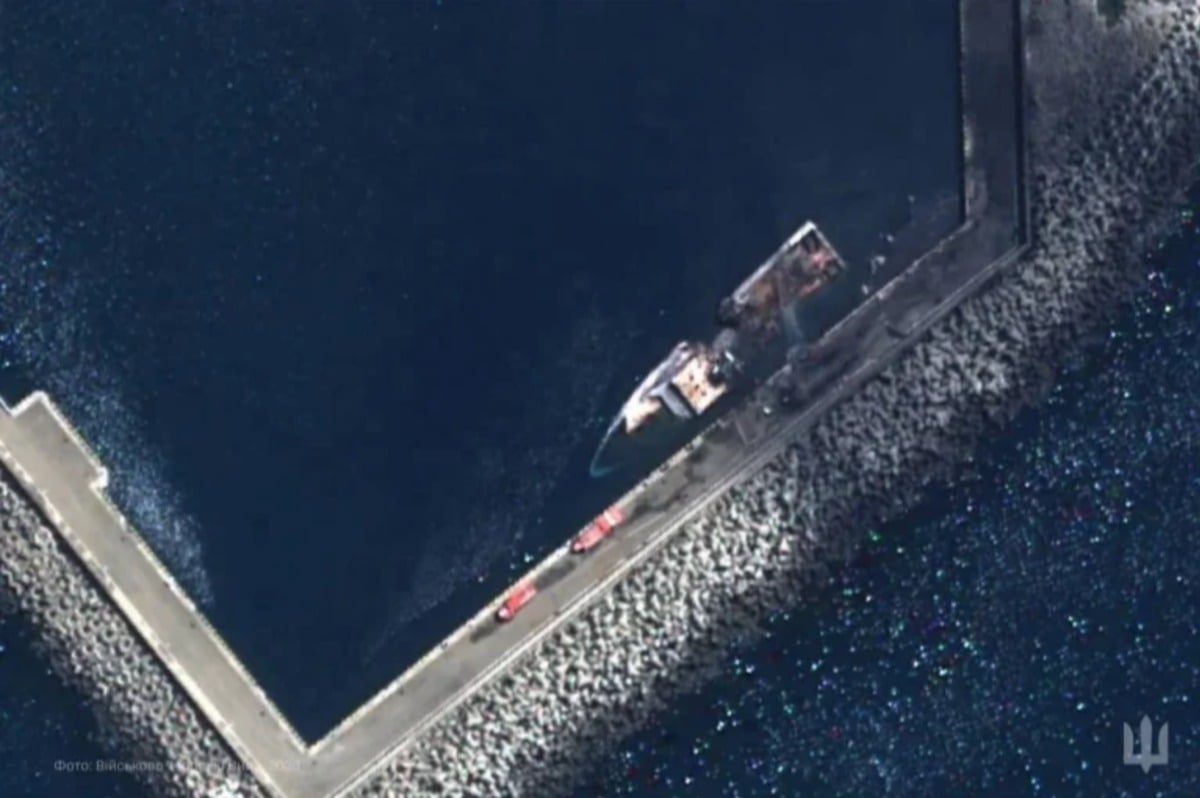
- The Ukrainian Navy released satellite imagery on July 14, 2026 confirming the destruction of the Russian FSB ship Izumrud near Novorossiysk.
- The image shows the vessel partially submerged against its pier, with visible fire damage to the surrounding dock area.
A satellite passing over southern Russia captured the aftermath Tuesday evening, and the image leaves little room for doubt: the Russian border guard ship Izumrud sits partially submerged against its pier, the surrounding dock scorched black from fire, exactly as Ukraine’s navy said it would be after announcing the ship’s destruction earlier the same day.
The Ukrainian Navy released the satellite photo the evening of July 14, following up on its own announcement hours earlier that Ukrainian sailors had sunk the vessel near Novorossiysk using the Sargan-3000, a domestically built unmanned surface strike boat that has become one of several such systems Ukraine now fields against Russian naval targets.
“The satellite image confirms the destruction of the Russian border guard patrol ship Izumrud next to the pier wall,” the Ukrainian Navy said.
The image itself shows a vessel listing heavily and partly underwater, its hull visibly compromised, while the pier around it appears darkened and damaged, consistent with the kind of fire and structural destruction a successful strike on a moored warship typically leaves behind. Satellite confirmation matters in a war where both sides routinely make competing claims about strikes and losses, since imagery from space offers a form of verification neither Kyiv nor Moscow can easily dispute or spin, particularly when the geolocation and damage pattern align with what a military has already announced through its own official channels.
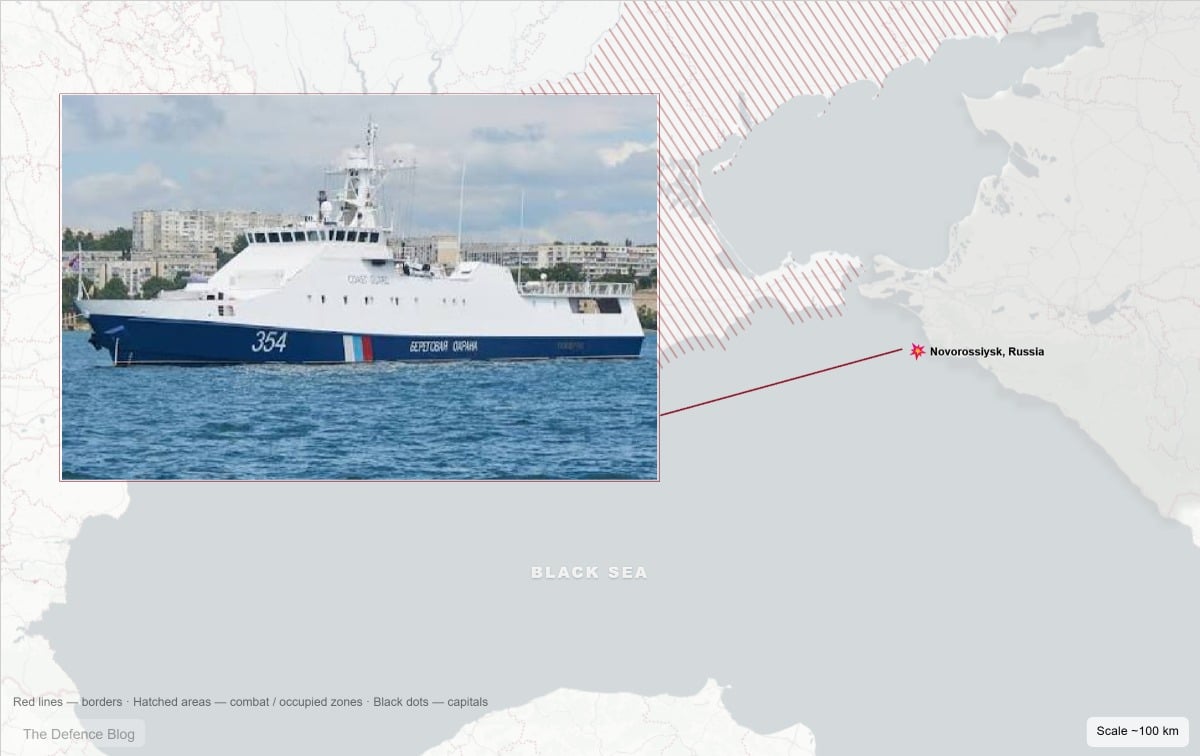
Izumrud belonged to Russia’s Project 22460 Okhotnik class, informally known as the Rubin class, a family of coast guard patrol vessels operated by the Federal Security Service’s Border Service, and this particular ship was launched in 2014, measured 62.5 meters (205 feet) in length, displaced between 630 and 750 tonnes (694 to 827 tons), and carried a helicopter landing pad that allowed it to support extended coastal patrol missions. What makes this specific ship’s loss carry weight beyond its tonnage is the history attached to it, a history the Ukrainian Navy made a point of highlighting when it first announced the strike.
Izumrud took part in the November 25, 2018 attack on Ukrainian naval vessels transiting the Kerch Strait, an incident that remains one of the most brazen acts of Russian aggression against Ukraine in the years before the full-scale invasion. Ukrainian reporting on the incident describes how Ukraine notified Russia in advance of the planned passage, as required under international maritime law, only for the Russian border ship Don to ram and destroy the Ukrainian tugboat Yany Kapu, after which Russian vessels opened fire on the Ukrainian gunboats Nikopol and Berdiansk as they attempted to return toward Odesa. Ukrainian accounts of the incident differ slightly on how many sailors were wounded in the exchange, with figures ranging from three to six, but they agree that Russia captured 24 Ukrainian servicemen that day, holding them for nearly a year before returning both the crews and the seized vessels on November 18, 2019, with the ships arriving back at the port of Ochakiv two days later.
“We continue to reduce the potential of the Russian aggressor at sea,” the Ukrainian Navy said.
That closing line reflects a pattern that has defined Ukraine’s naval war for years now, a country without a conventional battle fleet steadily grinding down Russia’s Black Sea presence through missiles, unmanned surface vessels, and underwater drones rather than fleet-on-fleet engagements. Ukraine’s Defense Ministry reported in April that roughly 30 percent of Russia’s Black Sea Fleet combat strength had been destroyed or seriously damaged since the start of the full-scale invasion, a toll significant enough that Russia relocated much of its remaining fleet from Sevastopol to Novorossiysk after repeated strikes made the Crimean port too dangerous to serve as a reliable home base. That relocation has not delivered the safety Russian commanders presumably hoped for, since Novorossiysk itself has absorbed repeated Ukrainian strikes throughout 2026, damaging or destroying vessels ranging from the frigate Admiral Essen to the minesweeper Valentin Pikul, with Izumrud now added to that growing list.
Releasing overhead satellite imagery within hours of an announced strike represents a more evidentiary approach, one that leaves Russian officials with less room to dismiss the claim as Ukrainian propaganda, particularly when the visible damage pattern, a partially sunken hull and a scorched pier, matches exactly what a successful strike on a moored vessel would be expected to produce.