

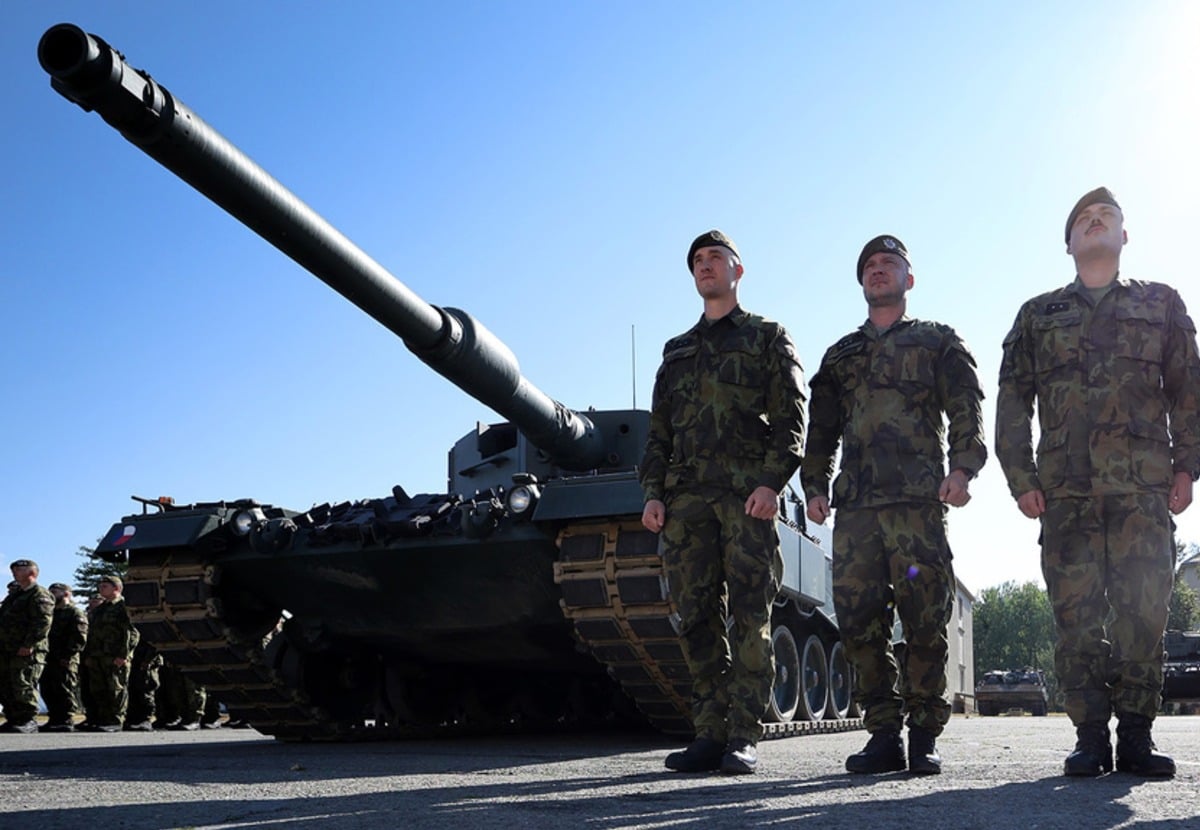
- The Czech Army received its final Leopard 2A4 tank on July 10 at Přáslavice, completing a 42-tank fleet delivery.
- Germany donated 28 tanks and two Büffel 3 recovery vehicles, while the Czech Republic purchased 14 additional tanks for about $187 million.
The Czech Army held a handover ceremony on July 10 at the 73rd Tank Battalion’s base in Přáslavice, a garrison town in the Olomouc region of eastern Czechia, marking the delivery of the final Leopard 2A4 in a fleet that now totals 42 tanks.
The Leopard 2A4 is an earlier variant of Germany’s Leopard 2 main battle tank family, a design that has become the most widely used tank among NATO member states, and its arrival in Přáslavice completes a four-year transition that began at the end of 2022, when the first Leopard rolled into the battalion’s motor pool. Until now, the unit relied on the T-72, a Soviet-designed tank that entered Czechoslovak service decades ago and has become increasingly difficult to maintain and upgrade to modern NATO standards.
Defense Minister Jaromír Zůna, who attended the ceremony alongside Lt. Gen. Miroslav Hlaváč, chief of the general staff of the Czech Armed Forces, and Lt. Col. Tomáš Suchý, commander of the 73rd Tank Battalion, framed the milestone as more than a simple equipment swap. Zůna said the completed deliveries mark a decisive break from Soviet-designed armor and a corresponding boost to how well Czech forces can operate alongside NATO allies, a point that carries real weight given that the Leopard 2 remains the alliance’s most common tank platform and shares logistics, training pipelines, and spare parts networks across multiple member states that field the same family of vehicles.
“The transition of the Czech armed forces from tanks of eastern origin to a western one is now complete, and with it comes a strengthening of Czech tank forces’ interoperability with alliance partners, since Leopard tanks rank among the most widely used tank type in the Alliance,” Defense Minister Jaromír Zůna said.
Germany transferred 28 of the 42 Leopard 2A4 tanks, along with two Büffel 3 armored recovery vehicles, as a gift in recognition of the substantial military assistance Czechia has provided to Ukraine throughout the war, according to Czech defense officials and multiple domestic outlets that covered the handover. The remaining 14 tanks came through a direct purchase the Czech Ministry of Defense signed with Rheinmetall Landsysteme in December 2024, a contract worth roughly 3.98 billion Czech koruna before tax, or approximately $187 million at current exchange rates. That purchase also required what Czech officials call “bohemizace,” a customization process that adapts the German-configured tanks for Czech service by installing new communications equipment, camouflage patterns, national markings, and machine guns, since the German Army’s own equipment for those systems isn’t included in the export package and has to be sourced separately for each buyer nation.
Lt. Gen. Hlaváč, addressing the significance of the transition, emphasized that swapping tank models represents only the visible part of a much larger organizational shift the battalion has had to absorb.
“Rearmament isn’t just about receiving new equipment. It means new tactical procedures, a change in training, new demands on command, logistics and operational support. Every such change tests the readiness of the entire unit. It requires expertise, discipline and a willingness to learn new things,” said Lt. Gen. Miroslav Hlaváč, chief of the general staff of the Czech Armed Forces.
Hlaváč’s point was that rearmament involves far more than accepting new hardware, since it also demands new tactical procedures, retrained crews, and revised standards for command, logistics, and maintenance, a transition that tests an entire unit’s readiness and requires expertise, discipline, and a genuine willingness among soldiers to learn unfamiliar systems from the ground up. That framing matters for understanding why a four-year timeline, which might sound slow for a tank swap on paper, actually reflects a deliberate effort to avoid rushing crews through a transition that touches nearly every aspect of how the battalion fights.
The Ministry of Defense has committed to acquiring 44 additional tanks in the newer Leopard 2A8 configuration, with deliveries planned between 2028 and 2030, and Czech officials have described that acquisition as essential to building a full heavy brigade capable of meeting the country’s NATO commitments. The Leopard 2A8 represents the latest production standard in the Leopard 2 family, incorporating upgraded armor and fire control improvements over the 2A4 variant now filling out the Přáslavice battalion, and the purchase is being financed in part through SAFE, a European Union financial instrument designed to help member states accelerate defense procurement by providing access to shared low-interest loans rather than relying solely on national budgets.
Rheinmetall, the German defense manufacturer supplying both the purchased Leopard 2A4 tanks and the future 2A8 fleet, sent a senior company executive to the Přáslavice ceremony, underscoring how central the firm has become to Czech armored modernization at a moment when European defense manufacturers are scrambling to expand production capacity across the continent. Rheinmetall has spent the past several years pivoting its business increasingly toward military production, a shift that mirrors a broader European trend of manufacturers reallocating investment away from civilian markets and toward defense contracts as governments across the continent rebuild land forces they allowed to shrink after the Cold War ended.
Sixty years after Soviet armor first rolled into Czechoslovak service, the last of that legacy is headed for retirement, and a battalion that spent decades training on machines built by a country that no longer exists now trains on tanks built by an alliance partner instead. What replaces the T-72 in Czech service isn’t just a newer machine. It’s a tank whose parts, training manuals, and combat doctrine are shared across a dozen allied armies, a form of interoperability that matters more with each passing year of war on Europe’s eastern edge.