

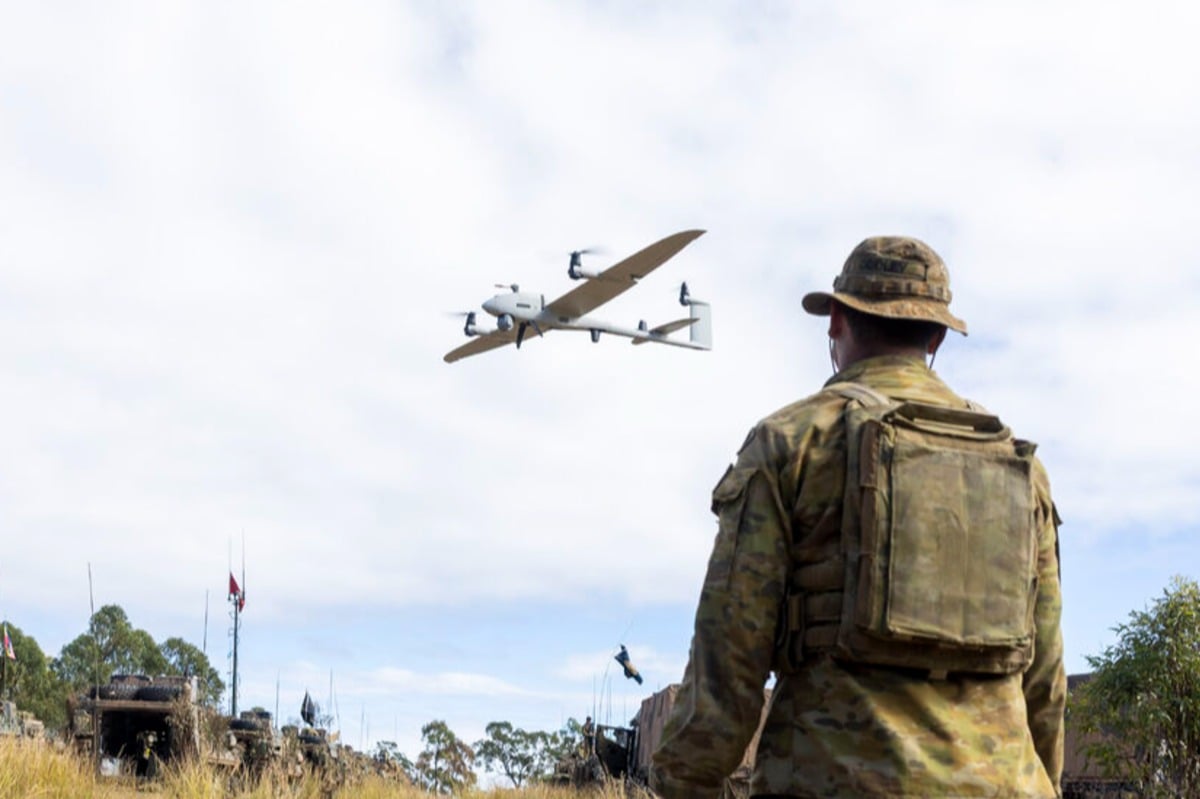
- Australia's Army flew the Vector AI fixed-wing drone, made by Germany's Quantum Systems, during Exercise Southern Jackaroo in Townsville, Queensland.
- The drone, used by the 2nd Cavalry Regiment, has a 2.8-meter wingspan and can fly more than 60 kilometers to identify targets for strikes.
Australia’s Army flew its Vector AI fixed-wing drone during Exercise Southern Jackaroo at the Townsville Field Training Area in Queensland, using the aircraft to identify targets in depth and feed that information directly into drone and artillery strikes on simulated enemy positions.
The drone is built by Quantum Systems, a German manufacturer whose reconnaissance aircraft have logged extensive combat use in Ukraine, where thousands of mission hours have shaped successive design upgrades to the platform. That combat pedigree matters because it means the version now flying with Australian soldiers has already been tested against the kind of electronic warfare and air defense threats a real battlefield throws at small unmanned aircraft, not just the controlled conditions of a training range.
The aircraft uses AI-enhanced processing to map terrain in real time and to detect and track objects on its own, cutting down the time a human operator needs to spend manually scanning video feeds for a target. With a wingspan of 2.8 meters (9.2 feet), the drone uses tiltrotor propulsion, the same basic principle behind the U.S. military’s much larger MV-22 Osprey, tilting its rotors between a vertical position for takeoff and landing and a forward-facing position for cruising flight. That hybrid design gives the Vector AI the ability to launch and recover without a runway, like a helicopter, while still covering long distances at the speed of a fixed-wing aircraft once it transitions into forward flight.
Corporal Harrison Hinson, a drone pilot with the 2nd Cavalry Regiment who has flown fixed-wing drones since 2022, said the alternative to using the Vector AI would have meant sending troops forward on foot or in vehicles to physically locate the enemy. “This also means that we would be putting our soldiers in direct fire range and at risk of compromise,” Hinson said. That trade-off sits at the center of why militaries around the world have poured money into reconnaissance drones over the past decade: every kilometer a drone can cover is a kilometer a human scout does not have to walk into range of enemy weapons.
Hinson said the drone gives his unit an additional layer of capability rather than replacing traditional reconnaissance outright. “With our employment of drones, we have one more tool at our disposal to enhance our reconnaissance and strike capabilities,” he said. He described the flying itself as approachable for anyone with experience on other drone platforms, even as he spent time studying the Vector AI’s specific strengths and limitations before relying on it in the field. “The flying side is quite easy if you have flown other systems,” Hinson said.
The operational value of a drone that can fly 60 kilometers or more comes from what the military calls depth: the ability to see past the enemy’s front-line positions and into the rear areas where supplies, reinforcements, and command elements move. Because the Vector AI can penetrate that deep into contested territory, it gives commanders visibility into how an enemy force resupplies and coordinates, information that is far harder to gather through short-range reconnaissance closer to the front. That visibility feeds directly into what planners call the kill chain, the sequence of steps a military takes to find a target, confirm it, and destroy it. Shortening that chain, by cutting out the time it takes to locate and verify a target, translates directly into faster offensive action on the battlefield, since a target spotted and struck in minutes is far harder for an enemy to relocate or reinforce than one that takes hours to confirm.
That same lesson has started reshaping how the unit thinks about defense, not just offense. Hinson said watching how drones like the Vector AI expose enemy positions has forced his own unit to rethink how it avoids exposure in return.
“We have to assume we are always being observed and need to better ourselves on how to hide or disguise our signatures,” he said.
The Vector AI’s presence at Southern Jackaroo also reflects a broader pattern in how Western militaries are sourcing reconnaissance technology. Rather than developing a fixed-wing AI drone from scratch, Australia’s Army is fielding a platform already refined through real combat feedback abroad, a shortcut that lets a smaller military benefit from lessons learned in a conflict it was never part of. As drone-enabled reconnaissance becomes a standard feature of modern land warfare, exercises like Southern Jackaroo function less as a test of whether the technology works and more as a rehearsal for how soldiers integrate it into the split-second decisions that define combat.