

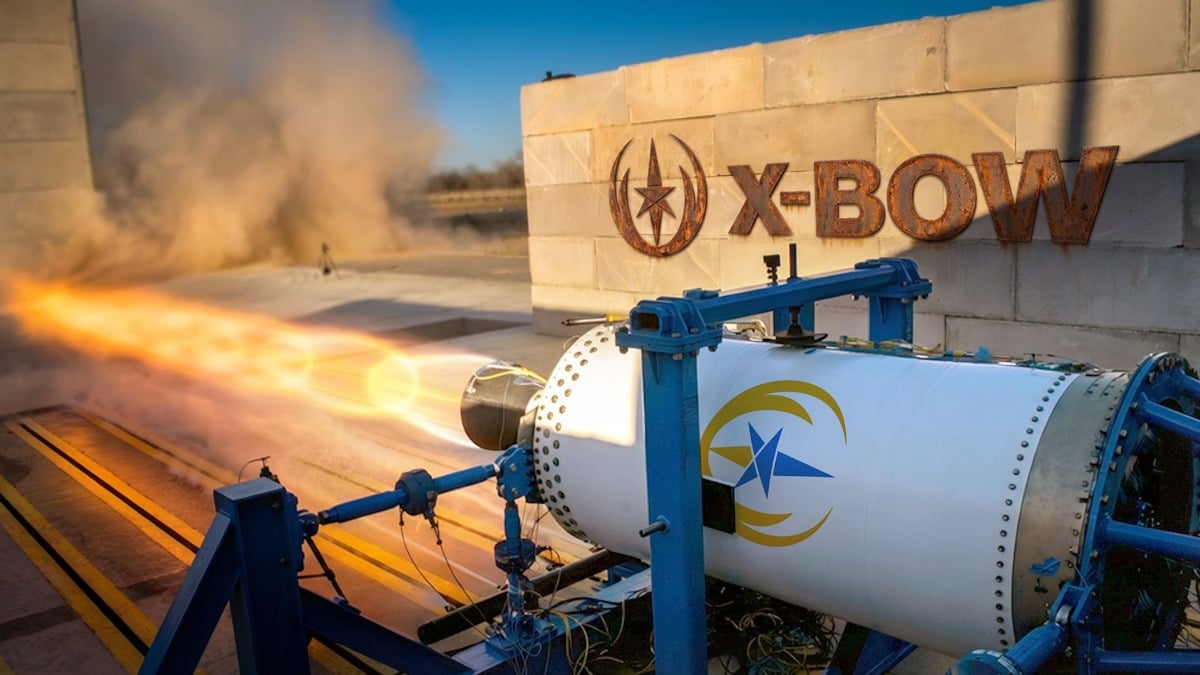
- The Missile Defense Agency awarded X-Bow Launch Systems a $11 million contract on July 2, 2026, to develop a solid rocket motor.
- The contract runs through July 2028 and aims to expand a solid rocket motor industrial base currently reliant on two primary manufacturers.
For decades, only two American companies could build the powerful solid rocket motors that launch the Pentagon’s biggest missiles into the sky, and the Missile Defense Agency just handed nearly $11 million to a New Mexico firm trying to break that monopoly wide open.
X-Bow Launch Systems, based in Albuquerque, won a competitive $10,981,581 contract on July 2 to design, develop, and demonstrate a high-performance solid rocket motor as part of the agency’s Rapid Response Small Launcher Technology program, with the Missile Defense Agency explicitly stating the goal is expanding an industrial base that currently depends on what officials call a duopoly of two primary manufacturers.
A solid rocket motor, or SRM, is essentially the engine that propels a missile or launch vehicle off the ground, using a pre-mixed solid propellant that burns steadily once ignited rather than requiring the complex plumbing and fuel pumps a liquid-fueled rocket engine needs. That simplicity makes solid rocket motors reliable, storable for years without maintenance, and quick to launch on demand, qualities that have made them the propulsion choice for everything from intercontinental ballistic missiles to the interceptors that shoot down incoming threats, which is exactly why the Missile Defense Agency cares so deeply about who actually manufactures them and how many companies are capable of doing it.
For most of the past decade, that answer has been just two companies, Northrop Grumman and L3Harris’s Aerojet Rocketdyne division, a concentration that traces back to a wave of defense industry consolidation completed by 2015, when earlier manufacturer Orbital ATK merged into what eventually became today’s duopoly. That narrow supplier base became a genuine national security concern once the Pentagon accelerated its push into hypersonic weapons and next-generation missile defense systems, since a production bottleneck at either company could stall entire weapons programs regardless of how much funding Congress approved. Then-Under Secretary of Defense for Acquisition and Sustainment William LaPlante told Congress in 2023 testimony that replenishing certain munitions stockpiles could take five to ten years at then-current production rates, a warning that helped drive the Pentagon’s broader push to qualify new solid rocket motor suppliers rather than remain dependent on just two companies for a component central to America’s entire missile arsenal.
X-Bow entered that effort in 2023, when the Department of Defense’s manufacturing capability expansion office awarded the company a $64 million contract specifically to expand production capacity and reduce manufacturing costs for solid rocket motors used in hypersonic weapons, a deal officials described at the time as breaking up the existing Northrop Grumman and Aerojet Rocketdyne duopoly by qualifying a genuinely new domestic supplier. What makes X-Bow’s approach distinctive within that broader push is a patented manufacturing process the company calls Additive Manufacturing of Solid Propellant, or AMSP, which uses 3D-printing-based techniques to build rocket motors considerably faster and at lower cost than the decades-old, batch-based casting processes the two established manufacturers have relied on since the Cold War. X-Bow has scaled that technology dramatically since first testing small tactical-sized motors, culminating in a successful August 2024 static test of the Ballesta-34, nicknamed the XB-32, a roughly 34-inch diameter motor the company says represents the largest advanced-manufactured solid propellant rocket motor ever fired, a milestone that placed X-Bow alongside Northrop Grumman and L3Harris as one of only three American companies now capable of producing strategic-class solid rocket motors.
X-Bow’s contract represents a follow-on Phase II award under SBIR topic number SB173-006, meaning the company has already cleared earlier evaluation stages proving its underlying concept before receiving this larger round of funding to actually build and demonstrate a working motor. The work will take place at X-Bow’s Albuquerque facilities over a two-year performance period running from July 2026 through July 2028, funded through fiscal year 2026 research, development, test, and evaluation money, with Redstone Arsenal in Alabama, the Missile Defense Agency’s primary contracting hub, overseeing the award.
X-Bow’s growth over the past two years extends well beyond this single contract, reflecting how quickly the Pentagon and private investors alike have moved to back the company’s push into a traditionally closed industry. Beyond its 2023 hypersonic motor contract, X-Bow won additional prototype agreements in 2024 to build Mk 72 and Mk 104 rocket motors used in the Navy’s Standard Missile family, along with a separate $60 million contract to help modernize the Navy’s own solid rocket motor production capacity. The company has also attracted substantial private capital, closing a $70 million Series B funding round in 2024 with backing from Razor’s Edge Ventures, Lockheed Martin, and Boeing, before expanding that same round to $105 million by May 2025 with additional Lockheed Martin support, a relationship that has since grown into a formal strategic partnership between X-Bow and one of the defense industry’s largest prime contractors. In November 2025, X-Bow completed installation of a full production version of its additive manufacturing system at a new facility in Luling, Texas, a milestone the company described as commissioning the nation’s newest solid rocket motor manufacturing facility.
Industry analysis published by the Observer Research Foundation projects that X-Bow’s manufacturing approach could eventually add somewhere between 30,000 and 50,000 solid rocket motors annually to combined American and allied stockpiles once fully scaled, a figure that, if realized, would represent a dramatic expansion of production capacity compared to what the traditional duopoly has historically delivered using older casting-based methods. That kind of scale matters enormously for a Pentagon that has spent years watching adversaries like China and Russia expand their own missile production while American manufacturing capacity remained constrained by a narrow supplier base dependent on manufacturing techniques largely unchanged since the earliest days of the Cold War.