

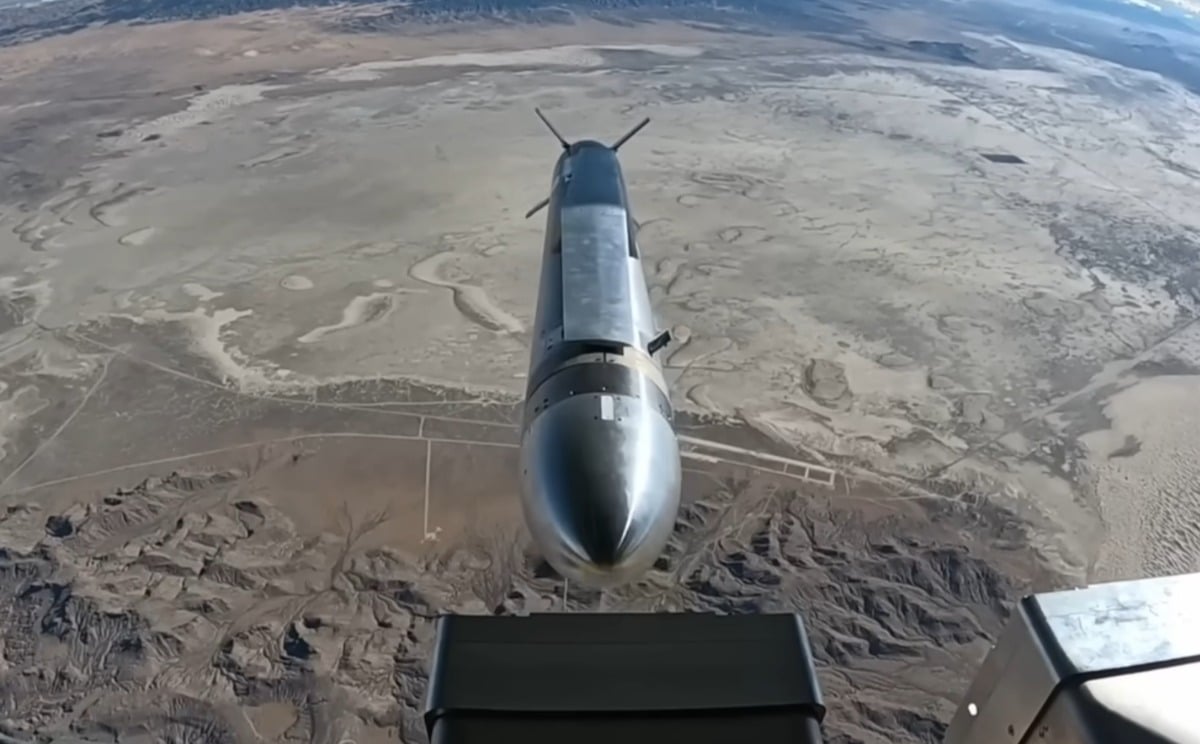
- USSOCOM awarded Leidos a $27.2 million contract modification on behalf of USSOCOM for AGM-190A Small Cruise Missile production rounds.
- Work will be performed in Huntsville, Alabama, with an expected completion date of February 26, 2029.
Leidos received a contract modification worth roughly $27.2 million on behalf of USSOCOM to buy what the military calls All Up Rounds, meaning fully assembled, ready-to-fire missiles rather than components or prototypes, for the AGM-190A Havoc Spear Small Cruise Missile program, with the work centered in Huntsville, Alabama, and expected to run through February 2029.
The AGM-190A, better known within the defense industry by its Leidos-given nickname Black Arrow, weighs in at roughly 200 pounds (91 kg), small enough that a two-person crew can handle one without heavy equipment, yet the missile has already demonstrated a standoff range exceeding 400 nautical miles (740 km) during flight testing from a C-130 aircraft, a reach that lets special operations forces strike targets from well outside the range of most short and medium-range air defenses. Power comes from a Pratt & Whitney TJ150-7 turbojet engine, a small jet engine built using additive manufacturing, commonly known as 3D printing, that generates 150 pounds of thrust and pushes the missile to a cruising speed of roughly Mach 0.8, or about 613 mph (988 km/h), with a service ceiling of 30,000 feet (9,144 meters), putting it well above most low-altitude air defense systems while still flying low enough to avoid many radar systems designed to track higher, faster threats.
What makes AGM-190A distinctive within the crowded market of American precision munitions is not raw performance but flexibility and price. Leidos built the missile around modular hardware and open system software specifically so operators can reconfigure it for different mission types without waiting for an entirely new weapon program, and the design can carry either a kinetic warhead for direct strikes or non-kinetic payloads for electronic warfare, jamming, or intelligence-gathering missions, giving special operations planners a single airframe capable of covering multiple mission profiles rather than needing separate weapons for each. The missile can launch from a striking range of platforms, including palletized drop deployment, ramp-mounted launch tubes fired from the back of an AC-130J Ghostrider gunship, or conventional wing-mounted stores pylons on fixed-wing aircraft, and Leidos has said the design is also compatible with MC-130J Commando II transports, MQ-9 Reaper drones, and the newer OA-1K Skyraider II light attack aircraft, a level of cross-platform compatibility that lets nearly any aircraft already in the special operations inventory carry and fire the weapon.
Havoc Spear’s path from internal research project to fielded weapon moved unusually fast by defense industry standards. Leidos began developing the missile in 2021 as an internally funded research effort, drawing directly on the company’s prior experience building the GBU-69 Small Glide Munition, a smaller precision-guided bomb Leidos has already delivered more than 4,000 units of to the military as of April 2025. That existing manufacturing and design experience let Leidos move quickly once U.S. Special Operations Command formally signed onto the program in 2022 through a Collaborative Research and Development Agreement, a legal arrangement that let government and industry engineers work jointly on refining the missile rather than the government simply issuing requirements and waiting for a finished product. Store separation testing from an AC-130J gunship succeeded in December 2023, the first full guided flight test followed in November 2024, and by May 2025 the missile had officially demonstrated its 400-nautical-mile range in testing, a roughly four-year sprint from initial concept to demonstrated combat-relevant performance that moves considerably faster than many traditional Pentagon missile programs.
The U.S. Air Force made the relationship official on February 26, 2026, when it formally designated the Small Cruise Missile as the AGM-190A, an official military designation that confirms a weapon system has moved from experimental status into the Pentagon’s standard inventory naming and classification system. That same week, the Air Force separately designated an unrelated cruise missile, the Barracuda-500M, as the AGM-189A, underscoring just how active the Pentagon’s pipeline for new small, affordable strike weapons has become as the military works to field cheaper alternatives to expensive legacy cruise missiles that can take years and hundreds of millions of dollars to develop and produce at scale.
This week’s $27.2 million order specifically funds actual missile rounds rather than continued testing or development work, a meaningful distinction in defense contracting language that signals the program has moved past the demonstration phase and into the early stages of building an operational stockpile USSOCOM can actually deploy. The contract modification draws on both fiscal year 2025 and fiscal year 2026 procurement funding, with the larger portion, roughly $23.65 million, coming from the newer 2026 budget, and the Pentagon has structured the funding so it will not expire at the end of the current fiscal year, giving Leidos flexibility to deliver rounds on a production schedule rather than facing pressure to rush manufacturing simply to spend down a budget allocation before a deadline.
Traditional cruise missiles like the Tomahawk offer far greater range and payload but come with a price tag running into the millions of dollars per unit, a cost that makes them impractical for the kind of smaller-scale, more frequent strike missions special operations forces often need to execute against a wider range of targets. A 200-pound missile that costs a fraction as much per unit while still reaching more than 400 nautical miles gives commanders an option for engaging targets that do not justify spending a multimillion-dollar weapon, expanding the range of missions special operations forces can execute without needing congressional approval for an expensive new munitions purchase every time the mission calls for standoff precision strike.