

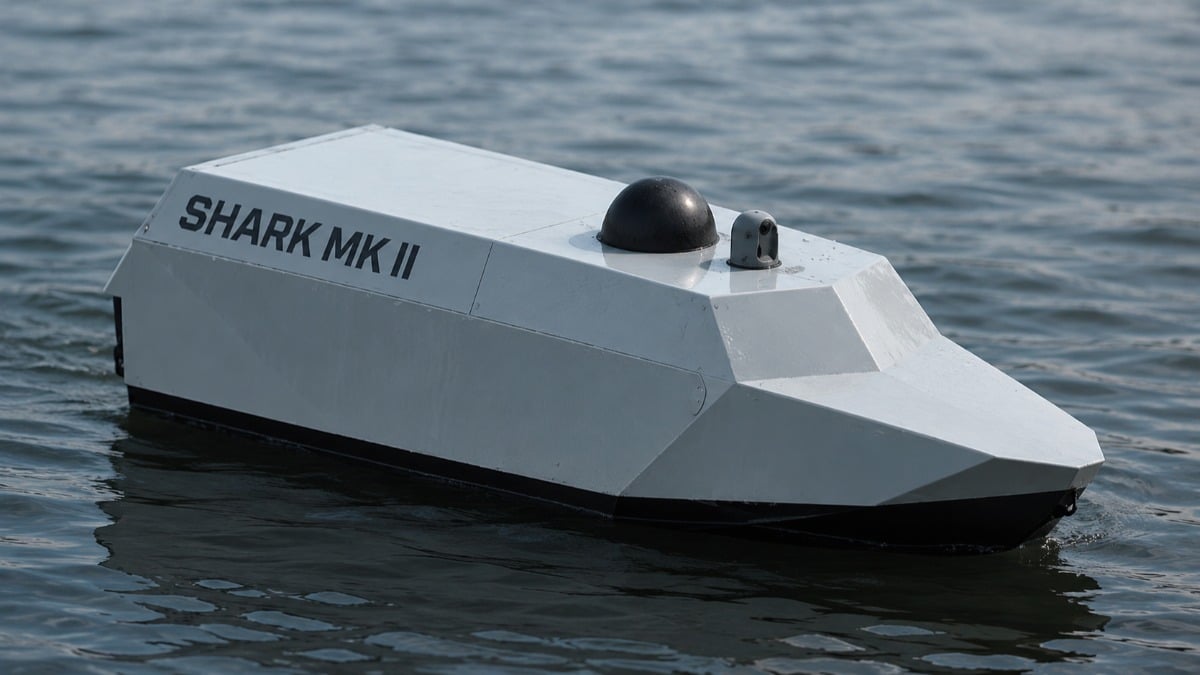
- The U.S. Navy awarded ReconCraft LLC a $24.96 million contract on July 7, 2026, for autonomous low-profile vessels.
- Work will be performed in Clackamas, Oregon, with an expected completion date of November 2028.
The U.S. Naval Sea Systems Command awarded ReconCraft LLC, a boatbuilder based in Anchorage, Alaska, a $24.96 million contract for autonomous low-profile vessels, a category of uncrewed watercraft the military has openly borrowed from the same low-visibility, semi-submersible design smugglers pioneered to avoid radar and visual detection while running narcotics through open water.
Autonomous low-profile vessels, often shortened to ALPVs and referred to informally within the military as “narco boats,” ride mostly submerged with only a small portion of the hull breaking the surface, a shape that dramatically reduces how easily radar, sonar, and the human eye can spot them against open ocean. The Marine Corps has spent roughly two years developing the concept as a way to resupply small, dispersed units operating across the Pacific, where established logistics bases and supply routes will likely be scarce or nonexistent during any future conflict, and where a vessel low enough in the water to avoid detection could mean the difference between supplies reaching Marines safely and a resupply run getting intercepted or destroyed before it ever arrives. The concept’s origins trace back to the ranks rather than the Pentagon’s usual acquisition pipeline, reportedly starting as an idea from a senior enlisted Marine weapons specialist at 4th Marine Regiment before the concept worked its way up through Force Design planning discussions in 2025.
The Marine Corps has already moved further along in fielding its own version of this technology than the new ReconCraft contract represents. Defense contractor Leidos has built at least three test ALPVs for the Marine Corps, with company officials telling National Defense magazine they expect follow-on orders to reach into the hundreds of vessels once the program matures, and Marine Corps logistics specialists tested one of the boats during exercises at Camp Pendleton, California, in January 2026. Officials estimated the base cost of a bare-bones ALPV without additional technology or mission payloads at roughly $150,000 per vessel, though that figure climbs considerably depending on what sensors, communications equipment, or cargo-handling systems a specific mission requires, a gap that helps explain why the Navy’s own contract with ReconCraft, covering a smaller but more specialized batch of vessels, carries a per-unit cost running well above that Marine Corps baseline.
Work under the new Navy contract will take place at ReconCraft’s production facility in Clackamas, Oregon, with the Navy expecting completion by November 2028. The funding comes from a Navy budget line specifically dedicated to accelerated procurement and fielding of innovative technologies, a category designed to move promising new capabilities from concept to fleet faster than the military’s traditional, multiyear acquisition process typically allows, and the money will expire at the end of the current fiscal year if not obligated, adding real urgency to getting this contract signed now rather than later. The Navy structured the award as a non-competitive acquisition under a federal regulation that permits sole-source contracts in specific circumstances, a designation that likely reflects ReconCraft’s existing track record building specialized military watercraft rather than the Navy opening the work to a broader competitive bidding process.
The company, a minority-owned and Native-owned small business, has built a substantial portfolio of Navy patrol and special operations craft over the past several years, including a $35.9 million contract in 2023 to build a dozen 40-foot patrol boats, a role in a combined $290 million indefinite-delivery contract alongside Louisiana-based Metal Shark to supply up to 73 patrol boats for the Navy’s Naval Expeditionary Combat Command, and a separate deal to build two Combatant Craft Medium vessels for Norway’s special operations forces, a low-observable design already in service with U.S. Navy special warfare units since 2015. That established relationship with naval special operations craft gives ReconCraft direct, relevant experience building vessels specifically engineered to avoid detection, exactly the design challenge an autonomous low-profile vessel presents in a different, uncrewed form.
The Navy has been actively researching how to make the low-profile hull shape more durable and reusable for military purposes, since the smuggling vessels that inspired the concept were typically built cheap and disposable, designed to survive one or two runs before being abandoned rather than surviving repeated military missions over years of service. Researchers at the Naval Surface Warfare Center Carderock in Maryland began a formal study in spring 2025, working with the University of Michigan to analyze the underlying physics of the narco-sub hull profile, since the original smuggling vessels had never been subject to rigorous engineering study despite decades of real-world use, leaving the Navy working to reverse-engineer proven design principles from boats that were never meant to last.
The service’s fiscal year 2027 budget request calls for 34 traditional crewed ships alongside five unmanned platforms, part of a broader five-year plan encompassing 122 ships and 63 autonomous systems, with Navy officials projecting the total fleet will grow from 395 vessels in fiscal 2027 to 450 vessels by fiscal 2031, a target that explicitly folds unmanned and autonomous systems into the Navy’s core force structure planning for what officials say is the first time in the service’s history. That expansion reflects growing Pentagon concern over the scale of China’s naval buildup, which has already surpassed the U.S. Navy in raw ship count, pushing American planners toward smaller, cheaper, more numerous autonomous vessels as one way to add mass to the fleet without matching Beijing’s shipbuilding pace hull for hull.