


- Photo and video evidence confirms at least seven Ukrainian drones struck Russia's Omsk Oil Refinery on July 6, 2026.
- Omsk was one of only two of Russia's top ten refineries never previously struck, and its only cracking catalyst producer.
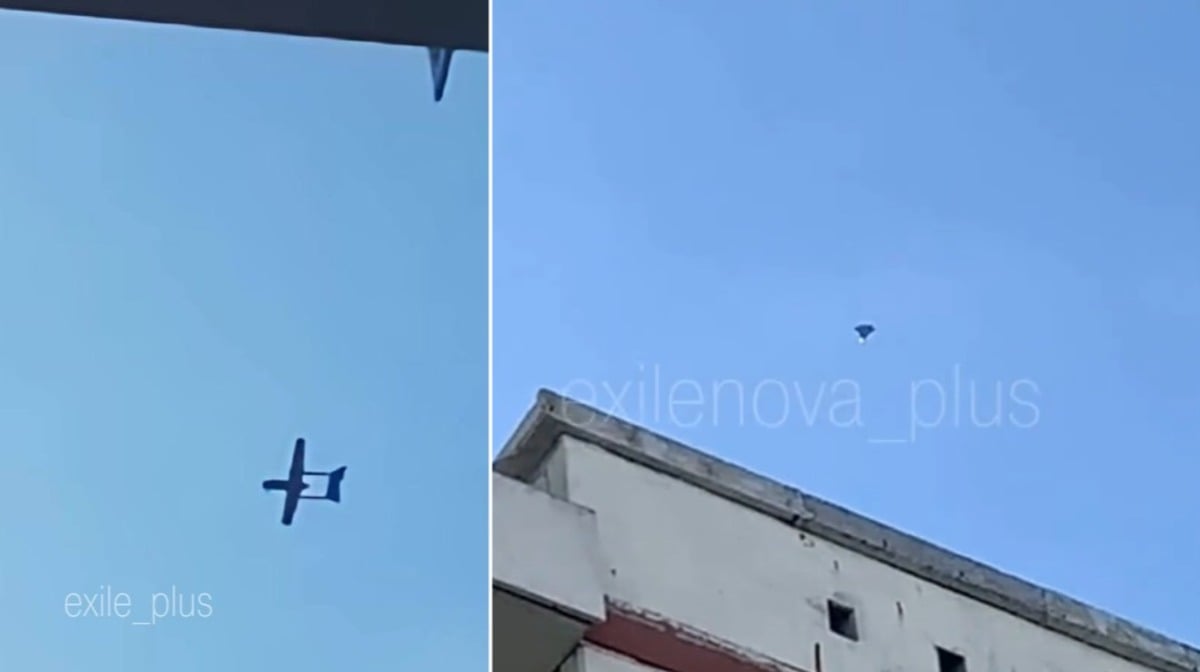
Photographs and video circulating on social media appear to show a Russian Su-57 stealth fighter trying, and failing, to stop Ukrainian strike drones from reaching Russia’s largest oil refinery on July 6, 2026, a claim that, if confirmed, would mark a rare and embarrassing operational failure for one of Russia’s scarcest and most advanced combat aircraft.
Multiple images and clips posted online show the Su-57 maneuvering near the incoming drones over Omsk, a Siberian city roughly 2,500 kilometers (1,550 miles) from the Ukrainian border, with some accounts describing the jet as having been scrambled as a last line of defense for the Omsk Oil Refinery, Russia’s largest, before failing to prevent the strike from reaching its target.
The Omsk Oil Refinery, owned by Gazprom Neft and capable of processing more than 20 million metric tons of crude oil annually, had been one of only two facilities among Russia’s ten largest refineries never struck by Ukrainian drones, according to analysis published by independent Russian outlet Meduza as recently as late June 2026, with the other holdout being the Angarsk Petrochemical Company far to the east in Irkutsk region. Omsk’s distance from Ukraine had made it one of the most difficult refinery targets to reach, and the region issued its first-ever drone threat alert only on June 10, an incident that passed without any confirmed strikes. Ukraine’s General Staff said the country’s broader systematic campaign had already disabled roughly 43 percent of Russia’s total oil refining capacity by early July, triggering fuel rationing and gas station lines across dozens of Russian regions well before this week’s attack on Omsk.
The presence of a Su-57 over Omsk fits a pattern aviation analysts had already begun documenting before this specific incident. Aviation journalist Thomas Newdick, writing for The War Zone in early July 2026, reported that Russia had reconfigured at least some of its handful of Su-57 stealth fighters specifically to hunt drones and cruise missiles threatening refineries and defense-industrial sites, based on photographs showing the jets carrying external R-73 and R-74 short-range air-to-air missiles alongside a new targeting pod mounted near the left engine.
Newdick noted that Russia is believed to operate only around nine Su-57s in total, aircraft long regarded as a strategic asset meant to guarantee Russian air superiority rather than a tool for chasing down cheap attack drones, and he suggested that repurposing what amounts to Russia’s air force “silver bullet” for anti-drone patrols signals serious underlying weaknesses in Russia’s ground-based air defenses, since a healthy network of Pantsir short-range systems and S-300 or S-400 long-range batteries would ordinarily handle this mission without needing to divert a scarce fifth-generation fighter at all.
The monitoring channel Exilenova+ reported a series of explosions in Omsk during the afternoon of July 6, with smoke visible rising over the city, and separately suggested the refinery was likely struck by a new modification of the Fire Point-produced FP-1 drone featuring an atypical wing geometry, an early report that initially described at least two confirmed impacts on the facility before subsequent photo and video evidence raised that confirmed count considerably higher.
Photographs and video that emerged after the attack confirm the strike reached its target, showing at least seven drones hitting the refinery complex, evidence that moves this incident well beyond the earlier, unverified claims about a Su-57 failing to stop the assault and into a confirmed successful strike on one of Russia’s most difficult targets. That confirmed impact carries strategic weight well beyond a single facility, a point Iryna Terekh, CEO and technical director of Fire Point, the Ukrainian company whose FP-1 drones are believed responsible for the strike, explained in detail once the results became clear.
“Achievement unlocked. By today, the Omsk refinery had remained one of only two refineries in the top 10 that had never been hit by Ukrainian drones. The other is the Angarsk Petrochemical Company in Irkutsk Oblast. Both are beyond the Urals. It was counted on to balance out the fuel crisis after the successful campaign by Ukraine’s Defense Forces (to grasp the scale: its capacity is nearly double that of the Moscow refinery). It is also the only Russian refinery that produces cracking catalysts, meaning the component on which secondary refining at other plants depends,” Terekh said.
Whatever role a Su-57 did or did not play trying to stop the attack, the confirmed result on the ground is that Russia’s largest refinery, previously considered protected by distance alone, no longer belongs on the shrinking list of untouched targets, and the fighter fleet Moscow now leans on to defend what remains has yet to prove it can hold that line any better than it did this time.