

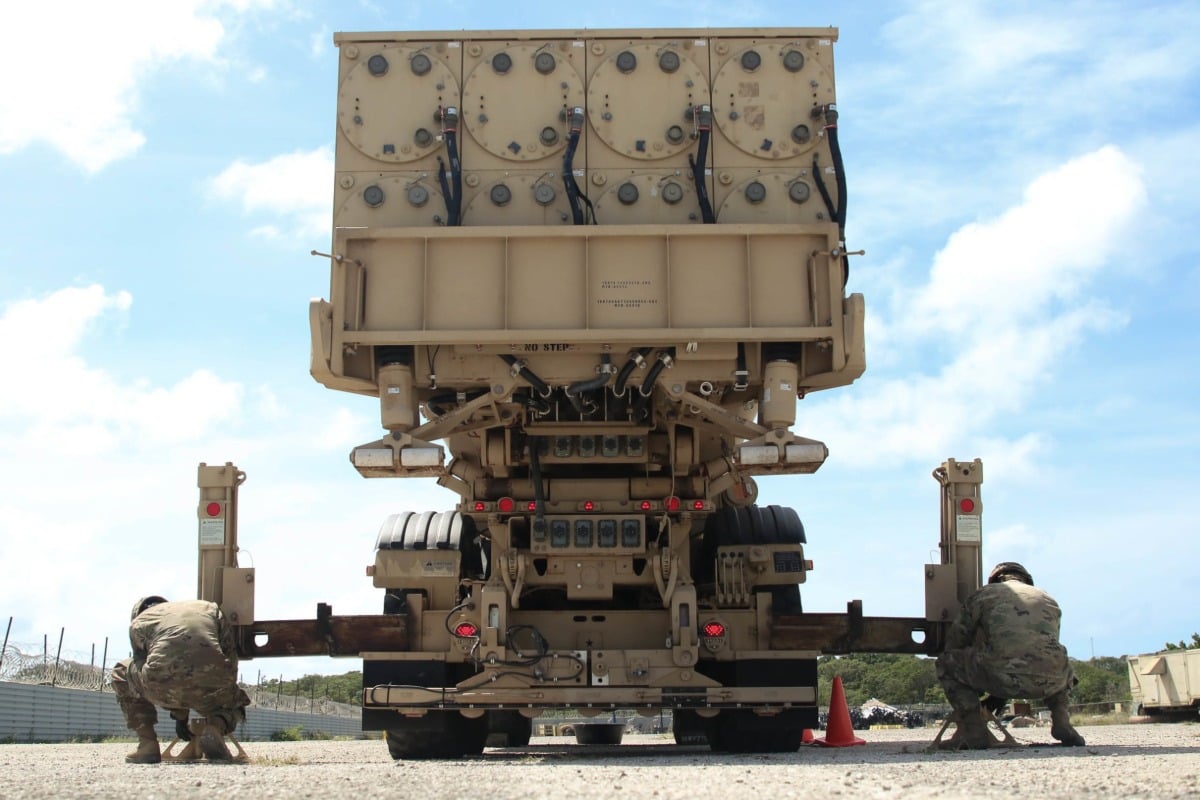
- The U.S. Army published a Request for Solutions Brief on June 25, 2026, seeking a prototype Battle Manager Suite for Guam's missile defense.
- Solution briefs are due July 15, 2026, with a contract award targeted for the first quarter of fiscal year 2027.
An American island sits closer to Beijing than it does to Hawaii, hosts thousands of U.S. troops, and the Pentagon has opened bidding for the software system meant to knit together everything standing between that island and a Chinese missile barrage.
The U.S. Army’s Portfolio Acquisition Executive for Fires, working on behalf of the Guam Defense System Joint Project Office, published a Request for Solutions Brief on June 25, 2026, seeking companies to prototype what the Pentagon calls a Battle Manager Suite, a command and control system that would pull data from existing Department of War systems into a single, unified picture of the threats aimed at Guam. Companies have until 4:00 p.m. Eastern on July 15 to submit their initial proposals, and only U.S. firms cleared to handle SECRET-level information and hardware are even eligible to compete.
The island sits within range of nuclear-capable missiles held by both China and North Korea, hosts Andersen Air Force Base and Naval Base Guam, and would almost certainly become a target in the opening hours of any conflict over Taiwan, since it functions as one of the closest major American military hubs to a potential Chinese invasion force. Congress recognized that vulnerability in the fiscal 2022 defense authorization act, directing the Pentagon to build what officials call a 360-degree Enhanced Integrated Air and Missile Defense capability for the island, and the Army stood up the Guam Defense System Joint Project Office in February 2024 to pull that effort together under a single three-star general, Lt. Gen. Robert A. Rasch Jr.
The Battle Manager Suite this new solicitation seeks to build addresses a problem that sounds almost mundane compared to missiles and radars, but officials describe it as the piece that determines whether everything else actually works together. Guam’s defense currently relies on more than 20 separate programs of record and prototype systems spread across the Army, Navy, Air Force, Marine Corps, and Missile Defense Agency, each originally built to operate on its own rather than as part of a single network, and the Battle Manager Suite is meant to fuse that patchwork into one system capable of tracking threats, recommending which weapon should fire at what target, and displaying a common operating picture to commanders in real time. The solicitation specifically requires the system to defend against both ballistic threats, meaning missiles that arc through the atmosphere like traditional intercontinental or medium-range weapons, and non-ballistic threats, a category that includes cruise missiles and drones that fly on a flatter trajectory and can be far harder for older radar systems to detect and track.
The Pentagon structured this competition as an Other Transaction Agreement for Prototype, authorized under a federal law known as 10 U.S. Code Section 4022, a contracting tool that lets the government sign faster, more flexible deals with companies than the standard, heavily regulated federal acquisition process allows. That statute comes with a built-in requirement designed to pull in companies beyond the traditional defense industrial base, since any winning proposal must involve either a nontraditional defense contractor or nonprofit research institution playing a significant role, an arrangement where every non-government participant qualifies as a small business, or a structure in which outside investors cover at least a third of the prototype’s total cost, conditions meant to encourage commercial technology firms rather than only the handful of giant defense contractors that typically win Pentagon software contracts.
The competition unfolds in three phases over the coming months, starting with the solution briefs due July 15, followed by a possible vendor demonstration phase in mid-August for companies whose written proposals impress evaluators, and finally a formal Request for Prototype Proposal that would ask finalists for detailed technical and cost submissions before the government picks a winner, with an award targeted for the first quarter of fiscal year 2027, sometime between October and December 2026. Whoever wins would work under a contract running up to five years total, structured as a one-year base period followed by four additional one-year options, and the solicitation notably states the government will screen submitted proposals against artificial intelligence detection tools, warning that a solution brief judged to rely too heavily on AI-generated content will be viewed as a sign the vendor lacks genuine understanding of the problem rather than evidence of efficient proposal writing.
This effort carries weight well beyond Guam itself, since Defense Secretary Pete Hegseth has publicly described the Guam Defense System as a model for Golden Dome, the Trump administration’s ambitious plan for a layered, nationwide missile shield over the continental United States, and program officials have said architectural elements developed for Guam, including the kind of joint engagement coordination and sensor fusion the Battle Manager Suite is meant to provide, could carry over directly into that larger homeland defense effort. That makes this relatively obscure software solicitation a potential blueprint for a much larger and more expensive national undertaking rather than an isolated island defense project.
None of this comes without real institutional strain, since a Government Accountability Office report released in May 2025 found the Pentagon still lacked a clear strategy for transferring operational responsibilities among the various military services managing pieces of the Guam Defense System, and Army officials disclosed the joint project office remained staffed at only 45 percent of its intended personnel levels as of mid-2025, gaps that have already contributed to schedule slippage from an original 2024 target for foundational capability. Live-fire tests of the Marine Corps’ Medium-Range Intercept Capability and Army Patriot systems are underway on Guam this summer as part of Exercise Valiant Shield 2026, evidence that individual weapon systems are progressing even as the software meant to tie them all together is only now heading out to bid.