

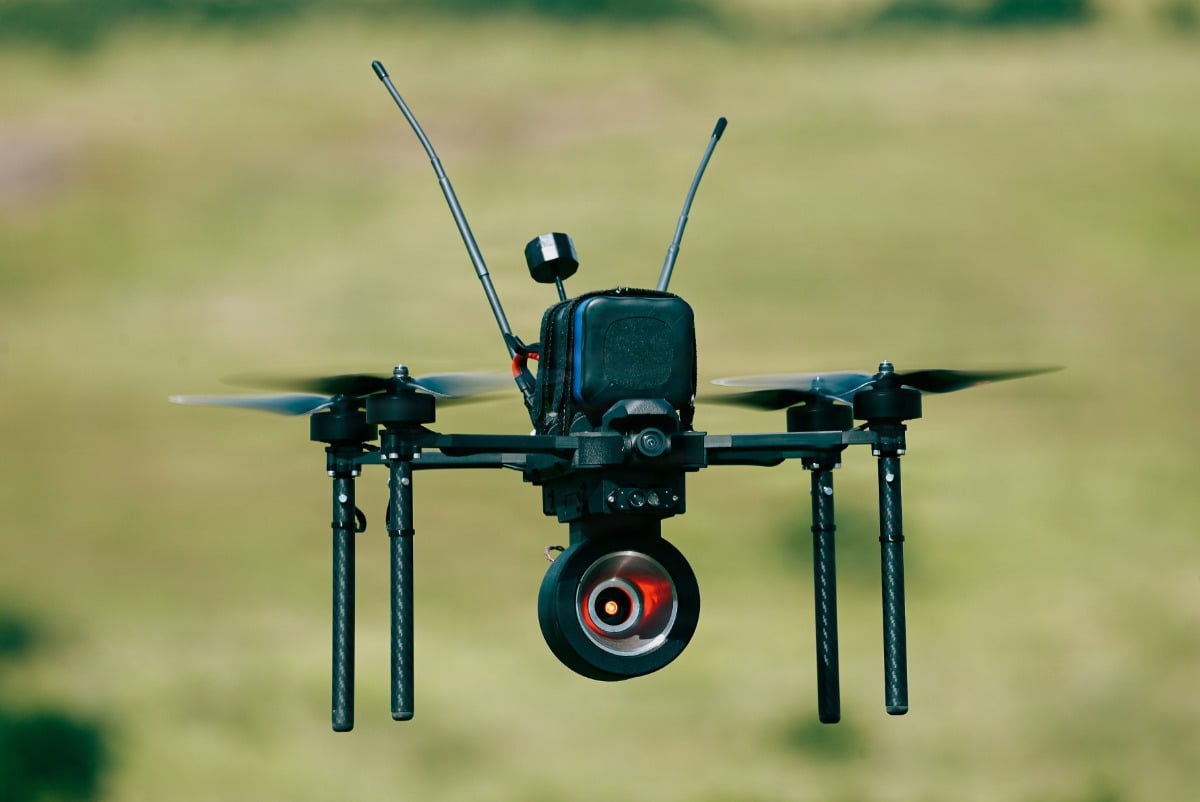
- The Pentagon's Drone Dominance Program advanced 19 companies to Gauntlet II testing at Fort Carson, Colorado in August 2026.
- Companies must deliver 120 drones with lethality payloads within about five weeks to remain eligible for the round.
Nineteen companies have survived a brutal, weeks-long elimination round built to answer one question the Pentagon considers existential: can American industry build enough cheap, lethal drones fast enough to matter in a real war.
The Drone Dominance Program, a Pentagon initiative jointly run by the Test Resource Management Center and the Defense Innovation Unit, announced on July 1, 2026, that 19 drone makers had advanced to the next round of testing, known as Gauntlet II, scheduled for Fort Carson, Colorado, in August.
The companies earned their spot by surviving a qualifying event held June 8 through 19 at Camp Grayling, Michigan, where 49 drone companies flew their aircraft through day and night missions built around two scenarios the Pentagon considers critical to future combat, striking targets at long range and conducting tactical assaults inside confined, building-like environments.
The Drone Dominance Program itself grew out of an executive order President Trump signed directing the Pentagon to close a dangerous gap between American drone capacity and that of potential adversaries, most notably China, which Senate Armed Services Committee Chairman Roger Wicker has said controls more than 90 percent of the global market for small, non-military drones through years of state subsidies and aggressive pricing. That dominance has left American-made drones costing anywhere from five to 25 times more than Chinese equivalents, according to testimony Wicker delivered earlier this year, a gap the Pentagon is trying to close through direct competition rather than a traditional, slow-moving acquisition process. The program carries a two-year, $1.1 billion budget and structures its search for suppliers as a series of head-to-head competitions called Gauntlets, with each round designed to be harder than the last and each winner earning real production orders rather than just bragging rights.
Gauntlet I already proved the model works at meaningful scale, since that first round, held at Fort Benning, Georgia, in February and March 2026, produced roughly $150 million in orders for 30,000 one-way attack drones split among the top performers, with a London-based company called Skycutter topping the leaderboard and a Ukrainian firm called UDD, short for Ukrainian Defense Drones, finishing sixth. Those 30,000 drones are being delivered to military units now, and the same pattern is expected to repeat and scale up dramatically with Gauntlet II, which carries a target of ordering roughly 50,000 to 60,000 additional drones from whichever companies perform best when testing resumes at Fort Carson.
The Pentagon’s announcement states that all 19 advancing companies must fulfill an order of 120 drones equipped with lethality payloads within approximately five weeks just to remain eligible to compete, a demanding production benchmark that filters out companies capable of building an impressive prototype but not yet capable of manufacturing at any real volume. Each of those drone makers is also paired with one or more specialized lethality providers, companies responsible for the warhead or payload systems that turn a drone airframe into an actual weapon, drawn from a roster the Pentagon selected earlier through a separate Lethality Prize Challenge that includes Bravo Ordnance, Kela Defense, Kraken Kinetics, Mountain Horse, and defense giant Northrop Grumman Systems Corp, a pairing structure that lets smaller drone startups focus on airframes and flight performance while established weapons specialists handle the part of the system that actually has to detonate reliably on target.
Travis Metz, deputy director of the Defense Innovation Unit, described the program’s ambitions in blunt terms shortly before this round of advancing companies was announced.
“As directed by President Trump and Secretary Hegseth, we have begun to equip our warfighters with the best drones in the world. We have ordered 30,000, which are being delivered now and will be ordering 60,000 more in September, all based on competitive events and moving supply chains to the United States as we progress,” Metz said.
Defense Innovation Unit Director Owen West framed the broader stakes in similarly urgent language, tying the domestic manufacturing push directly to how fast adversaries are moving.
“This is an urgent matter. Our adversaries are scaling their UAS technology, tactics and industries at an alarming rate. Following Secretary of War Hegseth’s orders, we are acting decisively to develop new defensive and offensive capabilities to match these threats,” West said.
The Pentagon has also moved to close a specific loophole heading into this next round, banning any Gauntlet II entrant from using motors or batteries sourced from what the program calls “covered countries,” a category that effectively targets Chinese components even as American companies race to stand up alternative domestic supply chains fast enough to keep pace with the competition schedule. That restriction carries real consequences for some of the companies that performed well in Gauntlet I but built their systems around Chinese-made parts, forcing them to find new suppliers within months or risk disqualification from future rounds regardless of how well their drones fly.
The urgency animating all of this traces back in part to a real combat deployment rather than a hypothetical scenario, since American forces used a one-way attack drone in combat for the first time earlier this year when Task Force Scorpion fired a system called LUCAS, a reverse-engineered version of Iran’s Shahed-136 built by Arizona-based SpektreWorks, during operations tied to the broader Iran conflict. LUCAS costs roughly $35,000 per unit, a price tag the Drone Dominance Program is explicitly trying to undercut by an order of magnitude, targeting roughly $5,000 per drone in the near term and pushing toward $2,000 per unit as the program matures and competition drives manufacturers to find cheaper ways to build effective, expendable weapons at scale.
By 2027, the Pentagon says it wants more than 200,000 of these AI-enabled attack drones fielded across the force, a number that sounds abstract until measured against how quickly the program has already moved from a February qualifying round at Fort Benning to a 60,000-drone follow-on order barely six months later.