

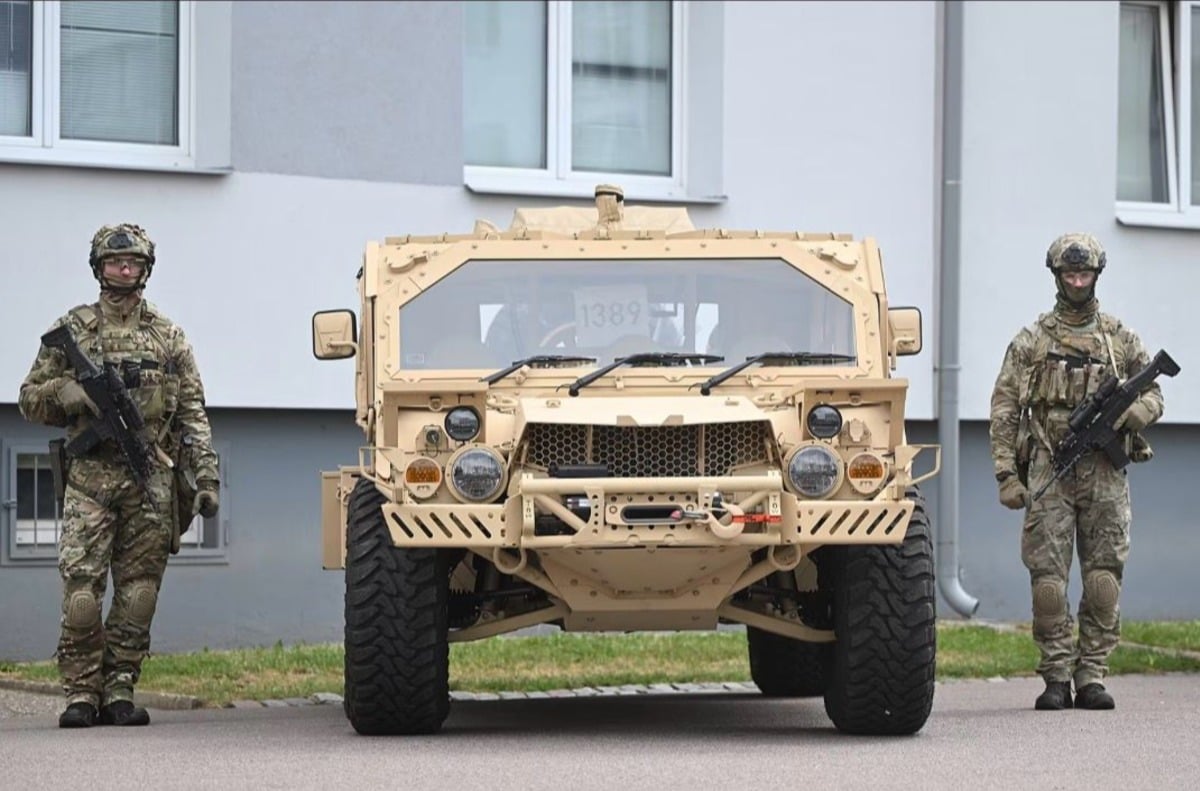
- The Czech 43rd Airborne Regiment received its first Flyer 72 HD vehicles during a ceremony in Chrudim.
- The Czech Republic will receive 46 Flyer 72 HD vehicles funded by a $26 million U.S. military grant.
Czech paratroopers in Chrudim have received their first U.S.-made Flyer 72 HD light tactical vehicles, beginning the replacement of aging Land Rover Defender Kajman vehicles that have served the unit since 2009 and giving the Czech Army’s airborne force a more mobile platform for raids, command tasks and combat operations across difficult terrain. The vehicles were unveiled during a ceremony attended by senior Czech and U.S. representatives, with Flyer Defense LLC and Czech defense firm STV Group marking the delivery as the first handover of the type to the Czech Republic.
The vehicles are destined for the 43rd Airborne Regiment, the Czech Army’s rapid-reaction airborne formation based in Chrudim. Local reporting by iDNES.cz said the regiment will receive 46 Flyer 72 Heavy Duty vehicles in total, with several already in Chrudim, another 22 in the Czech Republic and six more on the way. The U.S. Embassy in Prague said the vehicles were acquired through a U.S. military grant worth $26 million and provided to the Czech Republic as compensation for military equipment Prague donated to Ukraine. Robert C. Rice of Flyer Defense said the vehicles were delivered through Foreign Military Sales, the U.S. government channel used to provide defense equipment to allies and partners.
“Honored to represent Flyer Defense alongside STV Group as the Czech Republic unveiled its first Flyer 72 HD vehicles delivered through FMS,” Robert C. Rice of Flyer Defense LLC said.
The Czech vehicles will arrive in two main versions: command and combat. Colonel Petr Tesařík, commander of the 43rd Airborne Regiment, told Czech media that the Heavy Duty 72 variant selected for the Czech force is a six-seat vehicle and that the integrator will configure it into ten command vehicles, with the remainder built as combat vehicles. The vehicles are being delivered without their final mission equipment, meaning the Czech Army will still need to fit weapon stations, radios, communications equipment, counter-drone defenses, jammers and ballistic protection before they reach full operational configuration.
That unfinished delivery state is important because the Flyer 72 HD is built less like a single fixed vehicle type and more like a tactical platform that can accept mission kits. Flyer Defense markets the vehicle as a modular light strike platform with a payload of about 2,585 kg (5,700 lb), a top speed of about 153 km/h (95 mph), and a mission-profile range of about 483 km (300 miles), with a longer road range under easier driving conditions. The company lists a 1.83 m (72 in) chassis width, which helps explain why the vehicle appeals to airborne and special operations-style units that need a narrow, transportable platform rather than a heavier armored truck.
The vehicle’s battlefield value lies in the tradeoff between protection, speed and deployability. It cannot offer the armor of a heavy infantry fighting vehicle or MRAP, but it gives airborne troops a fast, weapons-capable vehicle that can move teams, sensors and firepower across terrain where ordinary utility vehicles struggle. Flyer Defense has developed the broader Flyer family for U.S. and allied light forces, and variants of the Flyer 72 have been associated with U.S. special operations and ground mobility vehicle programs, where transportability and off-road speed matter more than heavy armor.
For the 43rd Airborne Regiment, that kind of mobility addresses a real force-structure problem. The unit has grown from a battalion into a regiment, and Czech commanders have said its vehicle fleet must grow with it. The current Land Rover Defender Kajman vehicles gave Czech paratroopers useful mobility when they entered service, but the platform is no longer modern enough for a regiment expected to operate in a higher-threat environment shaped by drones, electronic warfare and precision fires. The Flyer 72 HD is meant to move small teams quickly while giving them more room for weapons, communications gear and mission equipment.
Tesařík told Czech media the platform can accept different kits depending on the customer’s requirements, including versions for mortar or anti-tank missions. That flexibility matters because airborne units often need to compress many battlefield functions into a small number of vehicles. A light force cannot bring a full armored brigade’s worth of equipment, so each platform has to do more than one job, from carrying command teams and radio systems to moving anti-armor weapons or supporting reconnaissance.
Czech Defense Minister Jaromír Zůna ordered an internal audit of part of the Flyer 72 HD project, focused on whether preliminary financial control was carried out during preparation of the property transfer and how the decision-making process was handled. Czech media reported that Zůna had been expected at the Chrudim event but ultimately did not attend. The U.S. Embassy in Prague previously declined to comment on the audit, while Czech ground forces commander Josef Trojánek said the project had been prepared over a longer period and that funding for the vehicles’ additional equipment should be secured.
The audit does not change the military logic behind the vehicles, but it shows how closely allied equipment transfers are now being watched in Europe. Since Russia’s full-scale invasion of Ukraine, the Czech Republic has become one of Kyiv’s most active military supporters, sending equipment from its own stocks while working with allies to backfill national capability gaps. The Flyer 72 HD package fits that pattern: Prague helped Ukraine, and Washington is helping Prague rebuild and modernize the capacity it gave up.