

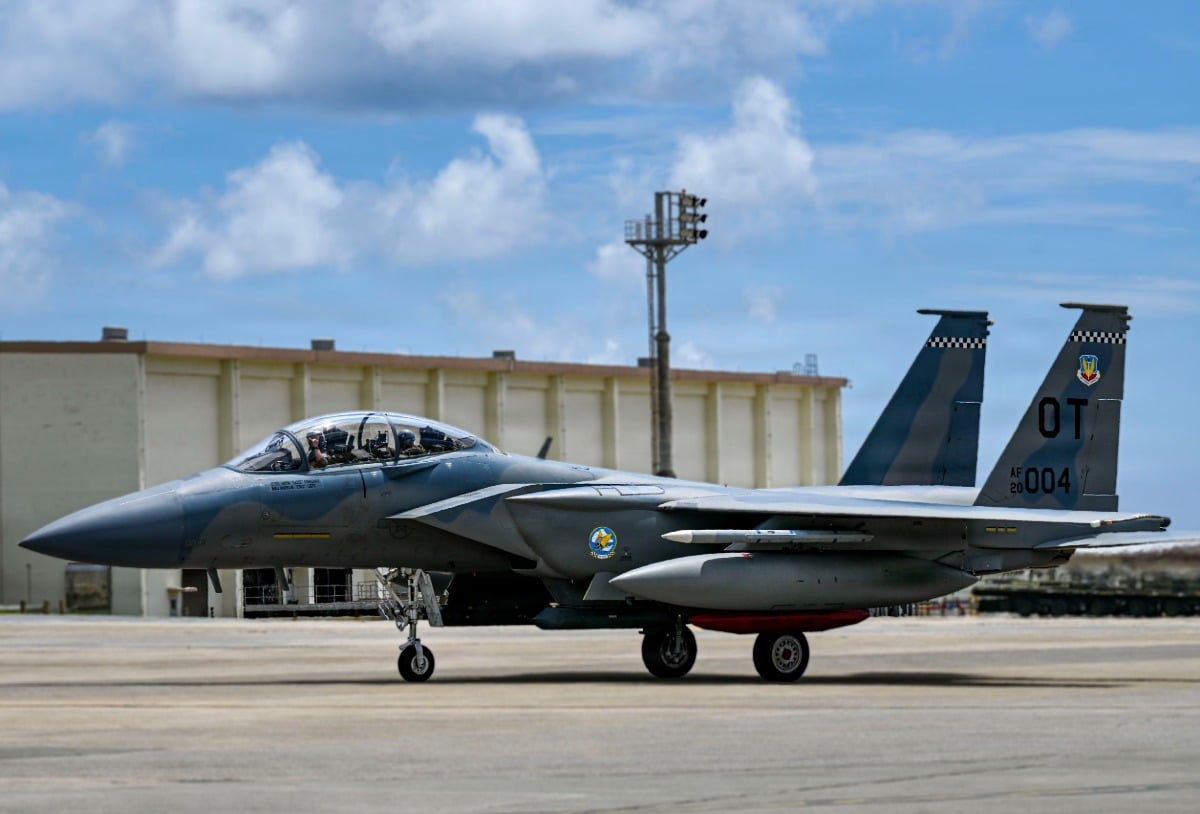
- An F-15EX Eagle II and two F-15E Strike Eagles from the 85th Test and Evaluation Squadron arrived at Kadena Air Base on June 29, 2026.
- The Air Force now expects the first permanent F-15EX jets at Kadena in 2027, later than the originally planned spring 2026.
The combat jet that is supposed to replace an aging fighter fleet on the front lines of the Pacific flew back into Okinawa this week, months after the Air Force quietly admitted its permanent arrival has slipped by a year. An F-15EX Eagle II, escorted by two F-15E Strike Eagle aircraft, landed at Kadena Air Base, Japan, on June 29, 2026, all three jets belonging to the 85th Test and Evaluation Squadron out of Eglin Air Force Base, Florida, according to Pacific Air Forces.
The visit marks the second time the Eagle II has flown into Kadena for training, following its first appearance there on July 12, 2025, and it gives pilots, maintainers, and support crews another chance to work with the jet that will eventually replace the base’s retired F-15C/D fleet before the aircraft becomes a permanent fixture at the base.
When the Pentagon announced in July 2024 that it would station 36 F-15EX Eagle IIs at Kadena to replace the 48 aging F-15C/D fighters flown by the 44th and 67th Fighter Squadrons, officials targeted spring 2026 for the first jets to show up. A labor strike at Boeing’s St. Louis production plant, which ran from August 4 to November 17, 2025, pushed that schedule back, and Air Force Secretary Troy Meink told the Senate Armed Services Committee on May 21, 2026, that the service now expects to deliver the first aircraft to Kadena in 2027, with the full transition wrapping up by 2028 or 2029, roughly a year behind the original plan. In the meantime, Kadena has leaned on rotating squadrons of F-22s, F-16s, and F-35s to keep a credible fighter presence on the island, a stopgap arrangement that has already stretched well beyond what anyone anticipated when the last active-duty F-15C flew its final Air Force flight at the base on January 24, 2025, closing out 45 years of Eagle operations there.
The F-15EX itself is not a stealth fighter, and the Air Force has never pitched it as one, but it represents a significant leap over the F-15C/D it is replacing. Derived from the F-15QA built for Qatar, the Eagle II adds the AN/ALQ-250 Eagle Passive Active Warning Survivability System, an electronic warfare suite that detects and jams enemy radar and missile threats, along with fly-by-wire flight controls, modernized cockpit displays, and an Open Mission Systems architecture that lets the Air Force plug in new sensors and software over time without redesigning the entire aircraft. It also carries more weapons stations and a larger overall payload than the jet it replaces, letting a single F-15EX carry a heavier mix of air-to-air and air-to-ground munitions than the aircraft it is retiring, a capability the Air Force argues offsets the fact that 36 Eagle IIs will eventually stand in for 48 older Eagles, a 25 percent reduction in raw aircraft count that officials say the newer jet’s expanded capacity should help offset.
Lt. Col. Casey Watts, commander of the 85th Test and Evaluation Squadron, explained why repeated visits like this one matter even though the permanent jets are still years away.
“Building familiarity with the aircraft now will help ensure a smooth transition as the Eagle II becomes part of Kadena’s long-term mission and strengthens combat readiness across the Indo-Pacific,” Watts said.
During the visit, Airmen from across the 18th Wing, Kadena’s host unit, are working directly with the test aircraft to refine coordination between operations, maintenance, and mission support teams, testing out the logistics chains, sustainment procedures, and combat generation processes the base will eventually need once its own F-15EXs arrive for good rather than on a temporary training rotation. That distinction matters because a fighter jet is only as useful as the ecosystem supporting it, and building the muscle memory for how to load weapons, service engines, and keep a jet flying at operational tempo takes years of practice that cannot simply begin the day the first permanent aircraft touches down.
Brig. Gen. John Gallemore, the 18th Wing commander, framed the visit as part of a longer arc for the base rather than an isolated training event.
“The F-15EX represents the next chapter of airpower at Kadena. Our Airmen have the opportunity to train with the aircraft, build confidence in its capabilities and ensure we’re ready to project lethality and integrate into operations as we continue providing combat power in support of a free and open Indo-Pacific,” Gallemore said.
For the 67th Fighter Squadron, which will become Kadena’s first operational F-15EX unit once the permanent jets finally arrive, integration events like this one carry outsized weight, since every hour spent working alongside a test aircraft now translates directly into institutional knowledge the squadron will lean on once it stands up its own fleet. The squadron traces its own history back to 1979, when it became the first unit in the Pacific fully equipped with F-15C/D Eagles, and its transition to the Eagle II represents a continuation of that legacy rather than a clean break from it, even as the actual jets it will fly remain grounded in production delays thousands of miles away.
Kadena sits roughly 400 miles from Taiwan, close enough that the base’s fighter capability functions as one of the clearest signals Washington sends about its commitment to the region, and every month the F-15EX transition slips is a month the base continues operating on a fleet of borrowed, rotational aircraft rather than a permanent force built and trained specifically for its mission.