

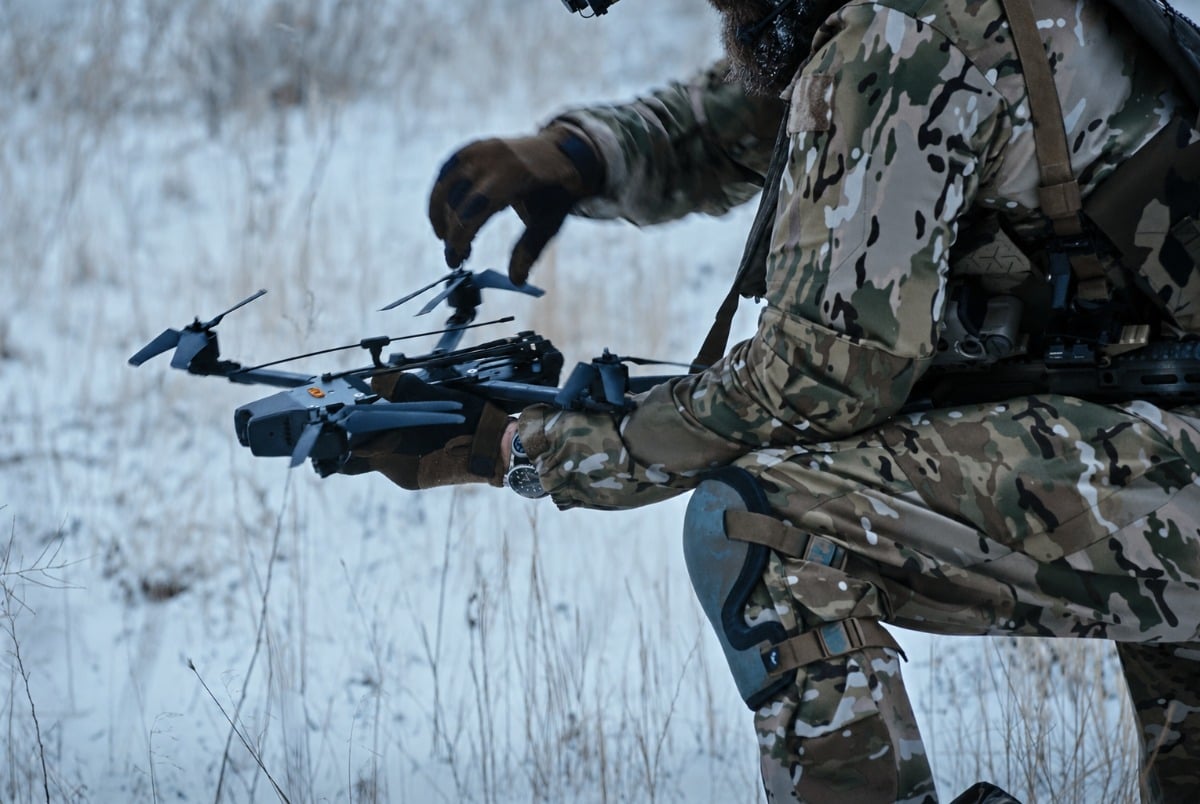
- The Washington Army National Guard issued a sole-source order for four Vector Defense FPV drones on July 1, 2026.
- The $20,000 purchase supports the Western Regional Counterdrug Training Center's counter-drone training for law enforcement.
Drug cartels have started borrowing tactics straight from the Ukraine battlefield, and Washington state’s National Guard just bought the hardware needed to teach police officers how to fight back.
The Washington Army National Guard issued a sole-source purchase order on July 1, 2026, for four Vector Defense first-person-view drones, two of the 10-inch class and two of the smaller 3.5-inch class, along with the controllers, batteries, chargers, and accessories needed to fly them, according to a notice published by the U.S. Property and Fiscal Office for Washington.
A first-person-view drone, commonly called an FPV drone, streams a live video feed directly to a pilot’s goggles or screen, letting the operator fly with the same immersive perspective as if they were sitting in the cockpit, a technology that has become notorious on modern battlefields for its combination of low cost and lethal precision.
The buyer is the Western Regional Counterdrug Training Center, known as WRCTC, one of five National Guard schoolhouses nationwide that provide free counternarcotics training to federal, state, local, and tribal law enforcement agencies rather than a combat unit preparing for deployment. Based at Camp Murray, Washington, WRCTC has spent decades teaching police officers everything from land navigation to tactical medicine, and in December 2025 the center launched a new course called Counter Unmanned Aircraft Systems for Narcotics Officer Operations, built specifically to help narcotics officers recognize and respond to criminals who are increasingly using drones to move drugs, scout law enforcement positions, and support other illegal activity. Maj. Andriy Karpenko, an instructor at the training center, said the curriculum for that course drew directly from overseas combat experience.
“The blueprint is taken from Ukraine and how they are using counter UAS measures from a defensive perspective,” Karpenko said.
That connection explains why a counterdrug training center needs genuine military-grade strike drones rather than hobbyist quadcopters, since teaching realistic countermeasures requires instructors and students to understand exactly what a capable, jam-resistant FPV drone can do in the hands of a sophisticated adversary. Washington’s adjutant general, Maj. Gen. Gent Welsh, framed the broader stakes when the counter-UAS course was first announced, describing a direct line between overseas combat lessons and threats now emerging domestically.
“This course will help bridge the gap between the lessons learned on the battlefield and what our law enforcement and security agencies in the U.S. will soon encounter,” Welsh said.
Vector Defense, the company supplying the drones, is a Utah-based startup founded in 2024 by Andy Yakulis, a West Point graduate and Army Special Operations veteran who left the service after 18 years to build what he describes as “wartech for the warfighter.” The company’s flagship product, the Hammer, became the first American-made FPV drone to integrate fiber-optic control lines, a technology that lets the aircraft fly on a physical cable spool up to 5,000 meters (16,400 feet) long rather than relying solely on radio signals, making it effectively immune to the electronic jamming that has become one of the most common ways to defeat drones in contested environments. Vector has since landed a multi-year contract with U.S. Special Operations Command, secured a $20 million loan from JPMorgan Chase to expand manufacturing at its Draper, Utah facility, and earned approval on the Pentagon’s Blue and Green UAS lists, the government’s vetting programs that certify a drone’s components, software, and data links meet strict security standards free of foreign supply chain risk.
FPV drones have reshaped modern combat largely because of their asymmetry, since a system that costs a few hundred to a few thousand dollars can destroy vehicles or equipment worth millions, and estimates cited within the drone industry attribute a majority of battlefield casualties in Ukraine to these small, agile aircraft rather than traditional artillery or armor. That same combination of cheap availability and outsized impact is precisely what worries counterdrug officials watching cartels adapt the same playbook for smuggling routes, surveillance, and evading interdiction along the border and beyond, and a $20,000 purchase order for four drones will not by itself change that fight. What it does confirm is that the National Guard’s counterdrug trainers are no longer treating small drones as a future problem to plan for eventually, they are treating it as a threat already here, one worth building a live-fire training curriculum around before more law enforcement agencies encounter it for the first time in the field rather than in a classroom.