

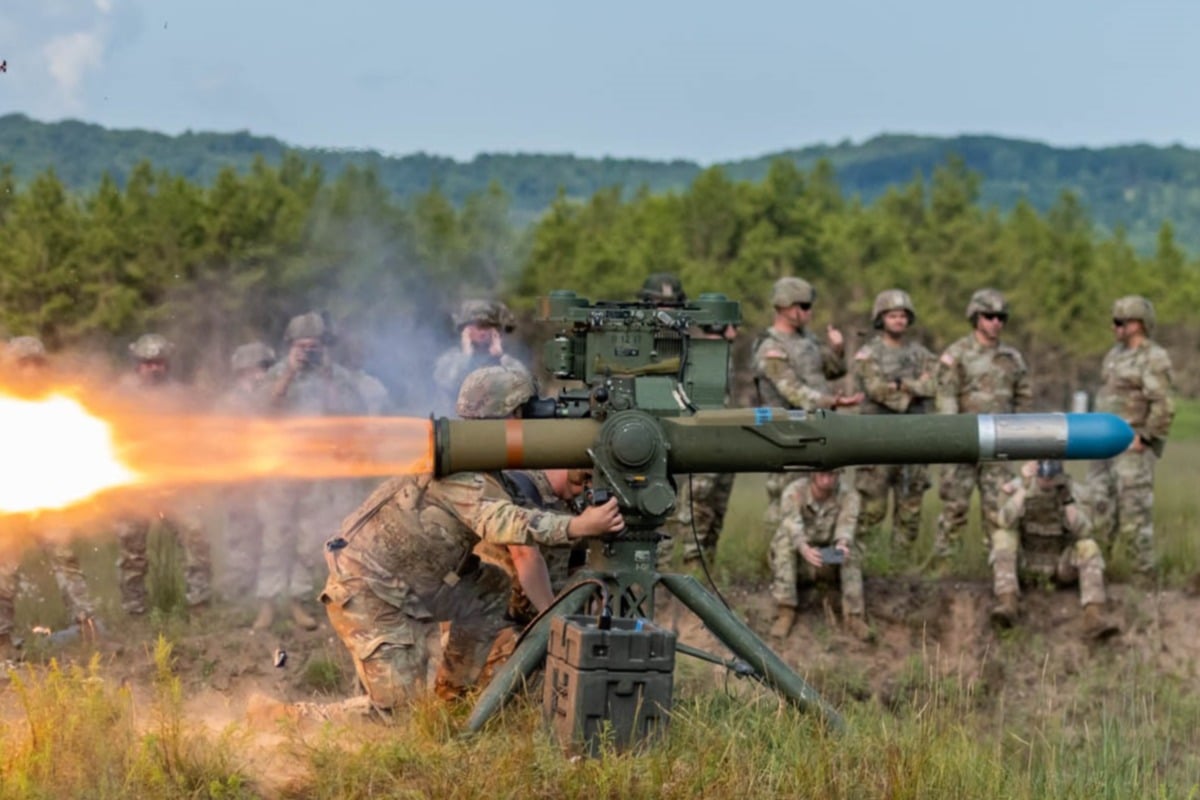
- The U.S. Army plans a sole-source logistics support contract with Raytheon for TOW ITAS and MITAS systems from 2028 through 2030.
- The contract would include a twelve-month base period with two twelve-month options, covering Army, Marine Corps, and allied use.
A missile system old enough to have fought in Vietnam is getting locked in for at least three more years of service, and the Army has confirmed only one company is allowed to keep it running.
The U.S. Army Contracting Command at Redstone Arsenal in Alabama published a presolicitation notice on July 1, 2026, announcing plans to award a sole-source contract to Raytheon Company for continued logistics support of the TOW Improved Target Acquisition System, known as ITAS, and its vehicle-mounted variant, the Modified ITAS, or MITAS.
TOW stands for Tube-launched, Optically-tracked, Wireless-guided, a family of anti-tank missiles the Army first fielded in the 1970s that soldiers still rely on today to destroy armored vehicles from a safe distance, and ITAS is the targeting and fire-control system that helps gunners find, track, and hit those targets with precision rather than relying on the missile’s older, more basic guidance electronics.
The Army wants the new contract to run from calendar year 2028 through 2030, structured as a twelve-month base period with two twelve-month option periods that could extend the total support window to three years, and the notice makes clear that the work covers not just the Army but the U.S. Marine Corps and forecasted foreign military sales to allied nations that also operate TOW ITAS systems. Contractor Logistics Support, the formal name for what the Army is buying, means Raytheon will continue providing spare parts, maintenance expertise, field service representatives who work directly alongside troops, and the information management support needed to keep ITAS units functioning across their operational lifespan rather than letting the Army try to sustain the specialized electronics and optics on its own.
ITAS itself represents a significant upgrade over the original TOW sighting system, built around a second-generation Forward-Looking Infrared sensor that lets gunners detect and track targets in darkness or bad weather, paired with an eye-safe laser rangefinder and a digital fire control computer that calculates the firing solution automatically rather than leaving a soldier to estimate range and lead by eye. The current version, designated the M41A7 TOW ITAS, combines a Target Acquisition Subsystem, a Fire Control Subsystem, a lithium-ion battery pack, and a modified traversing unit, and it can engage targets out to roughly 3.75 kilometers (2.3 miles) with standard TOW missiles, extending beyond four kilometers (2.5 miles) when paired with the longer-range Aero variant of the missile. The MITAS variant takes that same targeting technology and integrates it into the turret of the Army’s M1134 Stryker Anti-Tank Guided Missile Vehicle, letting a gunner operate the system from inside the protection of an armored hull rather than exposing themselves above the vehicle to acquire and engage a target.
Raytheon holds this work on a sole-source basis under a legal justification cited directly in the notice, Title 10 U.S.C. Section 2304(c)(1) as implemented by Federal Acquisition Regulation 6.302-1, a provision that allows the government to skip competitive bidding when only one company can reasonably meet a requirement. That reflects the reality that Raytheon designed and has manufactured ITAS for decades at its McKinney, Texas facility, giving the company deep institutional knowledge of the system’s electronics, software, and failure points that a new contractor would need years to replicate, a common justification across legacy weapons programs where the original manufacturer remains the only source with the technical data rights and specialized tooling to support a system already fielded across thousands of vehicles and units.
Raytheon secured a $72 million contract in 2025 to sustain and support ITAS, with company executive Dan Theisen describing the technology at the time as bolstering target recognition and engagement ranges while delivering increased battlefield performance and survivability for troops. The Army followed that with a $193.7 million contract modification awarded on January 27, 2026, for continued production of TOW missiles themselves at Raytheon’s Tucson, Arizona facility, with that production work scheduled to run through September 30, 2028, funded through fiscal year 2024 and fiscal year 2025 procurement dollars. Taken together with this new logistics support presolicitation, the pattern suggests the Army has settled on a strategy of extending TOW ITAS through the rest of this decade rather than replacing it wholesale, even as the service simultaneously invests in newer precision weapons for other roles.