

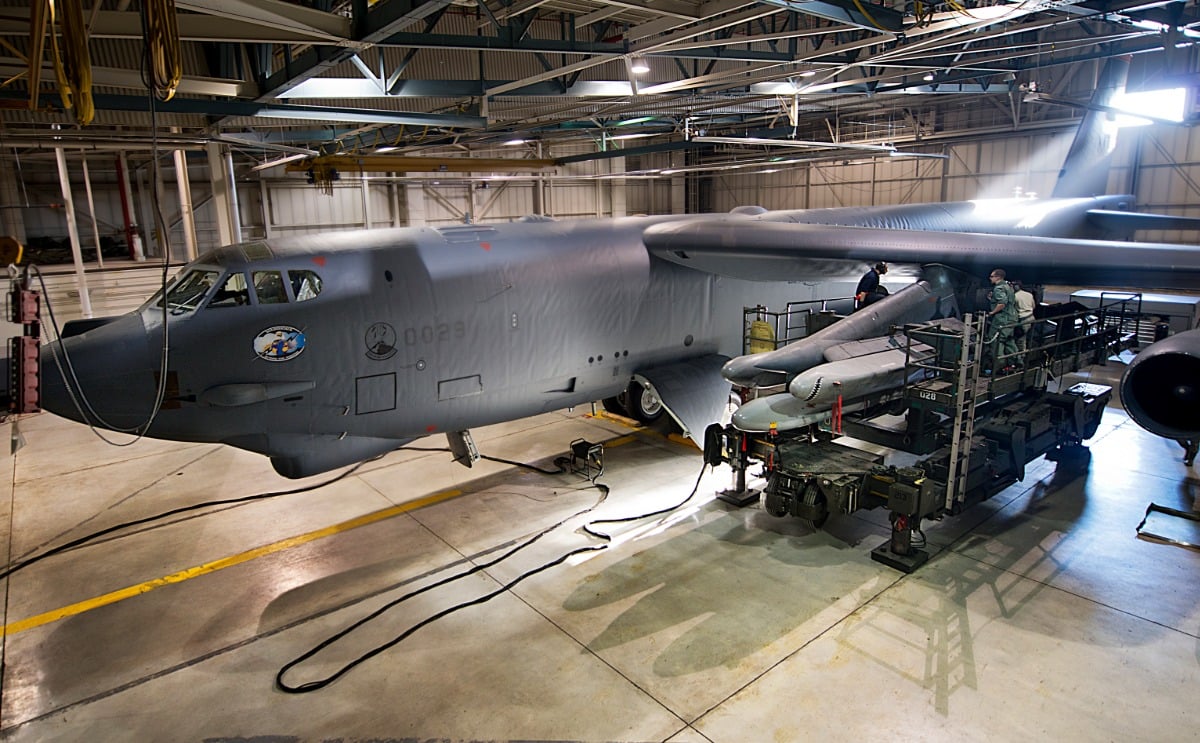
- Boeing received a $49.5 million sole-source contract on June 30, 2026, to remanufacture AGM-86B ALCM flight controllers and produce production test sets through June 2033.
- Work will be performed in Heath, Ohio, and Fort Walton Beach, Florida, managed by the Air Force Nuclear Weapons Center at Tinker Air Force Base.
Boeing secured a $49.5 million contract from the Air Force Nuclear Weapons Center on June 30, 2026, to remanufacture the electronic flight controllers and produce production test equipment that sustain the AGM-86B Air Launched Cruise Missile, the subsonic nuclear-capable cruise missile that has served as one of America’s primary airborne nuclear delivery systems since 1982.
The contract, awarded on a sole-source basis meaning Boeing is the only qualified provider, runs through June 2033 and commits just under $3 million in immediate fiscal year 2026 missile procurement funding. Work will be performed at Boeing’s Heath, Ohio facility and at Fort Walton Beach, Florida.
The AGM-86B Air Launched Cruise Missile, known throughout the Air Force simply as the ALCM, is a weapon that most Americans have never heard of despite being one of the foundational elements of the United States nuclear deterrent for four decades. The missile measures 6.32 m (20.7 ft) in length with a wingspan of 3.66 m (12 ft) when its pop-out wings deploy after launch, weighs approximately 1,360 kg (2,998 lb), and carries the W80-1 nuclear warhead with a selectable yield ranging from 5 to 150 kilotons, the higher end of which is roughly ten times the yield of the bomb dropped on Hiroshima in 1945. Powered by a Williams International F107-WR-101 turbofan engine that produces 272 kg (600 lb) of thrust, the ALCM cruises at approximately 885 km/h (550 mph) at low altitude, using terrain-contour matching navigation combined with inertial navigation to fly at a precision that gives it a circular error probable measured in tens of meters against targets hundreds of kilometers from its B-52H launch aircraft.
The B-52H Stratofortress, the Boeing-built bomber that carries the ALCM, can carry up to twenty of these missiles, twelve externally on wing pylons and eight more internally on a rotary launcher in the bomb bay, giving a single aircraft the theoretical capacity to deliver multiple independent nuclear strikes across widely separated targets from a single sortie. That launch-and-leave architecture, where the bombers can release their missiles outside the range of most adversary air defenses and turn back toward friendly airspace, is why the ALCM remains strategically valuable even though the airframe designs involved are decades old. The ALCM’s turbofan engine and its low radar cross-section, achieved through the weapon’s small dimensions and careful shaping, allow it to penetrate at low altitude beneath many radar coverage envelopes while traveling from launch point to target.
The controller that this Boeing contract remanufactures is the electronic brain of the weapon, managing the missile’s flight control surfaces, engine operation, navigation system, and terminal guidance sequence from the moment of launch through impact. Controllers on weapons of this age do not simply wear out from overuse; they face component obsolescence, the gradual unavailability of the specific electronic parts they were designed around in the early 1980s, which forces the kind of engineering work that goes well beyond simple maintenance into actual remanufacture of boards and assemblies using modern equivalent components that perform the same functions in a hardware environment that no longer exists commercially. The production test sets Boeing will produce alongside the remanufactured controllers are the specialized equipment used to verify that every remanufactured controller meets the original performance specification before it is returned to the weapons stockpile.
The contract runs through the Air Force Nuclear Weapons Center at Tinker Air Force Base in Oklahoma, the organization responsible for life-cycle management of Air Force nuclear weapons and their delivery systems. That routing is standard for any work touching a nuclear-certified weapon or its components, because the documentation, quality assurance, and security requirements for nuclear weapons sustainment are categorically more demanding than for conventional weapons, and the Nuclear Weapons Center maintains the institutional frameworks and regulatory authority needed to oversee work that must satisfy both military and Department of Energy nuclear weapon safety requirements simultaneously.
The Long Range Stand Off weapon, known as LRSO and currently in development by Raytheon Missiles and Defense under contracts dating to 2017, is intended to replace the ALCM with a more capable, stealthier, longer-ranged nuclear cruise missile compatible with both B-52H and B-21 Raider bombers. The LRSO program reached Milestone B, the development start authorization point, in 2023, but the weapon is not expected to reach initial operational capability until the late 2020s at the earliest under current program schedules, with full replacement of the ALCM expected to take years into the following decade. Boeing’s seven-year sustainment contract for ALCM controllers, running through 2033, covers exactly that transition period, keeping the existing weapon functional and certified while the replacement program completes development, testing, and initial production.
The ALCM’s longevity in service also reflects a broader pattern in nuclear weapons management where the cost and complexity of replacing a certified nuclear weapon creates strong incentives to extend existing stockpiles rather than rushing new designs into production. Life extension programs for nuclear warheads and weapon systems require extraordinary levels of testing, certification, and political consensus because every modification to a nuclear weapon, however seemingly minor, must be verified not to compromise either the weapon’s reliability or its safety under all foreseeable abnormal conditions.
Remanufacturing the ALCM’s controller rather than replacing the entire weapon system is a far more cost-effective approach to sustaining capability through the transition period, even if the per-unit engineering cost of remanufacture is higher than new production would be for a clean-sheet design.