

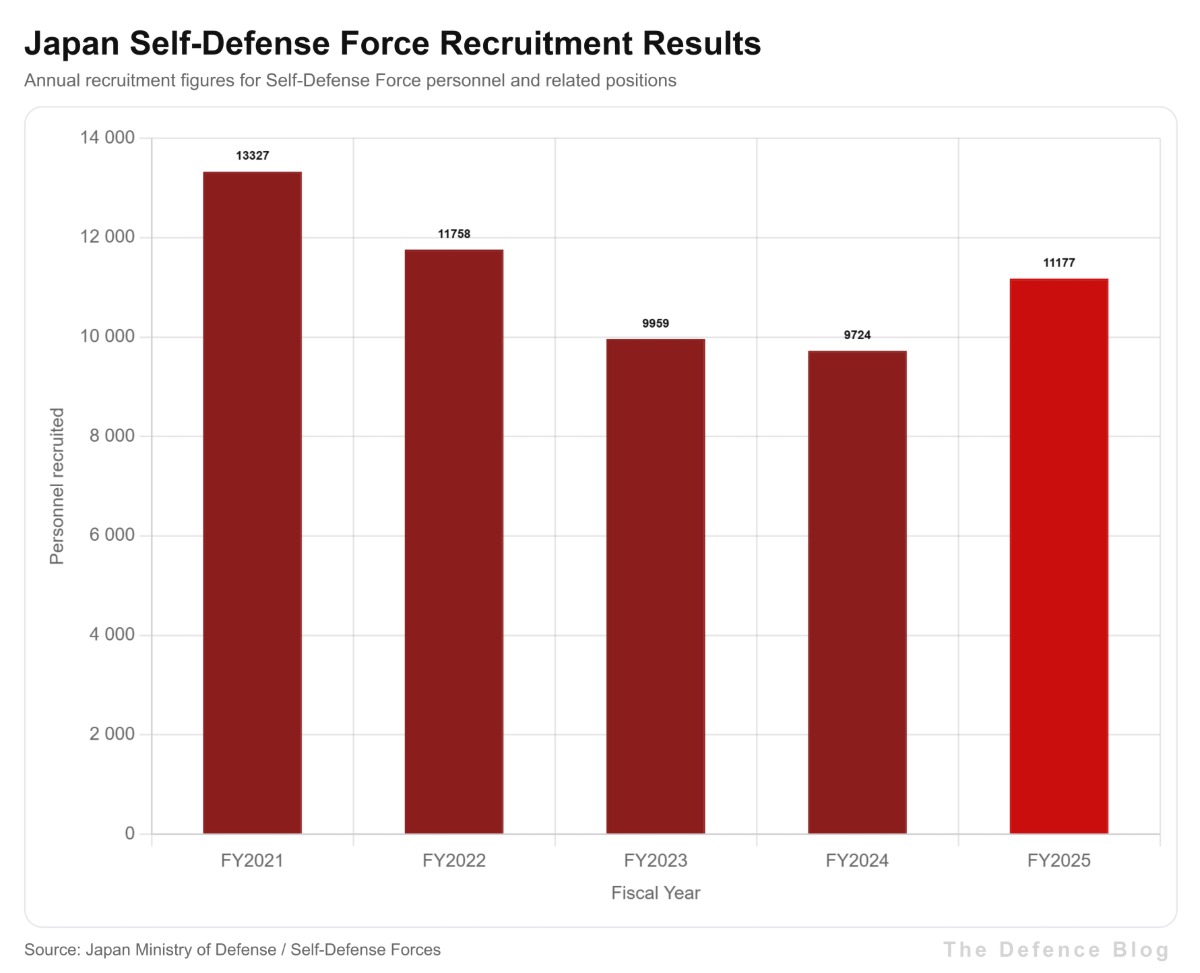
- Japan's Self-Defense Forces recruited 11,177 personnel in fiscal year 2025, up 1,453 from the prior year and the first time recruitment exceeded 10,000 in three years.
- Defense Minister Shinjiro Koizumi credited the recovery to more than 30 new allowances and compensation improvements introduced under a December 2024 government policy framework.
Japan’s Self-Defense Forces recruited 11,177 personnel in Fiscal Year 2025, surpassing 10,000 for the first time in three years and marking a 1,453-person increase over the previous year.
The turnaround reversed three consecutive years of declining recruitment that had culminated in fiscal 2023, when the SDF hit a record-low recruitment rate of just 51 percent of its target, registering only 9,959 new personnel against a goal of nearly 20,000 and raising serious questions about whether Japan could build the force it needed to execute its most ambitious military expansion since World War II.
Defense Minister Shinjiro Koizumi, who has become one of the most publicly assertive defense ministers in recent Japanese history since taking office in late 2024, credited the turnaround directly to a package of more than 30 new allowances and compensation improvements the government enacted following a December 2024 policy framework on improving the treatment and working conditions of SDF personnel.
“The foundation of defense power is people, and securing SDF personnel is the supreme priority,” Koizumi said at a June 16 press conference. “As a ministry, we will continue our various measures and transform the Ministry of Defense and the SDF into an organization that truly values people, so that SDF members can carry out the mission of national defense with high morale.”
Japan’s SDF has an authorized strength of approximately 247,000 personnel across the Ground, Maritime, and Air components, but as of the most recent publicly available figures, actual strength sits at roughly 227,000, meaning the force is operating at about 92 percent of authorized numbers at the officer and NCO levels while enlisted strength trails significantly further behind. The Brookings Institution, in a 2025 analysis of Japan’s defense personnel situation, described the widening gap between strategic ambition and the human capital needed to execute it as one of the defining military challenges the country faces in the coming decade.
The structural pressures driving that gap are demographic and economic, not primarily attitudinal toward military service. Japan’s working-age population has been contracting for years, and the labor market for young Japanese has become exceptionally competitive, with job openings outpacing available workers across the private sector at a ratio that makes military service’s historically modest compensation increasingly difficult to justify against civilian alternatives. The Geopolitical Monitor noted in June 2026 that there were approximately 3.52 private-sector job openings for every new high-school graduate seeking employment in fiscal 2023, the precise demographic cohort that the SDF most needs to attract. Military service cannot match that market unless it upgrades its compensation package substantially, which is precisely what the government’s December 2024 policy framework attempted to do.
Two specific recruitment categories drove the 2025 improvement, both tracked closely by the Ministry of Defense. The first is the General Candidate NCO track, a program for candidates between 18 and 33 years old who are trained to become non-commissioned officers, the sergeants and petty officers who actually supervise enlisted troops and support the officer corps in day-to-day operations. This category increased for the first time in five years, reaching 4,946 recruits, a particularly significant turnaround because NCOs represent the institutional backbone of any professional military and are the hardest category to rebuild once attrition depletes them. The second is the enlisted candidate track, which saw approximately 35 percent growth over fiscal 2024, reaching 4,320 recruits. Enlisted personnel, those in the immediate tactical roles that constitute the operational edge of the force, had been the most severely understrength category in prior years, with Nippon.com reporting in 2026 that enlisted strength had reached only 75.6 percent of authorized levels against the roughly 90 percent rates achieved for officers and NCOs.
The backdrop against which these recruitment figures land is Japan’s most ambitious military transformation in the postwar period. Under Prime Minister Sanae Takaichi, who has been explicit about Japan’s shift toward active deterrence, the country’s defense budget reached a record 9.04 trillion yen, approximately $58 billion, for fiscal 2026, the fourteenth consecutive year of defense spending growth and a trajectory that reflects Japan’s publicly stated intent to reach defense spending of 2 percent of GDP well ahead of the schedule NATO partners have been urging. The capabilities that budget is purchasing include long-range cruise missiles, additional F-35 aircraft, the new Aegis System Equipped Ships that will be the largest surface combatants ever operated by the Maritime SDF, and the expanded Type 12 surface-to-ship missile network that began fielding across Japan’s southwestern islands in 2025.
None of that hardware delivers its intended military effect without trained operators, maintenance personnel, and the command-and-control infrastructure that connects them. A country can accelerate procurement timelines by increasing a defense budget. It cannot accelerate the demographic pipeline that produces the young people who will crew the ships, fly the aircraft, and man the missile batteries. Japan’s recruitment crisis exposed that vulnerability more nakedly than any public policy document had, and the 11,177 figure announced in June 2026, while still below the government’s stated targets, represents concrete evidence that money directed at compensation reform can move the needle.
Japan’s working-age population will not stop contracting in fiscal 2026, and the private labor market will not suddenly become less competitive for young workers. What the Ministry of Defense has demonstrated is that compensation matters enough to shift behavior at the margin, and that the margin, in Japan’s case, is large enough to take 11,177 people over the symbolic threshold of 10,000. Whether it is large enough to reach the targets the SDF actually needs to execute its strategic plans remains the harder question.