

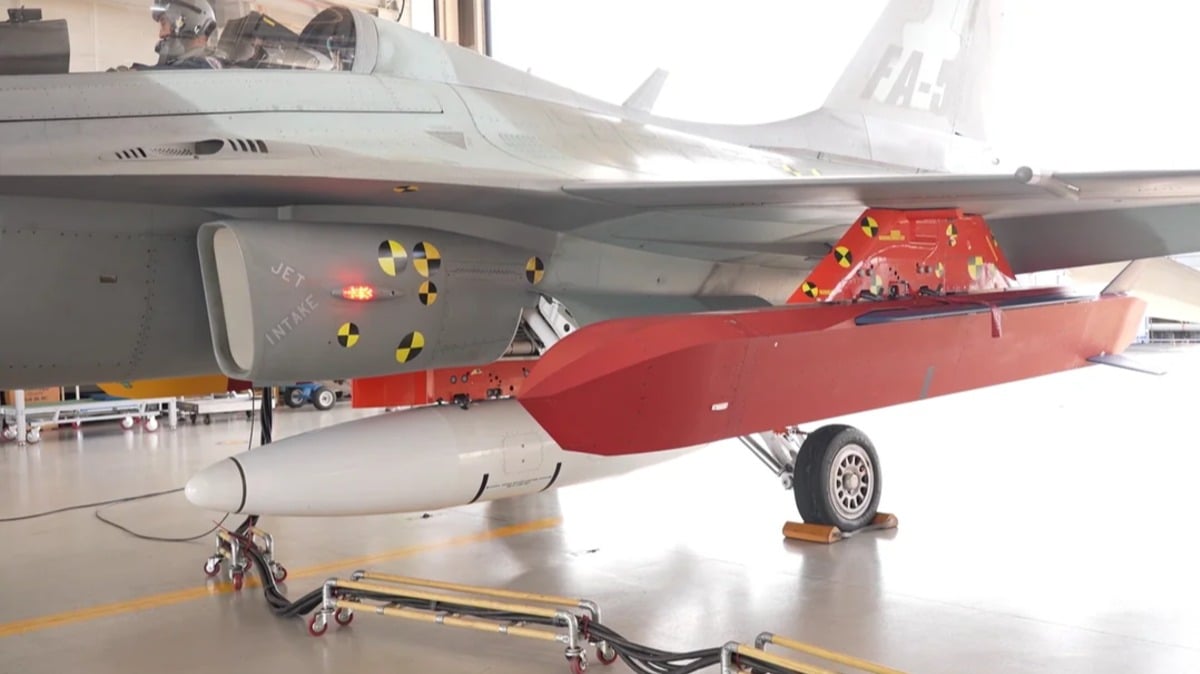
- South Korea's Cheonryong long-range air-to-ground cruise missile successfully completed its first technical flight test on June 25, 2026, after two failures in January and March.
- The missile targets North Korean underground bunkers, carries a range exceeding 600 km, and is planned for mass production in 2029 with operational deployment in the early 2030s.
South Korea successfully completed a technical flight test of its domestically developed long-range air-to-ground missile Cheonryong on June 25, 2026, following two consecutive failures in January and March that forced engineers to remotely shut down the engine and ditch the prototypes in the Yellow Sea, Seoul Economic Daily reported on June 28.
The test, conducted at the Air Force’s 3rd Training and Combat Wing, confirmed that the missile separated cleanly from an FA-50 light attack aircraft, ignited its jet engine in flight, and completed a stable powered trajectory, the milestones that the two earlier attempts could not achieve. If the program stays on its current schedule, Cheonryong will complete development by 2028, enter mass production in 2029, and reach operational deployment in the early 2030s aboard South Korea’s domestically built KF-21 Boramae fighter.
Cheonryong, which translates as “Heavenly Dragon” in Korean, is South Korea’s answer to a question that has grown increasingly urgent as North Korea continues to expand and harden its underground command infrastructure. The missile belongs to a category of weapons designed specifically to destroy deeply buried and reinforced targets, structures that conventional bombs cannot reach and that constitute the nerve centers of an adversary’s military command authority. North Korea has invested heavily in underground facilities carved into granite mountain ranges throughout the country, housing everything from ballistic missile storage to leadership bunkers designed to survive conventional strikes and allow the Kim regime to continue directing military operations through and after an initial exchange of fires.
South Korea currently covers part of this requirement with the German-built Taurus KEPD 350, a joint product of MBDA Germany and Saab that weighs 1.4 metric tons (3,086 lb) with a warhead of 480 kg (1,058 lb) and a range of 500 km (310 miles). The Taurus carries what its manufacturer describes as the Mephisto intelligent warhead system, a multi-stage penetrating warhead that punches through up to 6 m (20 ft) of reinforced concrete across multiple floors before detonating at the optimum point inside the structure. Britain’s Storm Shadow, the closest Western competitor and the weapon Ukraine has used against Russian targets since 2023, performs at a lower level than the Taurus by most published assessments, which is why defense analysts have described the Taurus as among the most capable conventional bunker-busting cruise missiles outside the United States inventory. South Korea imported 260 Taurus missiles under a program completed before the current development project began, and the Air Force has determined that figure falls short of the approximately 600 air-to-ground guided munitions it needs for the opening phase of any conflict on the peninsula.
Cheonryong is designed to fill that gap with a domestically produced weapon that matches or exceeds the Taurus in most performance categories while incorporating design improvements derived from both the Taurus and the American AGM-158 Joint Air-to-Surface Standoff Missile, known as JASSM. Seoul Economic Daily reported that the missile will carry a range exceeding 600 km (373 miles), which represents a 20 percent extension over the Taurus, while retaining approximately 90 percent of the Taurus’s penetration capability against hardened underground structures. The warhead configuration will emphasize the bunker-busting role even more aggressively than the current Taurus, with engineering focused specifically on defeating the multilayer underground concrete structures North Korea has built to protect its leadership.
The guidance architecture Seoul Economic Daily describes gives Cheonryong a circular error probable of 1 to 2 m (3 to 7 ft), achieved through a combination of terrain contour matching, image-based terminal guidance, and inertial navigation, a multi-modal approach that maintains accuracy even when GPS signals are jammed or degraded. The missile flies at low altitude throughout its flight profile to minimize the time it spends visible to enemy radar systems, and its airframe incorporates stealth shaping and radar-absorbent coatings that reduce its radar cross-section significantly compared to the more conventional airframe of the Taurus. The combination of low-altitude flight and stealth treatment gives Cheonryong a substantially lower probability of detection than its German predecessor, according to the Seoul Economic Daily report.
One of the more operationally significant design choices involves propellant storage. The Taurus requires fueling shortly before a mission, which adds preparation time when a strike order comes under time pressure. Cheonryong stores fuel internally in a ready state and can remain in that condition for five to ten years without degradation, meaning aircraft can be loaded and held on alert status without the fueling cycle that the Taurus requires. In a scenario where North Korean provocations require an immediate strike response, the ability to launch without a pre-mission fueling sequence could reduce the interval between a decision to strike and weapons on target by a meaningful margin.
The program’s integration plan extends the missile’s utility well beyond the KF-21, the next-generation fighter that represents the primary planned platform. Because Cheonryong is being engineered with reduced dimensions and weight compared to the Taurus to fit the KF-21’s internal and external carriage requirements, it will also be compatible with the FA-50, the KF-16, and the F-15K, meaning South Korea’s entire existing fighter inventory can potentially carry the weapon once it enters production. That compatibility across four different aircraft types dramatically multiplies the number of launch platforms available in the opening hours of a conflict, distributing the strike capacity across the fleet rather than concentrating it in any single aircraft type that an adversary might prioritize for suppression.
Cheonryong sits inside what South Korean defense planners call the Korean Three-Axis System, the integrated deterrence architecture that includes Kill Chain, the Korea Air and Missile Defense system, and the Korea Massive Punishment and Retaliation concept. Kill Chain covers pre-emptive strike capability designed to destroy North Korean missiles before they can be launched. Korea Massive Punishment and Retaliation covers the decapitation and leadership strike mission, the category Cheonryong is specifically designed to fulfill. A missile that can launch from South Korean airspace, fly below radar coverage at low altitude with a stealth airframe, navigate autonomously to a hardened underground target, penetrate 6 m (20 ft) of reinforced concrete, and detonate inside, without any dependence on American strategic assets, represents a qualitatively different deterrence posture than one reliant on imported German missiles that South Korea cannot produce itself.