

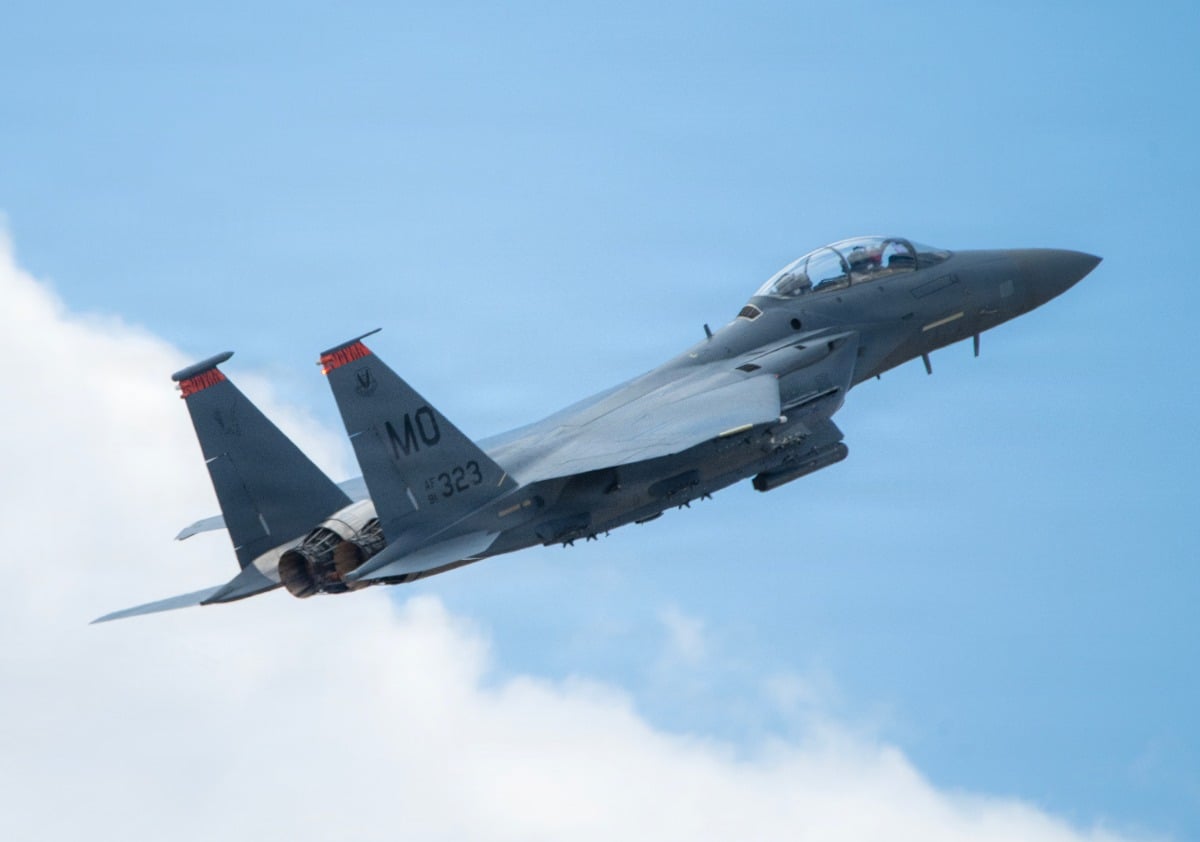
- The Air Force Life Cycle Management Center published a sources sought notice on June 26, 2026, seeking industry input for F-15 infrared search and track modernization.
- Industry responses are due July 27, 2026, with the program managed from Wright-Patterson Air Force Base, Ohio.
The U.S. Air Force is looking for industry solutions to upgrade one of the most tactically valuable but persistently underdeveloped sensors on its F-15 fleet — a heat-detecting system that can find and track enemy aircraft without ever turning on a radar, without alerting the enemy that it has been spotted, and without being fooled by even the most sophisticated electronic jamming.
The Air Force Life Cycle Management Center published a sources sought notice on June 26, 2026, seeking industry input for an F-15 Infrared Search and Track modernization program, with industry responses due July 27.
An infrared search and track system, known by the abbreviation IRST, is fundamentally different from the radar that most people associate with fighter jets. Radar works by emitting radio waves and listening for echoes bouncing back from targets, which means the radar pulse itself can be detected by any enemy aircraft equipped with a radar warning receiver – the electronic equivalent of a burglar alarm that tells the target it has been spotted. An IRST does the opposite: it passively detects the heat signatures that jet engines and airframes generate during flight, building a targeting solution from the infrared radiation the target cannot avoid emitting, without broadcasting any signal of its own. An F-15 pilot using IRST can detect, track, and fire on an enemy aircraft without ever activating the radar that would otherwise announce the engagement. In a combat environment saturated with electronic warfare jamming, where radar signals are actively suppressed or spoofed, IRST becomes the sensor that keeps working when everything else goes quiet.
The F-15’s IRST history is a patchwork of partial solutions that have never fully satisfied the Air Force’s requirements. The most recent operational iteration is the Eagle Integrated IRST, or EI-IRST, which uses Lockheed Martin’s Legion Pod, a sensor system carried in a modified centerline fuel tank housing the AN/ASG-34 infrared receiver derived from technology originally developed for the F-14D Tomcat. The program procured 38 Legion Pods for the F-15C, reaching initial operational capability in February 2022, but a Department of Defense operational test and evaluation review identified limitations in the pod configuration, most notably that mounting the sensor on the external centerline station imposes a restriction on the aircraft’s angle of attack in maneuvering flight, and that funding constraints prevented completing the full flight test envelope needed to clear those limitations. The pod is also a pod, which means it occupies a station that could otherwise carry fuel or weapons, trading payload flexibility for sensing capability.
The gap between what the Legion Pod delivered and what the Air Force actually wants in a modern air combat environment has sharpened considerably as adversary capabilities have evolved. China’s J-20 stealth fighter carries a fully integrated IRST system with 360-degree coverage provided by a distributed aperture network, while Russia’s Su-35S mounts the OLS-35 IRST that can detect a non-afterburning target from beyond 50 km (31 miles) in the forward hemisphere and beyond 90 km (56 miles) from the rear, where engine exhaust is directly visible. Europe’s Typhoon carries the Pirate IRST with similar detection ranges. Against those systems, an F-15 relying primarily on radar in a jammed or contested environment is at a significant disadvantage, because radar silence means sensor silence, while IRST-equipped opponents continue to build tracking solutions in complete radio silence. The Air Force’s sources sought notice is an acknowledgment that this gap needs to close.
The F-15EX Eagle II, the latest production variant of the airframe that the Air Force is now buying at a dramatically accelerated pace, having increased its planned fleet from 80 to 267 aircraft as of March 2026, provides new possibilities for IRST integration that earlier variants did not. The F-15EX’s digital backbone, built around the Advanced Display Core Processor II mission computer and the AN/APG-82(V)1 active electronically scanned array radar, can in principle host an integrated IRST as a fused sensor input rather than as an external pod running on its own separate processor. Boeing’s own research has already pointed in that direction: The War Zone reported in early 2025 that Boeing published imagery showing an F-15 Advanced Eagle fitted with what appeared to be a nose-mounted IRST sensor positioned ahead of the cockpit, with Boeing confirming the installation was real and not a digital mock-up. A nose-mounted internal IRST would provide a wider field of regard than a centerline pod, impose no aerodynamic or payload penalties, and integrate more naturally with the aircraft’s fire control architecture.
The Army Transformation Initiative announced in 2025 redirected investment away from platforms the Air Force deemed unsuitable for high-end competition, but the F-15EX moved in the opposite direction, with the service dramatically expanding its buy as a complement to the F-35 fleet in scenarios where large payloads, long endurance, and lower operating costs matter more than low observability. An F-15EX carrying up to 22 air-to-air missiles on its external stations, with an integrated next-generation IRST feeding targeting data directly to its fire control system, would be a meaningfully different air superiority asset than the radar-dependent legacy it partially replaces.