

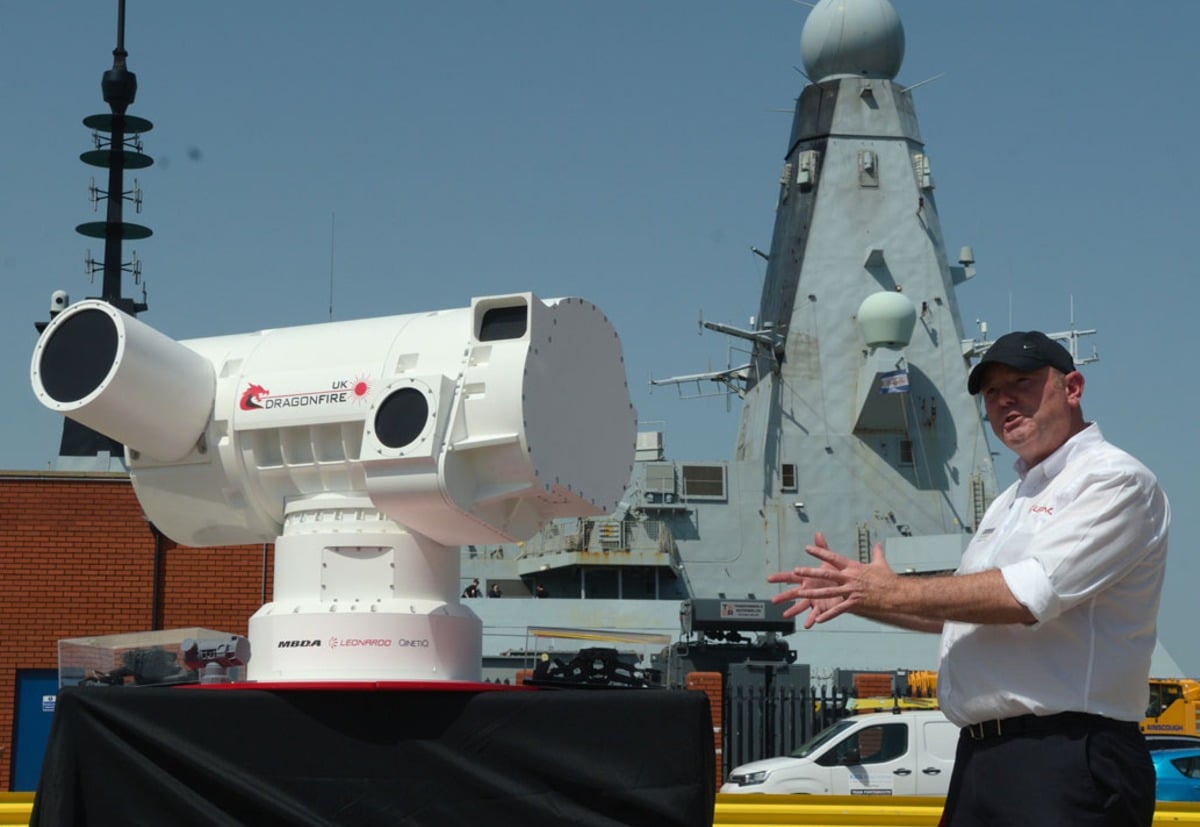
- MBDA received a $417 million contract in November 2025 to deliver two DragonFire laser systems for Royal Navy Type 45 destroyers, with first integration before end of 2027.
- Leonardo showcased DragonFire's beam director at the NATO Industrial Advisory Group Plenary hosted by the UK in Portsmouth on June 24, 2026.
A British laser weapon capable of destroying drones for roughly $13 a shot is on track to be installed aboard Royal Navy destroyers in 2027, making the UK the first European NATO member to field an operational shipborne directed-energy weapon, and the system’s makers used a major NATO industry forum in Portsmouth last week to demonstrate what they have built.
Leonardo, the Anglo-Italian defense company that designs and builds the precision beam director at the heart of the system, showcased DragonFire alongside several other capabilities at the NATO Industrial Advisory Group Plenary hosted by the UK on June 24, the company confirmed.
DragonFire is a British-developed, 50-kilowatt class laser weapon built by a consortium led by MBDA UK and including Leonardo UK, QinetiQ, and the Defence Science and Technology Laboratory, the UK Ministry of Defence’s in-house research organization. The system uses coherent beam combining, a technique in which multiple glass-fiber laser sources are precisely phased and merged into a single high-power beam with near diffraction-limited quality — meaning the laser remains tightly focused over long distances rather than spreading and losing intensity. The beam director that Leonardo provides sits inside a stabilized turret housing electro-optical sensors and a secondary tracking laser, allowing the system to continuously hold aim on a moving target regardless of the motion of the ship beneath it. The UK Ministry of Defence has described DragonFire’s precision as equivalent to hitting a coin at 1 km (0.6 miles), and while the weapon’s range remains classified, it is a line-of-sight system capable of engaging any visible target.
The production contract that turned DragonFire from a demonstrator into a deployable weapon came in November 2025, when MBDA received a £316 million ($417 million) contract to deliver the first two production systems for installation on Type 45 destroyers. The timeline has been accelerated by five years from its original mid-2030s target, driven by successful trials at the MOD Hebrides range in Scotland that included the UK’s first above-the-horizon laser engagement against fast-moving aerial targets. QinetiQ, which operates the Hebrides range and provides DragonFire’s laser source, followed with its own £67 million ($88 million) subcontract from MBDA to continue laser source development. The first ship integration is planned before the end of 2027, with government planning documents referencing a broader goal to equip up to four Type 45 destroyers, subject to performance during early operational deployment.
The Type 45, known in Royal Navy service as the Daring class, is Britain’s most capable air defense warship, a 7,350-tonne (16.2 million lb) destroyer built around the Sea Viper missile system, which can simultaneously engage multiple aircraft and ballistic missiles at long range. DragonFire does not replace Sea Viper but sits beneath it in the engagement envelope, handling the close-range, high-volume threats that consume expensive missiles at unsustainable rates. A drone intercepted by a Mach-speed air defense missile costs the defending navy far more than the attacking force spent to build and launch it. DragonFire’s approximately £10 ($13) cost per engagement fundamentally changes that arithmetic, allowing ships to absorb swarm attacks without depleting missile magazines reserved for strategic threats.
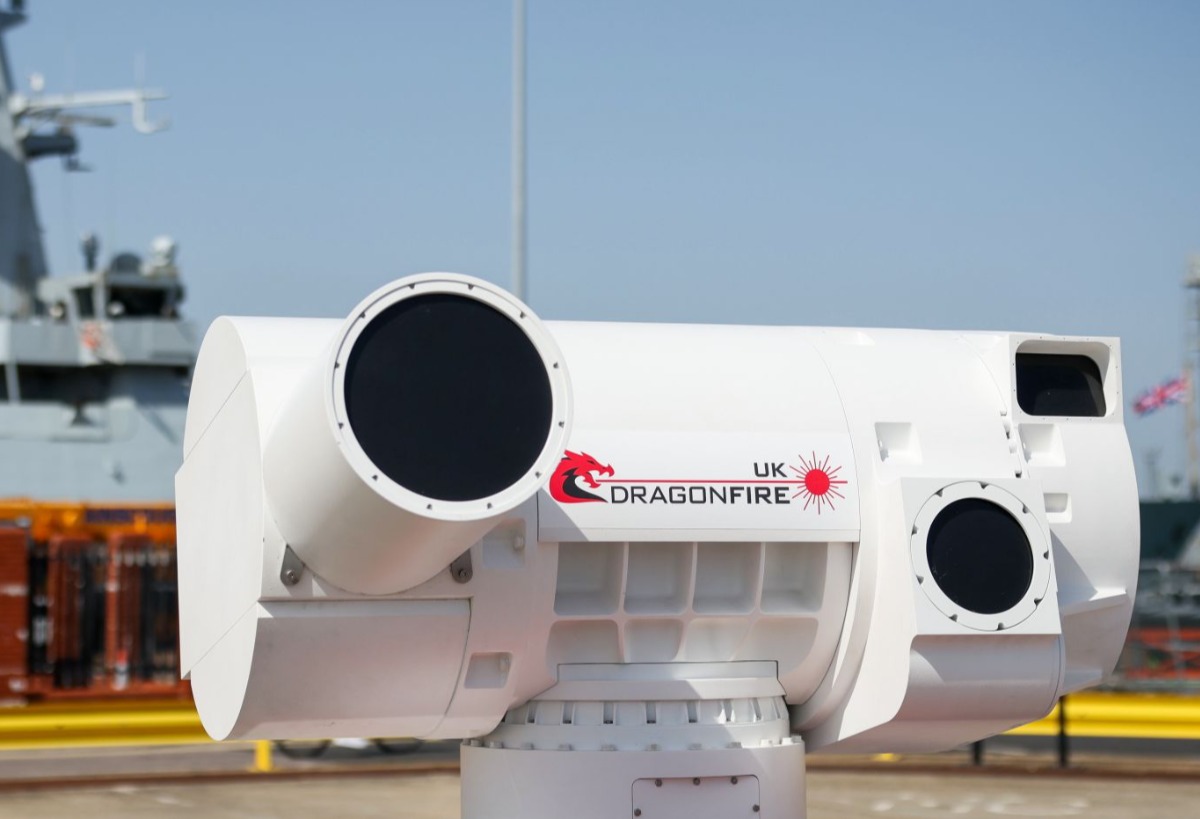
At the NIAG Plenary, Leonardo presented DragonFire alongside two other systems the company is developing for the British military. The first is Proteus, an autonomous rotary-wing technology demonstrator being developed with the Royal Navy and the National Armaments Director Group to advance uncrewed maritime aviation, which completed its first successful test flight earlier in 2026. The second is Falcon Shield, a modular counter-drone ecosystem that the UK military operates under the designation Orcus, a system that has seen extensive operational deployment protecting critical defense assets and major public events domestically and overseas, with NATO partners also drawing on its capabilities against unauthorized drone threats. The NIAG Plenary itself, established in 1968, serves as the formal mechanism through which NATO member nations’ defense industries communicate with the alliance on armaments cooperation and capability development. This year’s gathering was hosted by the UK for the first time this century.
The coherent beam combining technology at DragonFire’s core represents a genuine engineering breakthrough, not incremental improvement on existing designs. Earlier laser weapon programs, including American shipborne demonstrations aboard vessels like the USS Ponce, used simpler spectral beam combining or single-aperture laser sources that limited achievable power or beam quality over extended ranges. DragonFire’s approach to phasing multiple fiber laser sources so that their light waves align constructively allows the system to reach weapon-grade effects while maintaining the precision needed to sustain a burn through a specific small area of a target rather than simply heating its surface. Keeping that beam fixed on a 50 mm (2 inch) spot on a drone flying at 650 km/h (404 mph) while the host ship rolls in ocean swell, through salt-spray atmosphere, is the engineering problem the DragonFire consortium spent nearly a decade solving.
A weapon that can be recharged from the ship’s existing power supply, requires no magazine of missiles to deplete, and costs $13 per engagement is the kind of asymmetric defense advantage that naval planners have been pursuing since drones made cheap offense viable at scale. When the first Type 45 destroyer sails with DragonFire installed in 2027, Britain will have answered one of the most pressing tactical questions in naval warfare without firing a single missile.