

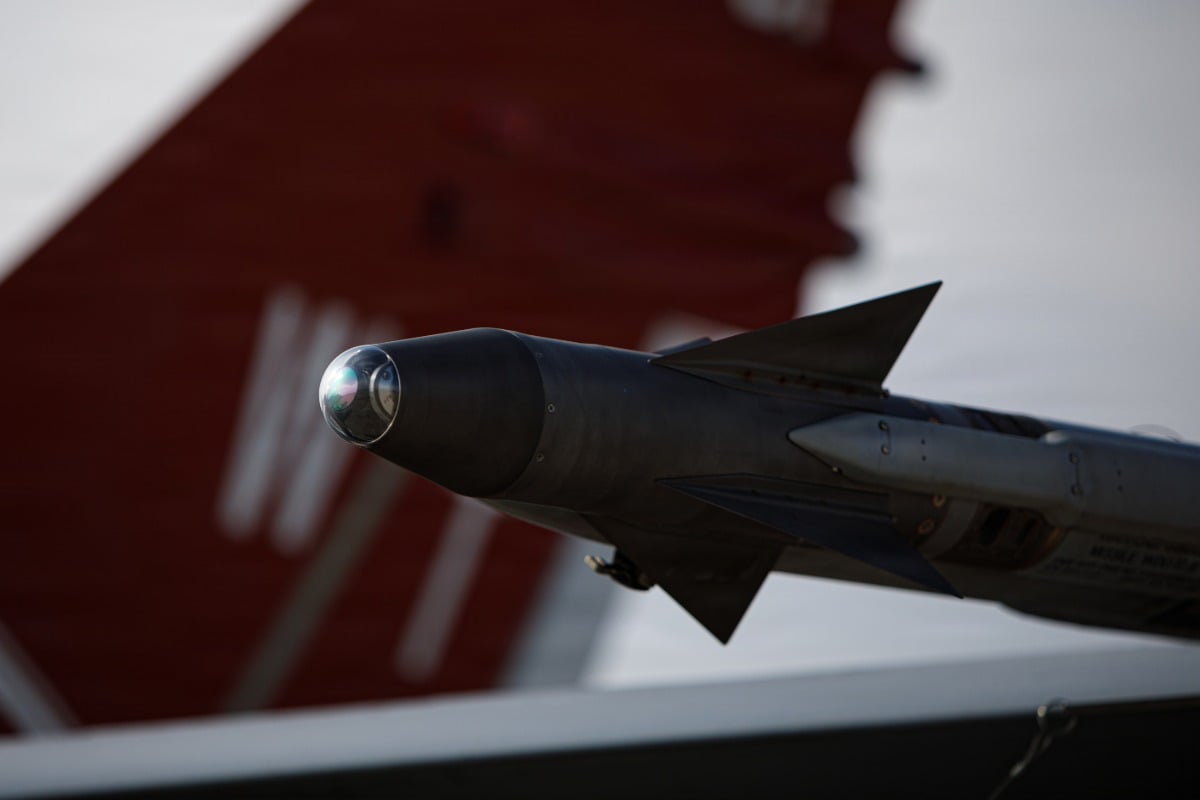
- Raytheon received a $1.1 billion contract modification to produce 1,653 AIM-9X Block II and 336 Block II+ missiles for U.S. services and foreign customers, completing by September 2029.
- Foreign military sales account for $744 million of the total contract value, reflecting global allied demand for the AIM-9X short-range air-to-air missile.
Raytheon has secured a $1.1 billion contract modification to produce nearly 2,000 AIM-9X Sidewinder air-to-air missiles for the U.S. Navy, Army, Air Force, and foreign military customers, cementing the latest production lot of America’s premier short-range dogfight missile as global demand continues to outpace manufacturing capacity.
The contract, awarded to Raytheon’s Tucson, Arizona facility and valued at up to $1.1 billion, covers production Lot 26 of the AIM-9X program, encompassing 1,653 AIM-9X-4 Block II tactical missiles for American military services, 336 AIM-9X-5 Block II+ missiles designated for foreign military sales, and an extensive range of training rounds, spare components, guidance units, and support equipment to sustain the missile system across its global user base.
Work is expected to complete by September 2029, drawing on funding from fiscal years 2024, 2025, and 2026 across Navy, Army, and Air Force missile procurement accounts, with the largest single funding source being foreign military sales customers contributing $744 million of the total obligated amount, a figure that reflects the AIM-9X’s status as one of the most widely exported American air-to-air missiles in service.
The AIM-9X Sidewinder is the latest evolution of a missile family that has been in continuous production since the early 1950s, making it one of the longest-running weapons programs in American military history. The original AIM-9 Sidewinder, developed by the Naval Weapons Center at China Lake, California, introduced the heat-seeking infrared guidance principle that remains central to the missile’s design seven decades later, though virtually every other aspect of the weapon has been transformed through successive generations of development. The AIM-9X Block II, which forms the bulk of this production lot, incorporates a digital fuse, a redesigned warhead, and a target detection device that together improve lethality against modern aircraft and guided weapons compared to the Block I configuration it succeeded. The Block II also introduced the ability to engage targets at angles far off the aircraft’s nose through integration with helmet-mounted cueing systems that allow pilots to designate targets simply by looking at them, a capability that fundamentally changed close-range aerial combat by removing the requirement for a pilot to maneuver the aircraft until the missile’s seeker head could physically point at the target.
The AIM-9X-5 Block II+ variant designated for foreign military sales in this contract represents a further development with enhanced electronic counter-countermeasures capability, designed to maintain effectiveness against adversaries deploying infrared countermeasures and advanced flare dispensing systems. The specific countries receiving the 336 Block II+ missiles were not identified in the contract announcement, consistent with the standard practice of not publicly disclosing foreign military sales recipients at the contract award stage, though the AIM-9X has been cleared for export to dozens of allied nations including most NATO members, Australia, Japan, South Korea, Taiwan, Saudi Arabia, and many others.
The training round complement in this production lot reflects the operational reality that missile proficiency requires extensive aircrew training that cannot be accomplished with live weapons. The contract covers 156 Captive Air Training Missiles, known as CATM-9X-4, which are inert versions of the missile that mount on aircraft and allow pilots to practice target acquisition and missile employment procedures through a realistic seeker display without releasing a live weapon. Seventeen multi-purpose training missiles and 57 Data Air Test Missiles round out the training inventory, along with 16 Special Air Training Missiles for specialized simulation requirements. Maintaining a robust training round inventory alongside the tactical missile stock is a logistical requirement that the contract addresses systematically rather than treating as an afterthought.
The production geography for this contract spans the American defense industrial supply chain with unusual breadth. Raytheon’s Tucson facility, which has been the primary AIM-9X final assembly location for the program’s history, accounts for 36 percent of the work value, while the remaining 64 percent distributes across facilities in Utah, Illinois, West Virginia, Oregon, California, Connecticut, Minnesota, Montana, Vermont, Ohio, and others, plus international supplier locations in Ontario, Canada, and Heilbronn, Germany. That geographic spread reflects both the complexity of the missile’s subsystems and the extent to which American defense production depends on specialized suppliers that have developed specific component manufacturing expertise over decades of program participation. The propulsion and steering sections, the advanced optical target detectors, the guidance units, and the electronics units each require specialized manufacturing capabilities that no single facility can replicate at scale.
At $744 million of the $1.1 billion total, foreign customers account for roughly two-thirds of the contract value, a proportion that reflects the global demand for short-range air-to-air missile capability among American allies who are modernizing their air forces in response to the same threat environment that has driven American procurement. NATO members expanding their air defense capacity, Indo-Pacific allies responding to Chinese military aviation growth, and Middle Eastern partners managing regional air threats all draw on the AIM-9X as a common capability that enables interoperability with American forces and access to the logistics and training infrastructure the United States maintains for the program globally.