

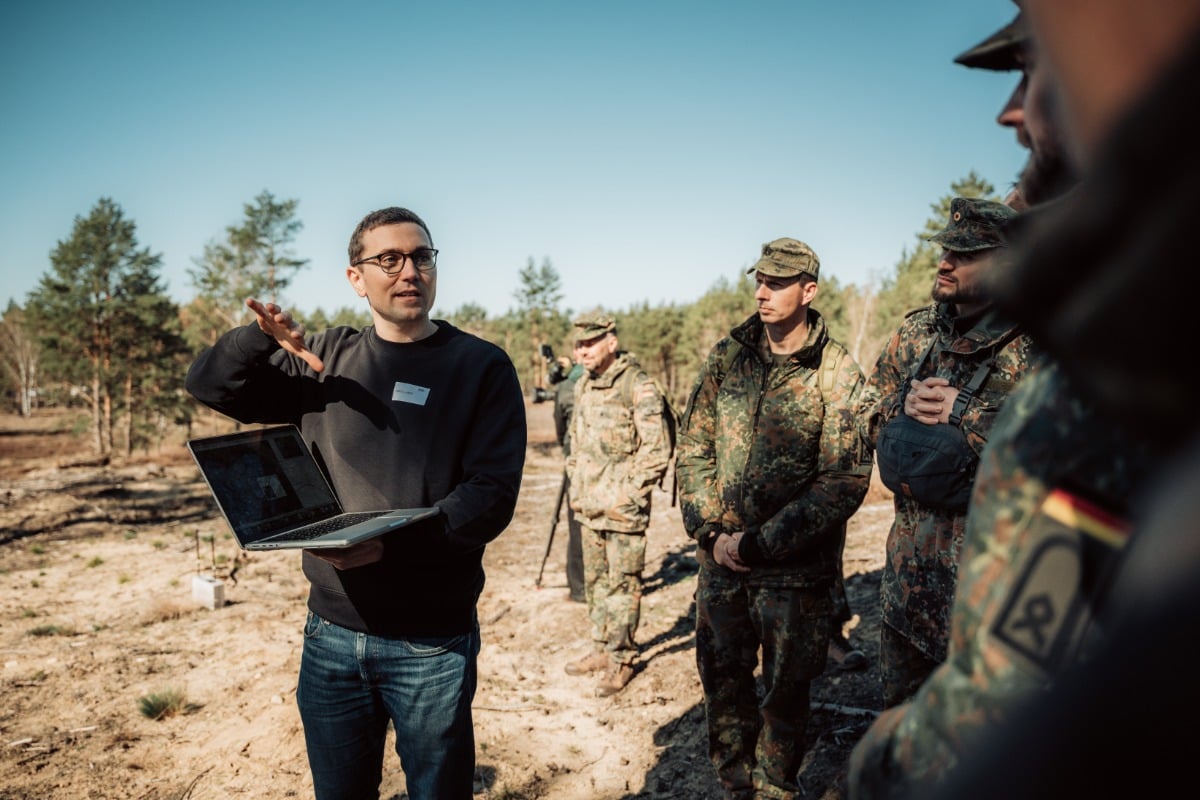
- SE3 Labs, a Munich-based spatial AI startup, emerged from stealth on June 26, 2026, with active Bundeswehr contracts and backing from Lakestar, Seedcamp, and the Sequoia Scout Fund.
- The company's platform provides GPS-denied autonomous navigation and shared 3D situational awareness across aerial and ground drone swarms controlled by a single operator.
A Munich-based artificial intelligence startup called SE3 Labs stepped out of stealth mode on June 26, 2026, announcing that its spatial AI platform is already under contract with the German Bundeswehr and operational in military exercises across Europe, where the company says it has reduced the time between detecting a target and engaging it by an order of magnitude.
The company’s core product is the software layer that sits between raw sensor data and meaningful action, giving unmanned systems the ability to understand three-dimensional space in real time and make decisions based on that understanding without continuous human input or a live satellite navigation link. That distinction matters because it addresses the central unsolved problem in military drone operations today: most unmanned aerial vehicles can follow a pre-programmed route or track a radio beacon, but they cannot reason about an environment they have never seen, adapt when that environment changes, or maintain orientation when GPS is jammed or spoofed. SE3’s platform, the company says, closes that gap.
The technical foundation rests on what the company calls visual-inertial odometry combined with real-time map matching, a navigation approach that uses cameras and inertial sensors to build and continuously update a spatial model of the surrounding environment without relying on satellite positioning. The method is well established in robotics research and has seen growing adoption in commercial autonomous systems, but deploying it reliably in the contested electromagnetic environments that characterize modern warfare, where GPS jamming and spoofing are routine tools of both state and non-state actors, presents engineering challenges that have kept most implementations in laboratory conditions. SE3 claims its system is already past that threshold and running in live operational settings with the Bundeswehr, Germany’s armed forces, though the press release does not specify which units or exercises are involved.
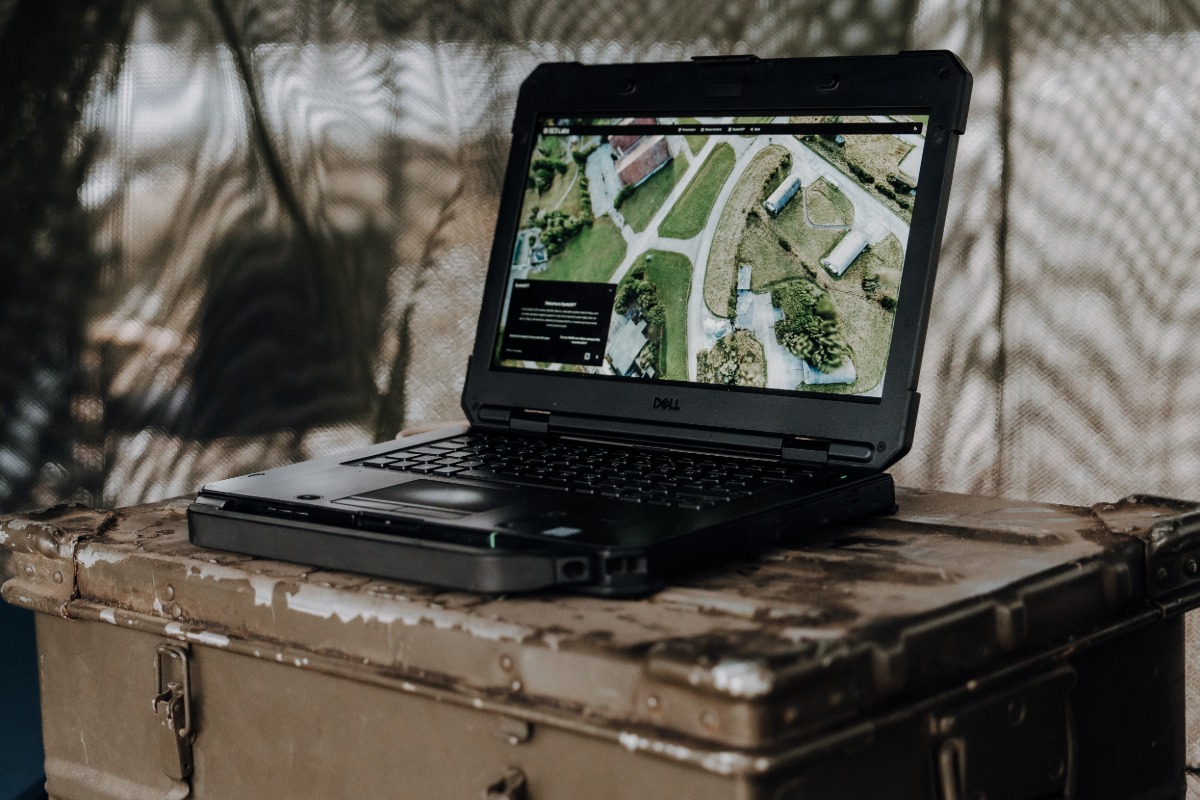
On top of the navigation layer, SE3 builds a perception stack that converts visual data into a continuously updated three-dimensional model of the operating environment, localizing objects in space to sub-meter accuracy and sharing that picture across an entire swarm of platforms in real time. The practical implication is significant: rather than each drone in a formation maintaining its own independent picture of the world, every platform in the swarm converges on the same shared spatial understanding, so a target identified by one unit is immediately available to all others without radio coordination delay or human relay. For an operator commanding that swarm, the interface is a live 3D common operating picture, controlled in natural language, meaning a commander speaks intent rather than issuing flight commands, and the system distributes that intent as coordinated behavior across multiple aerial and ground platforms simultaneously.
SE3 was founded by Lukas Koestler, who serves as CEO, Simon Klenk as chief technology officer, and Professor Daniel Cremers as chief science officer. Cremers holds the Chair for Computer Vision and Artificial Intelligence at the Technical University of Munich, one of Europe’s leading research institutions in the field, and brings credentials that are unusual in a defense startup context: he is president of the European Computer Vision Association, a director of the Munich Centre for Machine Learning, a member of the Bavarian Academy of Sciences and Humanities, and the recipient of the Gottfried Wilhelm Leibniz Prize, the highest distinction awarded in German academic research. The founding team collectively holds more than 400 published research papers with over 87,000 citations, a body of work that reflects deep roots in the academic computer vision community rather than the more common path of commercial software engineers pivoting into defense.
The rest of the team draws from a notable cross-section of autonomous systems and technology companies, with backgrounds spanning Nvidia, Tesla’s Autopilot program, Boston Consulting Group, Skydio (the American drone manufacturer that has supplied systems to multiple NATO militaries), and Isar Aerospace, the German rocket company developing small satellite launch vehicles for the European market. That combination of frontier research capability and operational deployment experience is precisely what defense procurement offices have been seeking in dual-use AI startups, and it likely explains how SE3 secured Bundeswehr contracts before emerging publicly.
“Advances in AI have enabled machines to understand language. The next step is enabling them to understand the physical world,” said Lukas Köstler, CEO and co-founder of SE3. “We’re building the category leader in Spatial AI. Our technology unlocks a new generation of autonomous systems that can operate reliably in real-world conditions across defense, public safety, and industrial applications.”
The investment backing SE3 reflects the same convergence of defense-oriented and mainstream venture capital that has characterized European defense technology funding since Russia’s full-scale invasion of Ukraine in 2022 accelerated political and financial appetite for homegrown military capability. Lakestar and Seedcamp led the round, joined by EWOR, the Sequoia Scout Fund, UnternehmerTUM Funding for Innovators, and a collection of strategic angels that includes the founders of Flixbus and the founders of Ascending Technologies, a German drone company acquired by Airbus in 2017 that pioneered multirotor platforms for industrial inspection. The specific funding amount was not disclosed.
Dr. Klaus Hommels, founder and chairman of Lakestar, articulated the strategic rationale that sits behind the investment in terms that go well beyond financial return. “Europe’s sovereignty depends on its ability to build and scale the critical capabilities that will define the next era of defence. SE3 is developing one of those capabilities, and we believe it will be essential to Europe’s security, resilience and technological independence,” Hommels said.
Carlos Eduardo Espinal, managing partner at Seedcamp, offered a technical framing that cuts to the heart of what differentiates SE3’s approach from the broader category of perception and autonomy software. “Perception alone doesn’t make a system autonomous. The harder problem is discernment: knowing what matters, separating urgent from merely important, ranking intentions against the mission and the environment. Without that layer, more sensors just produce more noise. SE3 is building the discernment layer for physical AI,” Espinal said.
The sensor-to-shooter timeline reduction SE3 claims, described in the press release as an improvement by an order of magnitude, would represent a compression from minutes to seconds in the decision cycle that currently separates target detection from authorized engagement in drone operations. That compression has been one of the defining operational goals of Western militaries observing drone warfare in Ukraine and other theaters, where the speed of the engagement cycle has repeatedly proved more decisive than the sophistication of individual platforms. Whether SE3’s system delivers that compression consistently across different terrain types, threat environments, and operational conditions remains a question that combat deployments will eventually answer more definitively than any exercise can.