

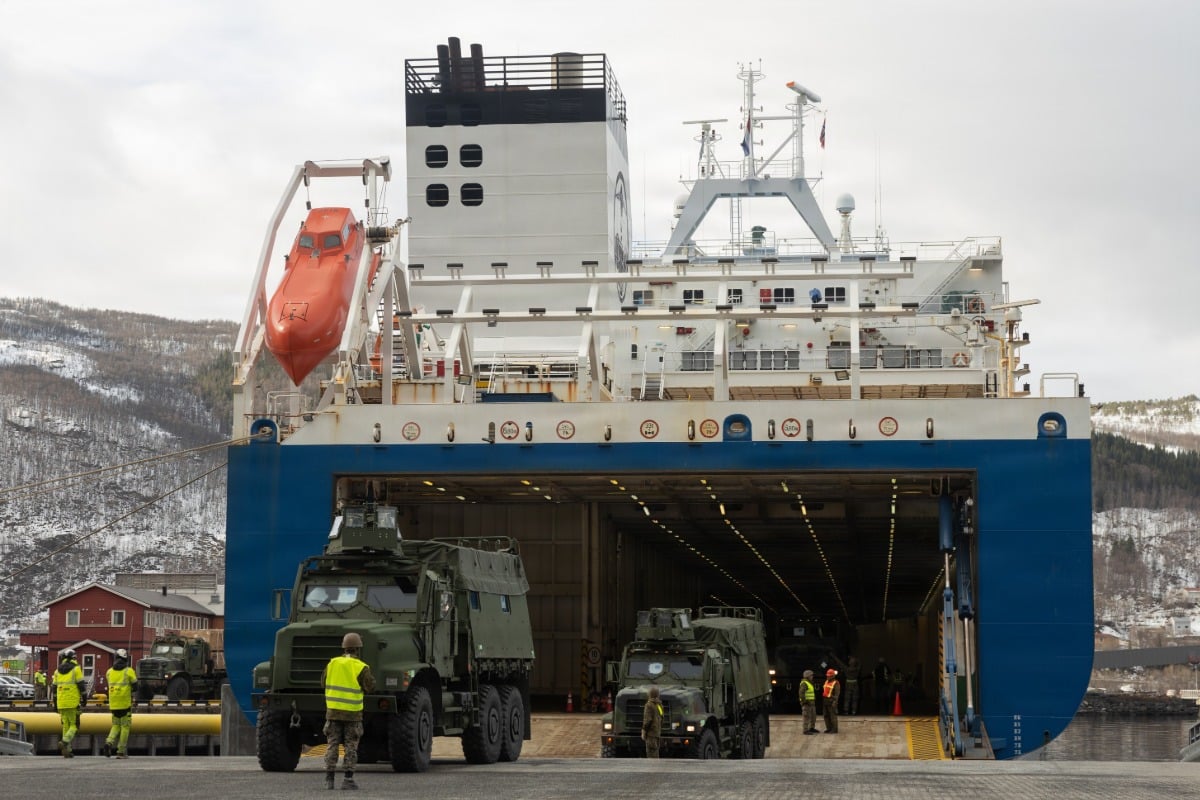
- Military Sealift Command awarded Schuyler Line Navigation a $37 million contract for four roll-on/roll-off bow ramp vessels operating from Naha, Japan, beginning July 30, 2026.
- The 180-day charter includes one 180-day option that would extend operations through July 2027 and raise total contract value to approximately $60 million.
The U.S. Navy has hired four civilian cargo ships capable of driving military vehicles directly onto beaches and island piers without fixed port infrastructure, chartering them for operations out of Naha, Japan, starting July 30, 2026, in a $37 million contract that tells a precise story about how seriously American military planners are taking the logistics challenge of fighting a distributed island campaign in the Pacific.
The contract, awarded to Schuyler Line Navigation Co. LLC of West Palm Beach, Florida, by the Military Sealift Command, the Navy’s logistics and transportation arm that keeps American forces supplied across every ocean, covers a 180-day time charter of four U.S.-flagged roll-on/roll-off bow ramp vessels, with a single 180-day option that, if exercised, would extend operations through July 24, 2027, and raise the total contract value to approximately $60 million. Roll-on/roll-off, universally shortened to RoRo in maritime logistics, describes vessels that carry wheeled or tracked cargo that drives aboard under its own power rather than being lifted by crane, the same basic concept as a car ferry but scaled to carry main battle tanks, armored vehicles, artillery systems, helicopters, and the full range of military ground equipment. Bow ramp capability adds the ability to unload directly onto a beach or a simple pier, rather than requiring a dedicated deep-water berth with shore-side loading equipment. A vessel with both features can, in principle, put military cargo ashore almost anywhere there is water deep enough to approach.
Naha, the capital of Okinawa Prefecture and home to the Naha Port Facility, is the primary U.S. military logistics node on Okinawa, managed by the U.S. Army’s 835th Transportation Battalion and Military Sealift Command Okinawa, a sub-command of MSC Far East headquartered in Singapore. The port sits at roughly 26 degrees north latitude in the East China Sea, placing it approximately 600 kilometers (373 miles) northeast of Taiwan and within a few hundred kilometers of the Ryukyu island chain, the arc of Japanese territory that stretches southwest from Okinawa toward the Taiwan Strait and that American and Japanese military planners have spent the past several years converting into the backbone of a forward defense architecture against Chinese military action. The port’s channel was dredged in 2019 to accommodate up to 26 medium roll-on/roll-off vessels, an investment that was explicitly aimed at enabling the kind of sealift surge the current contract represents.
The four vessels specified in the contract are described only in terms of their minimum functional requirements: each must provide at least 2,100 square feet (195 square meters) of cargo space individually, with the combined fleet offering no less than 12,600 square feet (1,170 square meters) total. That is a relatively modest capacity compared to large military sealift ships, which can carry hundreds of thousands of square feet of cargo, but the specification is calibrated for a different operational concept. The Marine Corps’ 12th Marine Littoral Regiment, which operates out of Okinawa and received its full weapons complement in June 2026, is built around small, dispersed units that need to move equipment and supplies between islands quickly and without the overhead of large amphibious ship operations. A small RoRo vessel that can dock at a fishing pier, unload a few trucks and trailers, and move on is a far more operationally flexible tool for that mission than a Wasp-class amphibious assault ship that requires a full logistics tail to operate.
The operational concept that the Naha charter supports has a formal name in Marine Corps doctrine: Expeditionary Advanced Base Operations, or EABO, the approach that positions small Marine units on islands throughout a contested maritime area to provide sensor coverage, fires, and logistics nodes without concentrating forces in locations that a potential adversary could strike with precision missiles. The 12th Marine Littoral Regiment’s Littoral Logistics Battalion has been developing the inter-island resupply capability the concept requires, using both conventional vessels and, as of 2025, the Autonomous Low-Profile Vessel developed by Leidos, a semi-submersible unmanned boat that conducted three-day supply missions through the Ryukyu Islands during Exercise Resolute Dragon 2025 before being halted short of Yonaguni Island, the westernmost point of Japanese territory located approximately 110 kilometers (68 miles) from Taiwan’s coast. The chartered RoRo vessels would provide a conventional, higher-capacity complement to those unmanned logistics efforts.
Nine companies submitted proposals in response to the competitive solicitation posted on the Government Point of Entry procurement website, a level of industry interest that reflects the active chartering market for small RoRo vessels in the Pacific and the Navy’s willingness to pay commercial rates for access to U.S.-flagged tonnage. Department of War policy requires Military Sealift Command to first seek U.S.-flagged commercial ships before turning to government-owned vessels, both to support the domestic maritime industry and to ensure that the U.S. flag fleet, which can be requisitioned for national defense in a crisis, remains commercially viable in peacetime. The contract’s $37 million base value and $60 million ceiling represent competitive commercial charter rates for four specialized vessels over a year of operations in a demanding theater.
Naha Port’s position in Okinawa enables the swift transit of naval assets, including amphibious ships and cargo vessels, to hotspots such as the Taiwan Strait, which lies approximately 600 kilometers to the southwest, allowing response times measured in days rather than weeks, according to an analysis of the facility published by Grokipedia drawing on U.S. military planning documents. That proximity is what makes Naha the right place to base this contract, rather than Yokosuka, Sasebo, or Guam: the four chartered vessels will be positioned to move rapidly into the island chain in either direction, north toward the Japanese home islands or southwest toward the chokepoints that any Pacific contingency would involve.
More than 90 percent of U.S. military equipment and supplies travels by sea, according to Military Sealift Command, and in a theater defined by island chains, contested straits, and distances measured in thousands of miles, the ability to move cargo between islands quickly, flexibly, and with minimal dependence on fixed port infrastructure is not a logistics convenience.