

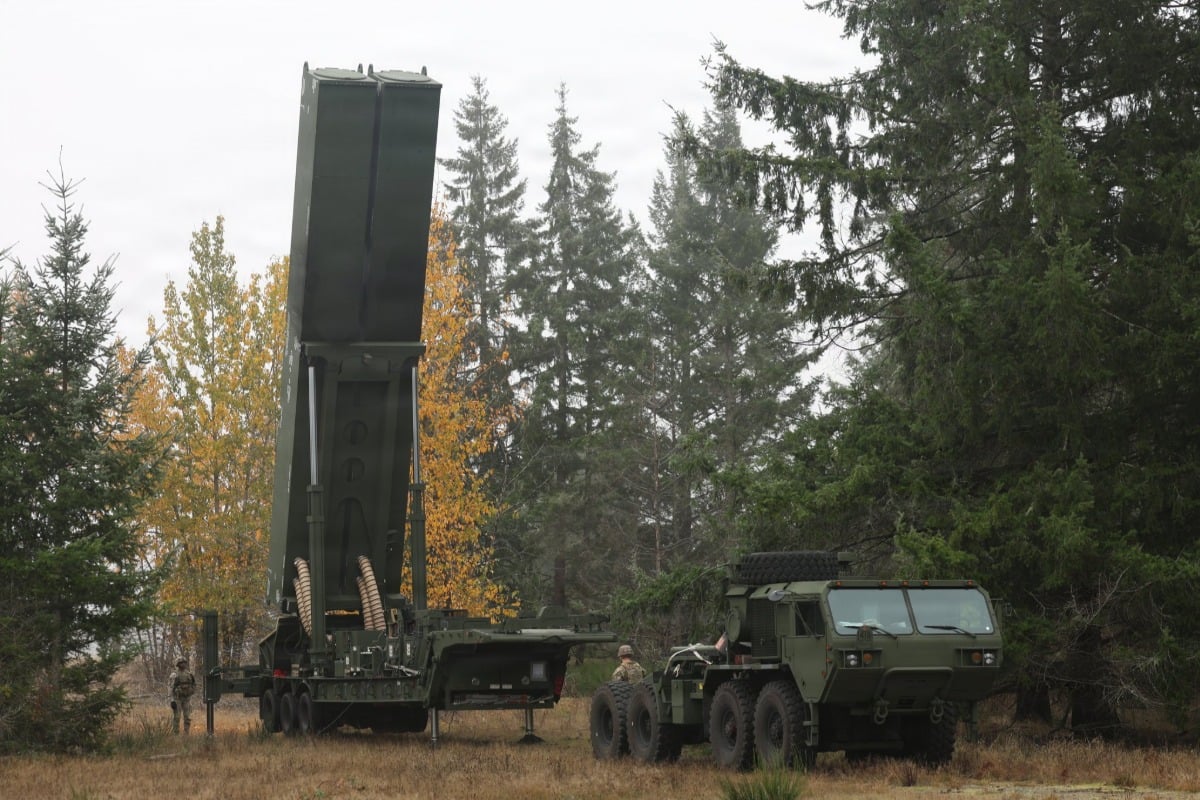
- The Navy awarded Lockheed Martin Space an $83 million contract modification on June 22, 2026, to procure additional hypersonic All-Up Rounds satisfying U.S. Army requirements under the Conventional Prompt Strike program.
- Work spans production sites across seven U.S. states and runs through June 2029, funded by $79 million in Army missile procurement appropriations obligated at award.
The U.S. Army is getting more hypersonic missiles, after the Navy awarded Lockheed Martin Space an $83 million contract modification on June 22, 2026, to procure additional All-Up Rounds under the Conventional Prompt Strike program satisfying Army requirements, with nearly the entire contract value funded by Army missile procurement appropriations and work running through June 2029 across production sites in seven states.
The contract, managed by the Navy’s Strategic Systems Programs office in Washington and awarded as a sole-source acquisition reflecting Lockheed Martin’s unique position as the program’s prime contractor, is a production action rather than a development one. All-Up Rounds, a term used across missile programs to describe fully assembled, ready-to-fire weapon systems as opposed to individual components or test articles, represent the actual weapons the Army will load onto its launcher vehicles and fire in combat. Ordering more of them means the Army is building its operational inventory, not running more tests.
The weapon these rounds belong to is the Long-Range Hypersonic Weapon, which the Army has named Dark Eagle, a ground-launched hypersonic missile system that shares its core technology with the Navy’s Conventional Prompt Strike program through a jointly developed component called the Common Hypersonic Glide Body. The glide body is the most technically demanding part of the weapon: an unpowered vehicle that separates from its two-stage solid-fuel rocket booster after the booster accelerates it to hypersonic speed, then guides itself to its target by maneuvering through the upper atmosphere at speeds exceeding Mach 5, roughly 6,100 kilometers per hour (3,800 mph), while enduring the extreme heat generated by that velocity.
Lockheed Martin builds the booster and assembles the complete missile system. Dynetics, an Alabama-based defense technology company and subsidiary of Leidos, developed the glide body itself.
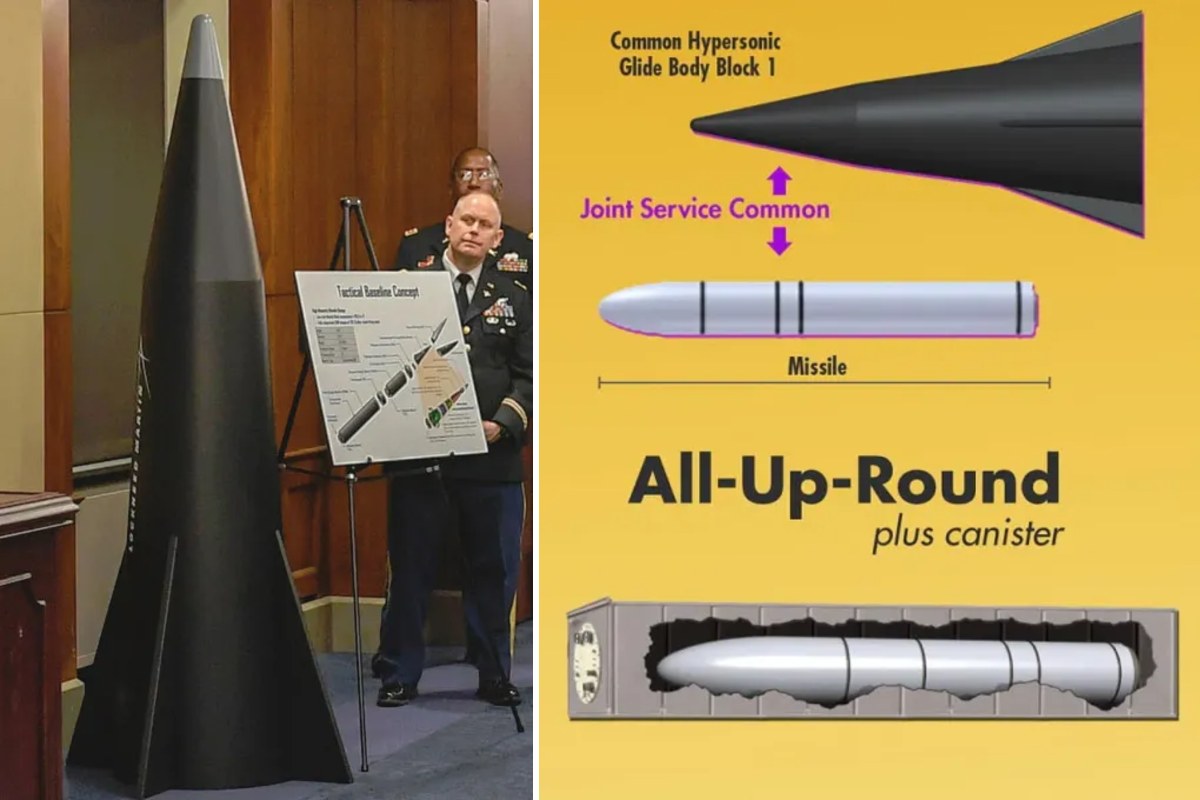
Building a single Common Hypersonic Glide Body design that both services can use reduces the total development investment required, allows testing to benefit both programs simultaneously, and creates production volume that drives unit costs down over time. The Army’s Dark Eagle and the Navy’s Conventional Prompt Strike are in this sense two versions of the same fundamental weapon, launched from different platforms and managed by different service acquisition chains, but drawing from the same industrial base and the same core engineering.
The Army intends to deploy the Dark Eagle in eight-missile batteries, each consisting of four M983 trucks and trailers carrying two missiles each in sealed launch canisters, alongside a command vehicle, giving each battery a complete self-contained launch capability that can disperse, hide, and fire from positions not tied to fixed infrastructure. That mobility is the Army’s answer to one of hypersonic weapons’ most significant tactical constraints: because the missiles are expensive and produced in limited quantities, they cannot be wasted on targets that conventional weapons could handle. Concentrating them in mobile batteries that can reposition rapidly after firing reduces the risk of the launchers being struck in retaliation before they can move.
The work spread across the June 22 contract modification covers seven specific locations across five states, with Lockheed’s Denver, Colorado facility taking the largest share at 31 percent, followed by Magna, Utah at 26 percent, Cortland, Alabama at 14 percent, Simsbury, Connecticut at 10 percent, and two New York facilities in East Aurora and Owego splitting 14 percent between them, with Sunnyvale, California accounting for 2 percent and various other locations covering the remainder. That geographic spread reflects the depth of the specialized industrial supply chain hypersonic weapons require: thermal protection materials, solid-fuel propellants, precision guidance electronics, and structural components manufactured to tolerances that no single facility can handle alone.
The Conventional Prompt Strike program successfully completed a flight test on December 12, 2024, overcoming a prior failure in June 2022 that set the program back and triggered a reassessment of the booster design. That successful test validated the complete weapon system and cleared the path for the production ramp now reflected in the June 22 contract action. Navy officials have said CPS testing is scheduled to begin aboard the Zumwalt-class destroyer USS Zumwalt in 2027 or 2028 following issues with land-based testing that delayed the original fielding timeline, while the Army’s Dark Eagle program has been working toward its own fielding schedule with the 5th Battalion, 3rd Field Artillery Regiment at Joint Base Lewis-McChord, Washington, designated as the first Dark Eagle unit.
The strategic rationale for hypersonic weapons is straightforward and has been articulated consistently by Department of War officials across multiple administrations: existing long-range precision strike weapons, even the most capable cruise missiles, fly at subsonic or low supersonic speeds that advanced adversary air defense systems, including China’s HQ-9 and Russia’s S-400 family, can engage with reasonable probability of success given sufficient warning time. A weapon flying at Mach 5 or faster on a maneuvering trajectory that does not follow a predictable ballistic arc presents a fundamentally different defensive problem. The intercept window is measured in seconds rather than minutes, the trajectory is unpredictable, and no currently fielded adversary air defense system has demonstrated the ability to reliably engage a maneuvering hypersonic glide vehicle at operational ranges.
In April 2026, Lockheed Martin received a $1.36 billion contract modification under the same contract number, N00030-22-C-1025, covering missile and launch platform production, systems integration, and long-lead materials through October 2032, according to Inside Defense, with funding drawn jointly from Army and Navy appropriations. The June 22 action is a separate, smaller procurement specifically targeting Army All-Up Round inventory, funded almost entirely from Army Missile Procurement funds rather than research and development accounts, a distinction that signals the Army is buying weapons for its stockpile rather than hardware for testing.
On April 29, 2026, U.S. Central Command requested that the Dark Eagle be sent to the Middle East for potential deployment against Iran during the 2026 Iran war, marking what would have been the first operational deployment of the technology, according to Bloomberg, which reported that CENTCOM made the request after Iran moved its missile launchers out of range of the Army’s Precision Strike Missile, the conventionally armed ballistic missile currently deployed in the region. Whether Dark Eagle rounds were ultimately deployed to the Middle East has not been confirmed by official sources, but the request itself confirms that military commanders regard the system as operationally ready for contingency use. The June 22 contract to procure additional All-Up Rounds is, in that context, a program catching up to the operational demand already being placed on it.