

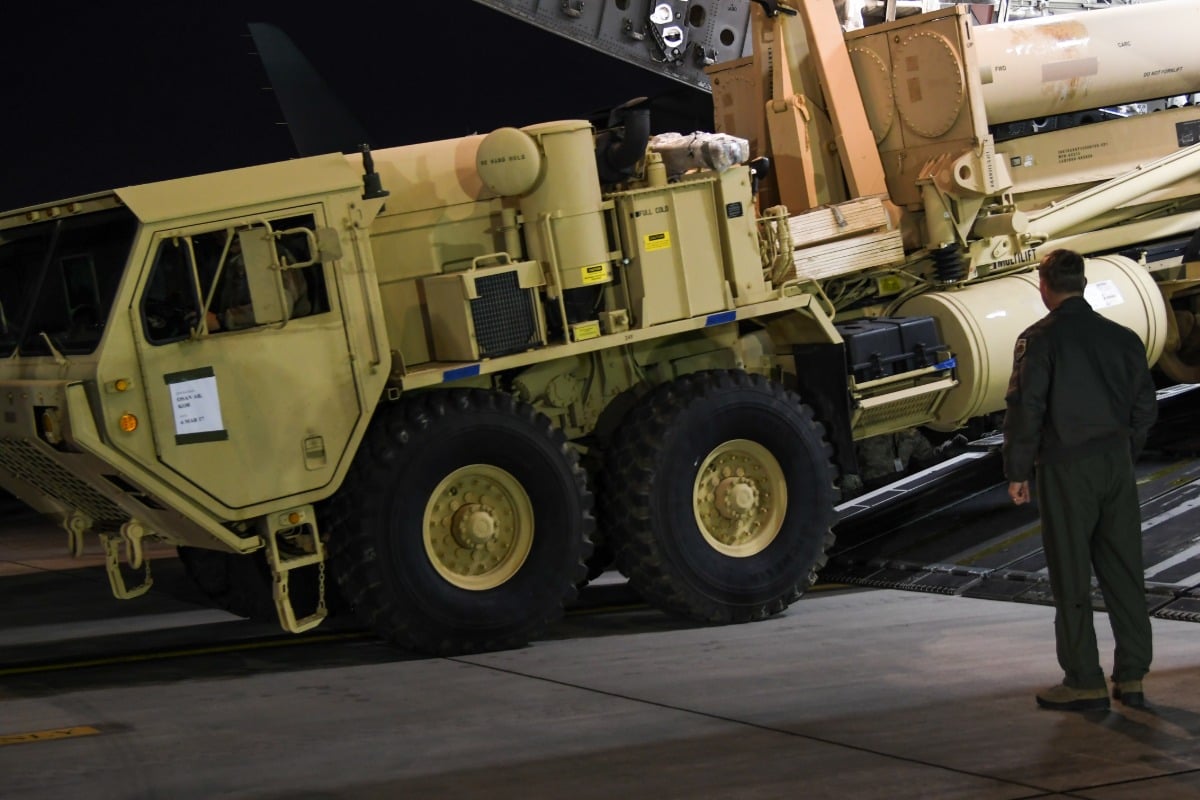
- All six THAAD launcher vehicles returned to Seongju base in South Korea by June 21, 2026, after moving to Osan Air Base in March, Yonhap reported.
- USFK Commander Gen. Xavier Brunson told the Senate in April that no THAAD system left South Korea, confirming only interceptor missiles were transferred.
All six truck-mounted launchers belonging to the U.S. Army’s only THAAD battery in South Korea have returned to their home base in Seongju County, ending a three-month deployment to Osan Air Base that sparked months of speculation about whether Washington was stripping the Korean Peninsula of missile defenses to support its military campaign against Iran, Yonhap News Agency reported Sunday.
The return of all six launcher vehicles to the Seongju base, confirmed through photographs released by Yonhap on June 21, closes the most visible chapter of a controversy that began in early March 2026, when the launcher trucks were first observed departing Seongju for Osan Air Base in Pyeongtaek, a facility located approximately 60 kilometers (37 miles) south of Seoul that regularly handles large U.S. military transport aircraft including the C-5 Galaxy and C-17 Globemaster, both capable of airlifting heavy military equipment over intercontinental distances. The movement immediately raised alarm in Seoul, Pyongyang watchers, and allied defense establishments across the Indo-Pacific, because the Seongju THAAD battery is South Korea’s only high-altitude missile defense system capable of intercepting ballistic missiles during the terminal phase of flight, and its potential removal, even partial, would create a gap in the layered defense architecture protecting American forces and South Korean cities from North Korean ballistic missiles.
THAAD, which stands for Terminal High Altitude Area Defense, is a mobile ground-based missile defense system built by Lockheed Martin that intercepts short-, medium-, and intermediate-range ballistic missiles at altitudes between 40 kilometers (25 miles) and 150 kilometers (93 miles), above the atmosphere where conventional air defense systems cannot reach and where the destructive effects of a nuclear or chemical warhead would be minimized even if the intercept occurs outside the atmosphere entirely. A single THAAD battery consists of six truck-mounted launchers, each carrying eight interceptor missiles in sealed canisters, a fire control and communications element that processes engagement solutions, and the AN/TPY-2 X-band radar, developed by Raytheon, which detects and tracks incoming ballistic threats at ranges sufficient to provide early warning and targeting data. At full capacity, the Seongju battery holds 48 interceptor missiles across its six launchers, enough to engage multiple simultaneous threats in a compressed engagement timeline.
The system was deployed to Seongju in 2017 following sustained North Korean ballistic missile testing that included successful tests of intermediate-range missiles capable of reaching U.S. military bases in Japan and Guam, and continued development of intercontinental ballistic missile technology. The deployment triggered diplomatic protests from China and Russia, both of which argued that the AN/TPY-2 radar’s long-range detection capability could be used to collect surveillance data on their own military activities well beyond the Korean Peninsula, a technical capability the radar possesses but which U.S. and South Korean officials consistently described as irrelevant to the system’s defensive purpose.
What the March 2026 launcher movement actually involved, according to the most credible reconstructions from South Korean and American reporting, was not the removal of the THAAD system itself but a carefully managed transfer of interceptor missiles. According to military sources cited by the Seoul Economic Daily, the six THAAD launch vehicles moved from Seongju to Osan Air Base, where they unloaded only their interceptor missiles before returning, meaning that if all six vehicles transported their full payload, up to 48 interceptor missiles would have been moved to Osan and staged for airlift to the Middle East. The launchers themselves, the radar, and the fire control element never left South Korea, which is why U.S. Forces Korea Commander General Xavier Brunson was able to tell the Senate Armed Services Committee on April 21 with technical accuracy that no THAAD system had been moved.
“We have not moved any THAAD system,” Brunson told senators. “THAAD remains on the Korean Peninsula.”
Brunson added that the United States was sending munitions forward and that they were “sitting right now waiting to move,” a careful formulation that distinguished between the interceptor missiles, which were being transferred, and the broader system, which remained in place. That distinction matters because a THAAD launcher without interceptor missiles is a truck with empty tubes, operationally useless until reloaded, while the radar and fire control element retain their detection and tracking capability regardless of launcher status.
The reason for the interceptor transfer points directly to the intensity of the U.S.-Iran conflict that began in early 2026. On March 6, an unnamed U.S. official told The Wall Street Journal that the Pentagon was rushing to replace a THAAD radar damaged in an Iranian-backed drone strike in Jordan, and four days later The Washington Post reported that the Pentagon was moving THAAD system components from South Korea to the Middle East. Iran and Iranian proxy forces had conducted sustained ballistic missile and drone attacks against U.S. military bases across the Middle East, depleting the interceptor inventories of THAAD batteries already deployed in the region. Replenishing those batteries required drawing from available stockpiles elsewhere, and the Seongju battery represented one of the more accessible sources of THAAD interceptors in the U.S. global inventory.
The decision to strip interceptors from a battery defending against North Korea to replenish batteries defending against Iran reflects the zero-sum reality of American missile defense stockpiles in 2026, a problem that defense analysts have flagged for years without producing the industrial surge needed to address it. THAAD interceptors are produced by Lockheed Martin at a rate that has never kept pace with the system’s expanding global deployment, and the Iran conflict accelerated consumption at a rate that forced uncomfortable choices about where to accept risk. South Korea accepted that risk for the duration of the transfer, banking on the judgment that North Korea would not choose the weeks of the Iran conflict to conduct a major ballistic missile attack on the peninsula.
The full THAAD battery has now returned to Seongju after a temporary move to Osan sparked speculation about a possible Middle East deployment, and U.S. Forces Korea declined to comment on the specific movements, citing operational security, while directing media to Brunson’s Senate testimony for guidance on the command’s posture. South Korean Defense Minister Ahn Gyu-back said during a May meeting with correspondents in Washington that Seoul and Washington had not discussed transferring the THAAD system itself, a statement consistent with what the physical evidence ultimately showed.
Whether the Seongju battery has been reloaded with a full complement of 48 interceptor missiles following the return of its launchers is not publicly known, and U.S. Forces Korea has not addressed the question. A launcher that has returned to base is not necessarily a launcher that is combat-ready at full capacity, and the gap between a truck returning and a tube being reloaded is a question that carries real operational weight on a peninsula where North Korea maintains one of the world’s largest ballistic missile arsenals.