

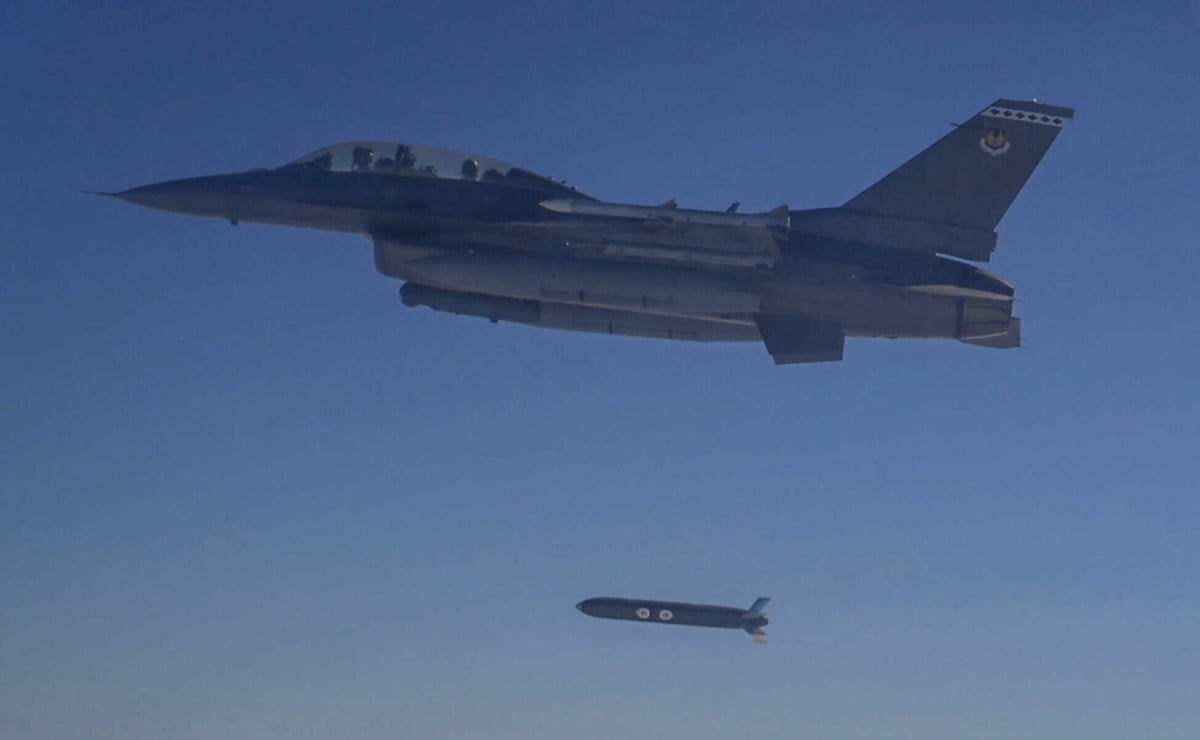
- A Russian Telegram channel claims Ukraine used AGM-188 Rusty Dagger missiles to strike the Sborka plant in Voronezh; the claim is unconfirmed by official sources.
- The AGM-188A, developed by Zone 5 Technologies for Ukraine, has a reported range exceeding 930 km; the first delivery batch of 840 missiles is scheduled for October 2026.
A Russian military-affiliated Telegram channel claims Ukraine used U.S.-supplied AGM-188 Rusty Dagger cruise missiles to strike the Sborka semiconductor plant in Voronezh, a claim that, if confirmed, would represent the first documented combat use of a weapon system the United States designed from scratch specifically to give Ukraine a mass-producible long-range strike capability at a fraction of the cost of conventional cruise missiles.
The claim comes from the channel “Voevoda Broadcasts,” cited by the Status-6, and has not been independently verified or confirmed by either the Ukrainian or American governments at time of publication.
The AGM-188A Rusty Dagger is a turbojet-powered, air-launched, precision-guided standoff munition developed by Zone 5 Technologies under the U.S. Air Force’s Extended Range Attack Munition program, a procurement effort the Air Force launched in early 2024 with an explicit primary purpose: to provide Ukraine with affordable, mass-producible long-range strike weapons faster than existing programs could deliver them. The missile is a hybrid between a conventional cruise missile and a guided aerial bomb, fitting within the size and weight envelope of a standard 500-pound (227-kilogram) Mk 82 unguided bomb, which means any aircraft currently capable of carrying that bomb can potentially carry the Rusty Dagger without significant modification to the weapon station.
Zone 5 Technologies won the ERAM contract in March 2025. By January 2026, the company had conducted a live-warhead test at Eglin Air Force Base in Florida, detonating a fully armed Rusty Dagger against a target and meeting all primary test objectives. By April 2026, an F-16D assigned to the 40th Flight Test Squadron at Eglin had carried the missile through captive-carry evaluations, fit and function checks, and an airborne release trial over the Gulf of Mexico, during which the weapon demonstrated controlled separation from the aircraft and completed its programmed flight profile. Lt. Col. Brett Tillman, commander of the 780th Test Squadron, described the team’s ability to “safely test and deliver a critical capability at incredible speed.”
The first production batch of 840 ERAM missiles is planned for delivery in October 2026, with Ukraine cleared to purchase up to 3,350 missiles including spares and support equipment for an estimated total cost of $825 million. That approved sale, announced by the Defense Security Cooperation Agency in August 2025, covered missiles produced by both Zone 5 Technologies and CoAspire, the two companies selected to participate in the ERAM program. Whether any missiles from an earlier test or pre-production batch reached Ukraine before the October delivery schedule is not confirmed in open sources, though U.S. official Kyle Bass wrote on social media in May 2026 that ERAM was “already on its way,” a statement that Defense Express and other outlets flagged as potentially indicating earlier-than-scheduled deliveries without official confirmation.
The AGM-188A Rusty Dagger is reported to have a range of more than 930 kilometers (578 miles), more than double the original ERAM requirement of 460 kilometers (286 miles), while reportedly weighing only about 200 kilograms (441 pounds) including a 45-kilogram (99-pound) warhead. That warhead mass is modest by cruise missile standards, roughly comparable to the warhead carried by a Russian Shahed-136 kamikaze drone, but the missile’s precision and standoff range compensate for what its warhead lacks in raw explosive power. A target struck by a weapon that arrives from 930 kilometers away, launched from an F-16 flying well behind the front line, has no practical defense against that combination of range, speed, and accuracy using the air defense systems Russia currently fields in depth.
The operational significance of the Rusty Dagger for Ukraine’s F-16 fleet is substantial and was the explicit design rationale from the program’s inception. Ukraine has operated F-16 Fighting Falcon multirole fighters, the American fourth-generation jet that has served as the backbone of dozens of air forces worldwide since the 1970s, since receiving its first examples from European NATO allies in 2024. The aircraft gave Ukraine a capable platform, but its standoff strike options remained constrained by the range of available weapons. Storm Shadow cruise missiles, jointly produced by Britain and France and already in Ukrainian service, have a range of approximately 560 kilometers (348 miles) and have been used to strike targets in occupied Crimea and deep in Russian-held territory. The Rusty Dagger, at more than 930 kilometers (578 miles) of reported range, would extend that reach considerably further while costing significantly less per unit, enabling Ukraine to field the weapons in volumes that more expensive systems cannot match.
Because the AGM-188A can reportedly be launched from any aircraft capable of employing JDAM-guided munitions, a squadron of 12 F-16 Fighting Falcon fighters could theoretically launch as many as 144 ERAM cruise missiles in a single sortie, creating a saturation attack capability that Russian air defenses would struggle to absorb. That scale of employment is what the ERAM program was built to enable, and it is why the program’s primary purpose was publicly described as supporting Ukraine even before a contract had been awarded.
Voronezh sits approximately 500 kilometers (310 miles) from the Ukrainian border, a distance well within the range of multiple weapons systems Ukraine already operates, including Storm Shadow, various drone types, and Ukrainian-produced cruise missiles such as the Neptun and Flamingo variants. The Sborka semiconductor plant in Voronezh, which Ukraine’s Main Intelligence Directorate has documented as a supplier of precision electronic components to the Kh-101 cruise missile, the Iskander-K ballistic missile complex, and the Pantsir-S1 air defense system, represents exactly the kind of high-value, specific target that a precision standoff weapon is designed to engage: a facility that is neither a large industrial complex nor a hardened military installation, but a specialized node in a supply chain where a single well-placed hit produces consequences far beyond the immediate physical damage.
Whether the weapon that hit Sborka was an AGM-188A Rusty Dagger, a Storm Shadow, a Ukrainian-produced missile, or something else entirely remains unconfirmed. The Russian channel making the claim has an interest in attributing the strike to an American-supplied weapon, because doing so serves a narrative about Western escalation that Russian state media has pursued consistently throughout the war. That does not make the claim false, but it is a reason to treat it as unverified until Ukrainian or American sources either confirm or deny it. What is not in question is that a weapon of this description exists, that Ukraine is its intended primary user, and that the Voronezh plant it allegedly struck was a legitimate military target by any definition of that term.