

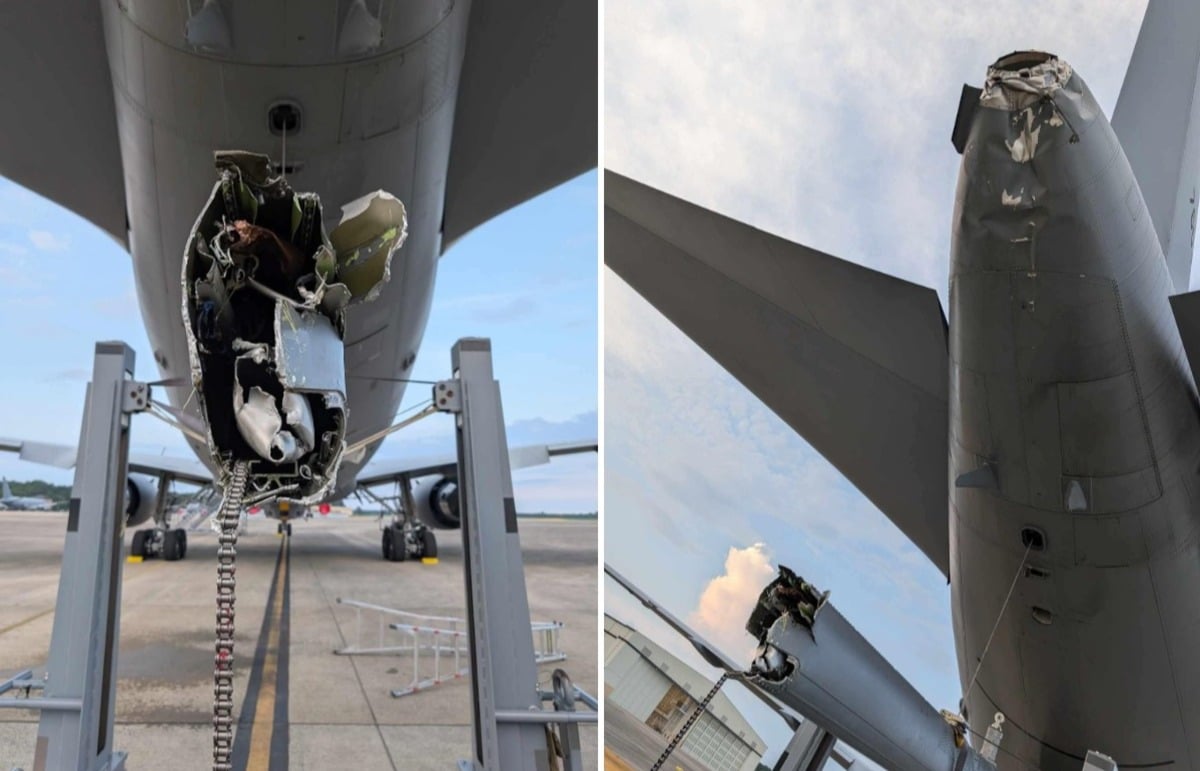
- The official U.S. Air Force Accident Investigation Board report confirmed a KC-46A boom separated over the Atlantic on July 8, 2025, causing $9,979,567 in damage to the tanker.
- The board identified boom operator control inputs as the primary cause while acknowledging a known Category 1 stiff boom deficiency was applicable to the accident.
A known design flaw in the U.S. Air Force’s newest and most expensive aerial refueling tanker has now contributed to four separate midair accidents since 2022, including two incidents where the aircraft’s refueling boom, a 15-meter (50-foot) telescoping arm worth millions of dollars, was torn completely off the plane and fell into the ocean, Task & Purpose reported on June 16, 2026, citing a newly released Air Force accident investigation report that The Defence Blog has reviewed in full.
The aircraft at the center of the recurring problem is the KC-46A Pegasus, a Boeing-built tanker based on the 767 commercial widebody airliner that the Air Force purchased to replace its aging KC-135 Stratotanker fleet, which has been in service since the late 1950s. The KC-46A cost approximately $239 million per aircraft and was intended to be a generational upgrade in aerial refueling capability, bringing modern avionics, a remote vision system for boom operators, and improved fuel transfer capacity to the tanker mission. Instead, the aircraft has become a case study in how a known, unfixed mechanical defect can compound over time into a pattern of accidents that investigators keep attributing to individual crew members while the underlying problem remains unresolved.
The July 2025 accident documented in the official Accident Investigation Board report, signed by board president Colonel Kevin E. White on May 20, 2026, and approved by Major General Gerald A. Donohue on June 10, 2026, occurred on July 8, 2025, during a training mission approximately 160 kilometers (100 miles) off the coast of Virginia. A KC-46A assigned to the 344th Air Refueling Squadron, 22nd Air Refueling Wing, McConnell Air Force Base in Kansas, was conducting air refueling track 636, a designated refueling corridor over the Atlantic Ocean, servicing four flights of two F-22A Raptor fighters each from the 1st Fighter Wing at Joint Base Langley-Eustis, Virginia. The mishap occurred during contact with the fifth F-22A, piloted by a student fighter pilot with just 13 total flight hours in the aircraft, who was under direct supervision of a qualified F-22A instructor pilot with 1,032 hours in the type.
What the report reveals about the sequence leading to the accident is more damning than any summary can capture. The student pilot had already caused three emergency breakaways during the refueling timeframe before the mishap contact, a pattern the report describes as reflecting difficulty with air refueling throughout the mission. During the mishap contact itself, the F-22 moved forward approximately 2.1 meters (7 feet) in just 10 seconds, approaching the inner telescope limit of the refueling boom, at which point the boom operator initiated a disconnect. The fighter continued an additional 0.6 meters (2 feet) inward, forcing the boom operator to direct an emergency breakaway. The student pilot followed the appropriate breakaway procedure and reversed her forward movement, but the report found she had not accounted for the excessive power setting required to overcome the KC-46A’s stiff boom breakout forces and failed to reduce power appropriately, causing the F-22 to continue moving forward relative to the tanker while the two aircraft were still physically connected.

The boom operator’s response to that situation is where the investigation places primary responsibility for what happened next. The official report states that the boom operator made manual control inputs to the air refueling flight control stick that caused “a radial force to be applied to the ARB nozzle and the nozzle to then become bound inside the receiver’s air refueling receptacle,” which subsequently produced “an unrecoverable boom fly-up rate upon release from the receptacle, striking MA1 and driving a critical failure of the boom structure which then departed in flight.”
The physical destruction the report documents is extensive. The two structural tubes of the boom cracked and separated slightly forward of the U-Tail assembly under the stress of the impact. The aft section of the boom, including the U-Tail and the telescoping tube, detached entirely and fell into the Atlantic Ocean, where it was never recovered. The boom’s impact on the KC-46A’s fuselage caused the latch hook-eye to shear off completely, leaving a hole in the fuselage between the remaining hoist cable and shock absorber. The shock absorber ruptured on impact and deflated completely. The boom’s separation simultaneously tore all internal wiring, hydraulic tubing, and telescoping chains and cables. The KC-46A itself sustained damage to its auxiliary power unit access doors, the APU exhaust system, the APU exhaust deflector, and the aircraft’s tail section. The estimated damage to the tanker totaled $9,979,567. The F-22 landed safely at Joint Base Langley-Eustis. The KC-46A declared an emergency and diverted to Seymour Johnson Air Force Base in North Carolina.
The report acknowledged throughout its analysis that the underlying defect enabling the jam, a condition known as nozzle binding caused by what the Air Force formally classifies as a Category 1 deficiency in the KC-46A’s boom telescope being too stiff while in contact with a receiver aircraft, was present and applicable to this accident. The Air Force’s own deficiency documentation states that “axial breakout forces are too stiff causing unsuitable interactions of the boom with receivers,” that the stiffness causes receiver aircraft to inadvertently carry excess thrust that can cause them to accelerate rapidly toward the tanker upon disconnect, and that during testing of the stiff boom “once the breakout forces were overcome, an excessive telescope rate would build if the forces were not immediately corrected by the receiver pilot.” A Category 1 deficiency, by the Air Force’s own definition, covers defects that “may cause death, severe injury, or loss or major damage to weapon system.” The board president noted the deficiency was “applicable to this accident investigation for the boom telescope” while designating crew inputs as the primary cause.
Notably, the report’s analysis of flight control computer data was conducted with data analysis and animation provided directly by Boeing and in consultation with a Boeing employee, as well as animation created by the Air Force Safety Center and analysis from a Subject Matter Expert from the Aerial Refueling Certification Agency, a combination of sources that reflects both the technical complexity of reconstructing the accident sequence and the degree to which Boeing remains involved in investigating failures of its own hardware.
The 2025 accident stands in direct contrast to the findings of a 2022 KC-46A boom accident investigation, which reached a notably different conclusion about where responsibility lay. In that earlier case, board president Colonel Chad Cisewski wrote that “a pattern begins to emerge which leads me to conclude that this FCS input by [the boom operator] was inadvertent and due to a limitation of the KC-46 [boom] control system,” adding that “it is not a reasonable conclusion that [the boom operator] could have recognized his inadvertent input and corrected the situation with the current [boom] control deficiencies.” The 2022 report blamed the aircraft. The 2024 and 2025 reports blamed the crews. The defect connecting all four accidents has been in the Air Force’s own records throughout, classified at the highest level of severity, and it remains unresolved.
The Government Accountability Office, the independent congressional watchdog that audits federal programs, published a separate report just one week before the 2025 investigation became public that placed the KC-46A’s problems in their full operational context, as Task & Purpose reported. The GAO found that as of February 2026, Air Force officials reported one critical deficiency related to the KC-46A’s refueling boom, and that unit officials described additional problems including frequently failing electrical components on the boom, sensors that do not perform accurately, airframe cracks, and other structural issues. The tanker fleet, the GAO found, did not meet the Air Force’s availability and capability standards from fiscal year 2019 through fiscal year 2025, six consecutive years in which American air power’s logistical backbone fell short of its own requirements.
The practical consequence has been increasing dependence on the KC-135, a tanker whose airframes are in some cases older than the grandparents of the pilots flying them.