

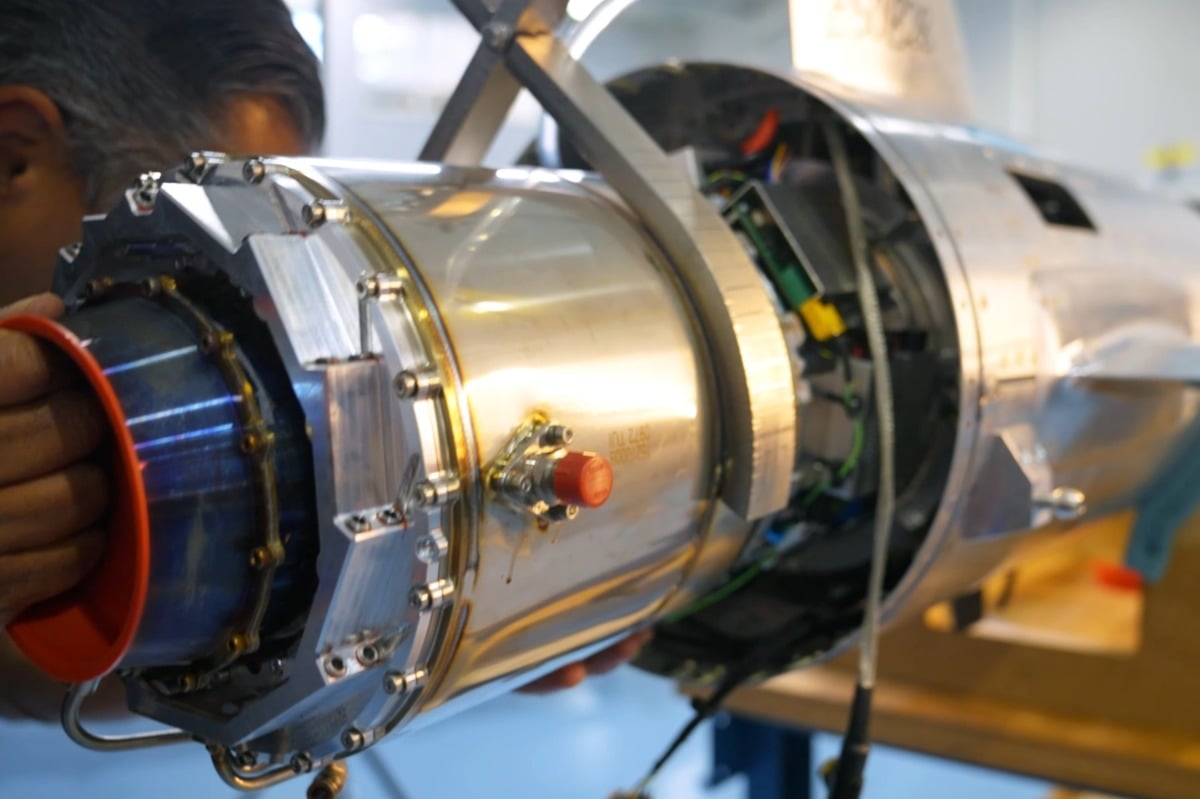
- Destinus completed its 1,000th T150 turbojet engine in 2026, produced entirely in-house in Europe to power the Ruta B1 and B2 cruise missile family.
- The company also announced the Ruta B3 long-range strike system with a 2,000 km range, powered by the next-generation T220 turbojet engine under development.
A European defense firm has quietly crossed a threshold that the continent’s established arms industry has struggled to reach for decades, completing its 1,000th turbojet engine on a production line built entirely in-house and designed to sustain the kind of output that modern cruise missile warfare demands.
Destinus, an aerospace and defense company that has positioned itself as a vertically integrated cruise missile manufacturer, announced in 2026 that it has completed the 1,000th unit of its T150 turbojet engine, the propulsion system that powers its Ruta B1 and Ruta B2 cruise missile family. The engine is designed, manufactured, and quality-controlled entirely within Destinus’ own European facilities, without reliance on external propulsion suppliers, a structural choice that the company’s leadership describes not as a preference but as an industrial necessity given the history of bottlenecks that have constrained European cruise missile production for years.
Sidney Berndt, Destinus’ Chief Manufacturing Officer, framed the milestone with a precision that cuts through the usual announcement language.
“Producing one engine is engineering. Producing a thousand is industrial capability. The T150 was built from scratch. The design, tooling, test infrastructure, supply chain and quality control were all developed and are owned by Destinus. What you see here is not a prototype line. It is a European production system that can sustain the production of thousands of missile systems per year.”
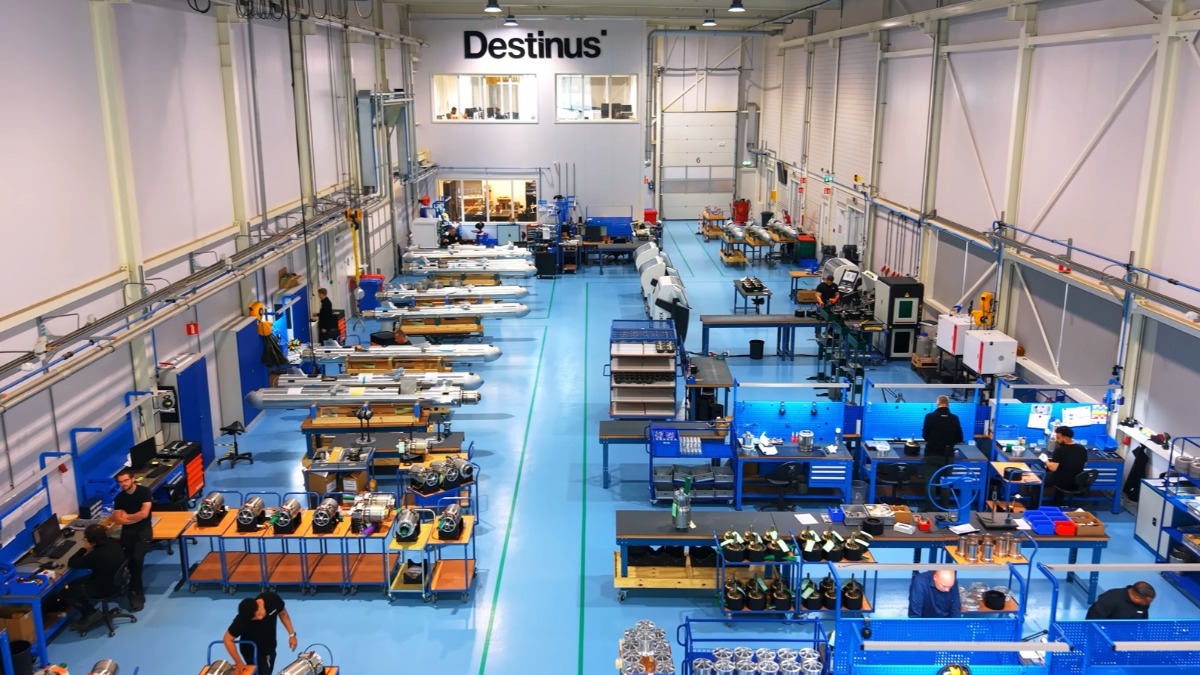
The T150 is a turbojet engine, a propulsion category that works by drawing air into a compressor, mixing it with fuel, igniting the mixture in a combustion chamber, and expelling the exhaust through a turbine and nozzle to generate forward thrust. Turbojet engines of this class are the standard propulsion solution for subsonic cruise missiles because they offer a favorable balance of fuel efficiency, compact dimensions, and the sustained thrust needed to power a missile across hundreds of kilometers at low altitude. The challenge for any manufacturer attempting to produce them at scale is not the engineering of a single unit but the creation of a repeatable, quality-controlled production system capable of delivering consistent performance across hundreds or thousands of units with minimal variation, a problem that requires tooling, supply chain management, and test infrastructure that takes years and significant capital investment to build.
The Ruta cruise missile family that the T150 powers represents Destinus’ primary current product line in the strike systems category. The Ruta B1 and B2 are subsonic cruise missiles designed for operational deployment, and their serial production depends entirely on the T150 production line delivering engines at a pace that matches missile assembly rates. Cruise missiles are single-use weapons, meaning that every operational use consumes one complete propulsion system along with the rest of the airframe, which creates an industrial demand profile fundamentally different from aircraft engines that are maintained and reused over years of service. Producing cruise missiles at militarily meaningful quantities therefore requires an engine production line that can sustain continuous output, not a prototype facility that builds units in small batches.
Europe’s difficulty in meeting that requirement has been a documented vulnerability throughout the post-Cold War period and has become acutely visible since Russia’s full-scale invasion of Ukraine in 2022 demonstrated how quickly cruise missile stockpiles deplete under sustained combat conditions. Western nations supplying cruise missiles to Ukraine, including the United Kingdom’s Storm Shadow and the French SCALP, discovered that replenishment rates lagged consumption rates by significant margins, exposing the degree to which European defense industrial capacity had atrophied during decades of reduced procurement. The propulsion bottleneck Destinus explicitly identifies in its announcement is not a theoretical concern: it is the specific industrial failure mode that European governments and NATO planners have been scrambling to address since the conflict began.
Destinus’ vertical integration model, owning and operating its own engine design and production capability rather than sourcing propulsion from a separate supplier, is a deliberate structural response to that vulnerability. External propulsion dependencies have historically constrained European cruise missile production rates because engine manufacturers operating on separate business cycles, procurement timelines, and quality assurance frameworks introduce friction into the production ramp-up process that compound at scale. By bringing the entire propulsion capability in-house, Destinus retains direct control over the single component most likely to become a limiting factor in high-volume production.
The 1,000th engine milestone also arrives in the context of Destinus’ announced joint venture with Rheinmetall, the German defense and industrial conglomerate, under the Rheinmetall Destinus Strike Systems partnership, which is designed to combine Destinus’ cruise missile technology with Rheinmetall’s manufacturing scale and defense industry relationships. That partnership positions the T150 production line not merely as a supplier to Destinus’ own missile programs but as a potential propulsion source for a broader family of European strike systems produced at Rheinmetall’s industrial scale.
Looking further along the product roadmap, the T150 is now joined in development by the T220, a next-generation turbojet engine also being built entirely in-house at Destinus, which will power the Ruta B3, a long-range strike system with a stated range of 2,000 kilometers (1,243 miles). A cruise missile capable of reaching targets 2,000 kilometers away from its launch point places it in a category that can strike deep into an adversary’s strategic depth from well outside the range of most air defense systems, a capability that NATO members have been actively seeking to expand as the lessons of the Ukraine conflict accumulate. The T150 and T220 together form what Destinus describes as a propulsion family, a deliberate product architecture that allows the company to scale different capability tiers from a common engineering and manufacturing base rather than treating each missile program as a standalone industrial challenge.
One thousand engines built on a European production line that did not exist a few years ago, feeding a cruise missile program that is scaling toward thousands of units per year: the numbers are modest by the standards of Cold War-era defense production, but in the context of where European strike capability stood at the start of this decade, they represent something the continent has been trying to rebuild for a generation.