

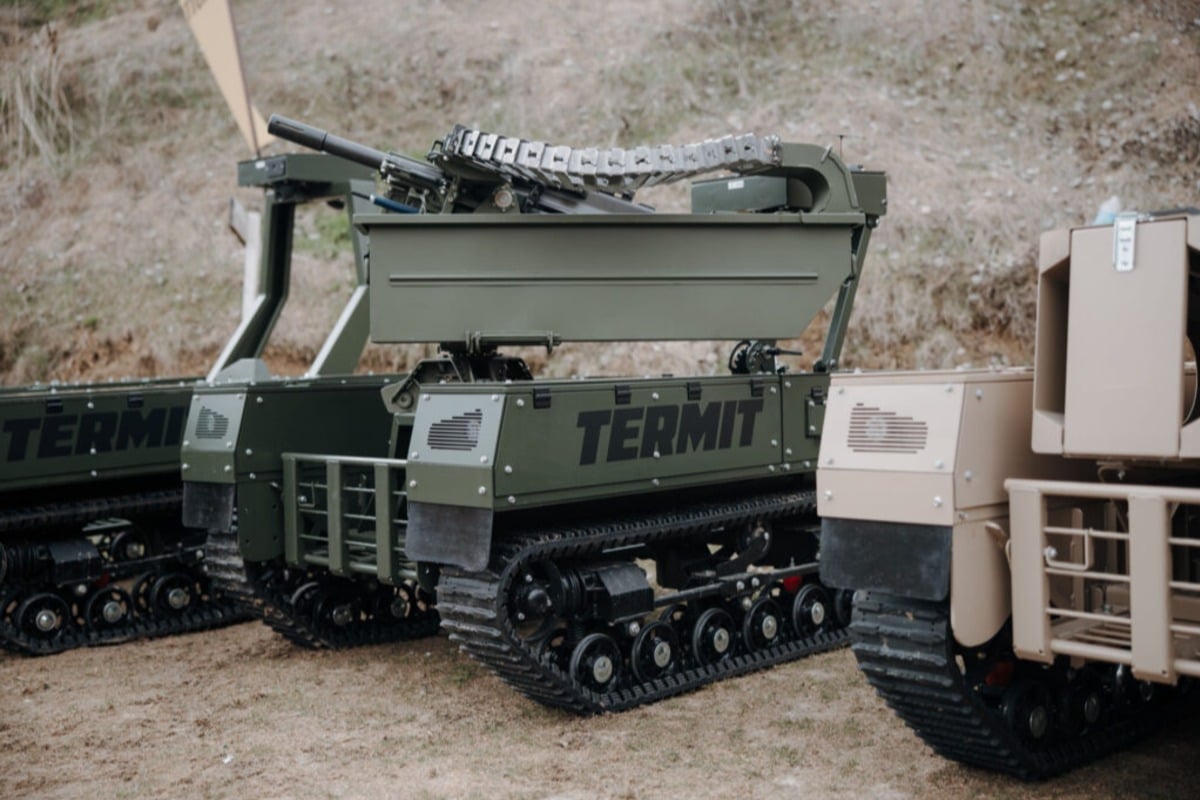
- Quantum Systems and Tencore launched joint venture Quantum Tencore Industries on June 19, 2026, to deliver 2,000 TerMIT UGVs to Ukraine within 12 months.
- The German Ministry of Defence is funding the programme, which represents the largest known unmanned ground vehicle procurement in Europe to date.
Germany is about to become the production floor for the largest unmanned ground vehicle order ever placed in Europe, and the robots heading to the front line were designed and battle-tested in Ukraine before a single one rolls off a German assembly line.
Quantum Systems, a Munich-based deep-tech defense company, and Tencore, a leading Ukrainian ground robotics manufacturer, announced on June 19, 2026, the formation of Quantum Tencore Industries, a joint venture that has secured an initial order for 2,000 TerMIT unmanned ground vehicles to be delivered to the Ukrainian Armed Forces within the next 12 months. The German Ministry of Defence is funding the programme, making this the first contract for the newly established venture and the largest known UGV procurement in Europe to date, surpassing in volume any comparable ground robotics order placed by a NATO member state.
The TerMIT is a tracked, multi-role unmanned ground vehicle designed by Ukrainian engineers under the pressure of actual combat conditions, a development environment that no laboratory exercise or peacetime trial can replicate. Tencore describes it as a software-defined platform, meaning its core capabilities expand through software updates rather than physical modifications, a design philosophy that allows the same vehicle to shift between logistics runs, casualty evacuation, field engineering support, and frontline combat missions without requiring a hardware rebuild. Tencore states that more than 3,000 TerMIT platforms are already deployed with Ukrainian forces and that the company currently produces more than 300 units per month, giving it a production baseline that most Western defense startups cannot match.
Hendrik Kramer, Managing Director of Quantum Tencore Industries, framed the significance of the programme in direct terms drawn from battlefield observation.
“Over the past 12 months, UGVs have fundamentally changed battlefield operations in Ukraine, from logistics and casualty evacuation to frontline combat missions. By combining battle-proven Ukrainian ground systems with German industrial scale, QTI is contributing to building strategic capacity in one of the most important emerging capabilities of modern warfare.”
That characterization is grounded in documented operational reality. Ukrainian forces have deployed ground robots extensively since 2023, using them to move ammunition and supplies to positions where vehicle access draws immediate fire, to extract wounded personnel from areas too exposed for medics on foot, and increasingly to carry weapons into contact zones where sending soldiers means absorbing unacceptable casualties. The TerMIT has logged what Tencore describes as thousands of missions across those categories, a combat record that Western UGV programs, most of which remain in prototype or limited-trial phases, cannot yet claim.
Maksym Vasylchenko, Co-Founder and CEO of Tencore, pointed directly to the model that makes the joint venture structurally different from a conventional export deal.
“Ukrainian engineers have developed highly effective ground robotic systems under real operational conditions. With Quantum Systems, we now have the industrial partner to scale these systems in Germany, expand production, and ensure reliable delivery to Ukrainian forces.”
Quantum Tencore Industries is the second joint venture Quantum Systems has established under what it calls the “Build with Ukraine” initiative, following Quantum Frontline Industries, which focuses on aerial unmanned systems and operates under a similar European-Ukrainian co-production framework. That model addresses a problem that has defined Western military aid to Ukraine since 2022: the gap between political willingness to supply systems and industrial capacity to produce them at the volume and pace that sustained combat operations demand. By embedding Ukrainian-designed systems into German manufacturing infrastructure, the initiative attempts to collapse that gap rather than work around it.
The TerMIT’s integration into Quantum Systems’ MOSAIC UXS platform, the company’s software backbone for coordinating unmanned systems across air, land, and sea domains, positions the vehicle within a broader interoperability architecture rather than as a standalone product. MOSAIC connects UGVs, aerial drones, sensors, counter-drone systems, and drone ports into a single operational network, which means a TerMIT operating in the field can in principle be coordinated with aerial reconnaissance assets and electronic warfare systems through the same software layer. That level of integration represents a meaningful leap beyond the kind of teleoperated ground vehicles that dominated the early years of the conflict, where operators controlled single platforms over direct radio links with no broader situational awareness built into the system.
Two thousand ground robots, designed in a country at war and built in the industrial heartland of Europe, headed back to the front within a year: that is the timeline Quantum Tencore Industries is committing to, and the world will be watching to see whether the industrial model can keep pace with the battlefield’s appetite.