

- The U.S. Army Contracting Command issued a sources sought notice on June 15, 2026, seeking manufacturers able to support Javelin Weapon System production and life-cycle support from fiscal years 2027 to 2036.
- The Raytheon-Lockheed Martin Javelin Joint Venture remains the original developer and intellectual property owner; responses to the notice are due June 30, 2026.
The shoulder-fired missile that Ukrainian soldiers have used to destroy hundreds of Russian tanks is about to become the subject of one of the most significant American weapons procurement planning exercises in years, as the U.S. Army Contracting Command issued a sources sought notice on June 15, 2026, asking defense manufacturers to identify whether they can support continued production of the Javelin Weapon System from fiscal year 2027 through fiscal year 2036, a ten-year planning horizon that signals the Army intends to keep buying this weapon in significant quantities well into the next decade and wants to understand the full scope of who can help make that happen.
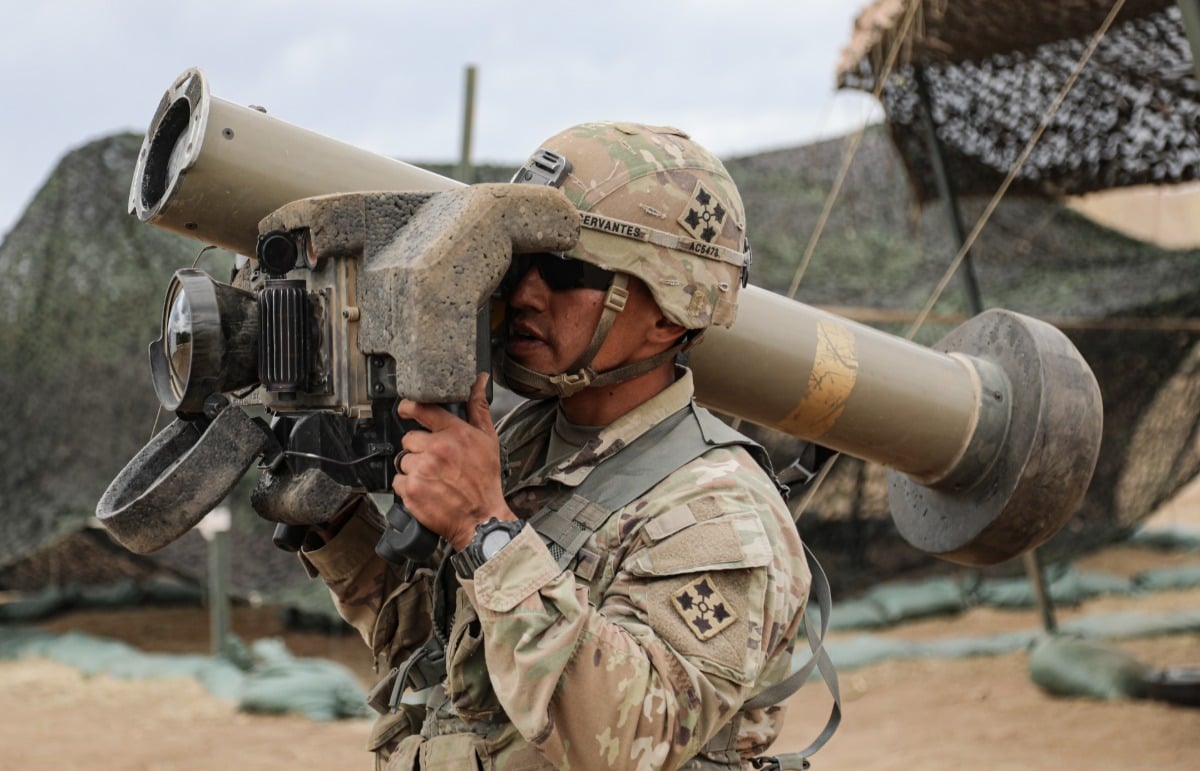
The Javelin is a medium-range, man-portable anti-tank missile that a single soldier can carry, set up, aim, and fire without assistance, and that guides itself to the target after launch without any further input from the operator, a capability called “fire and forget” that allows the soldier to take cover or move to a new position immediately after firing rather than remaining exposed to guide the missile toward its target the way older anti-tank systems required.
The system uses an imaging infrared seeker and an advanced tandem warhead, allowing it to engage tanks with conventional or reactive armor, tracking the heat difference between a tank and its background environment and locking onto that signature before launch so the missile guides itself autonomously even if the target moves after firing. The Javelin has a maximum range in excess of 4,500 meters (4,921 yards) and can be used in top-attack mode, where the missile arcs upward and dives onto the thinner roof armor of a tank, or direct-fire mode against targets where a flat trajectory is more appropriate, giving the operator flexibility to choose the most effective engagement geometry based on terrain and target type.
The Javelin Joint Venture between Raytheon, a division of RTX Corporation, and Lockheed Martin has produced the Javelin since the system entered U.S. service in 1996, and the joint venture holds the intellectual property and technical data package for the weapon, which means any expansion of Javelin production or any new contractor entering the supply chain must work within the constraints of that existing intellectual property arrangement rather than independently replicating the weapon’s design. The sources sought notice explicitly acknowledges this reality, noting that the government does not intend to provide a Javelin technical data package because it does not own a complete one, and identifying the Raytheon-Lockheed Martin joint venture’s CAGE code as the original developer and owner of the system, which sets important boundaries for what any responding company could actually contribute to the production ecosystem without infringing on the joint venture’s proprietary technology.
What the Army is actually seeking through this market research is not a competitor to the Raytheon-Lockheed Martin joint venture but rather an understanding of the full supplier ecosystem that supports Javelin production and life-cycle maintenance, including companies that manufacture or could manufacture the missiles themselves, the Command Launch Units that serve as the sight and firing device the soldier carries, vehicle adapters that allow Javelin to be fired from armored vehicles rather than from a soldier’s shoulder, training devices that replicate the system’s operation for teaching purposes, spare batteries, spare components, and the engineering support services that keep a complex precision weapon system in operational condition across decades of military service. The breadth of that list reflects how many specialized suppliers and service providers contribute to keeping a modern guided missile system operational at the scale the Army and Marine Corps require.
The operational context driving this planning exercise is impossible to discuss without reference to Ukraine, where Javelin missiles transferred from the United States and its allies have played a documented and significant role in destroying Russian armored vehicles since the full-scale invasion began in February 2022. The United States has transferred thousands of Javelin missiles to Ukraine as part of military assistance packages, and those transfers have drawn down existing American stockpiles while simultaneously generating political and strategic pressure to rebuild those stockpiles faster than the existing production rate allows. The Army’s ten-year planning horizon for continued Javelin procurement from fiscal year 2027 through 2036 reflects both the need to replenish what has been transferred and the recognition that the lessons of Ukraine have validated the continued relevance of man-portable anti-tank guided missiles against peer and near-peer adversaries who field large numbers of main battle tanks and armored vehicles.
The production reality that the sources sought notice implicitly addresses is that Javelin production has been running at elevated rates since the Ukraine war began, with the Raytheon-Lockheed Martin joint venture ramping output from a pre-war rate of approximately 2,100 missiles per year to higher rates in response to demand, but even at elevated production the combination of domestic military requirements and ally assistance commitments has stretched the production system. Understanding which additional suppliers could contribute components, subassemblies, or services that expand the production capacity without duplicating the proprietary technology the joint venture controls is exactly the kind of market research that a sources sought notice is designed to accomplish before the Army moves to a formal contract solicitation.
Responses to the sources sought notice are due by June 30, 2026, with interested parties instructed to submit white papers addressing their technical capabilities, relevant past experience, and assessment of the most efficient method to execute the anticipated work, submitted to a specific Army contracting officer rather than through a general public portal, which is standard practice for acquisition planning documents that may touch on sensitive production capacity information. The notice explicitly states that it does not commit the government to issuing a formal request for proposals or awarding any contract, and that all costs of responding fall on the responding companies rather than the government, again standard language for sources sought notices that serve as market research tools rather than procurement actions.