

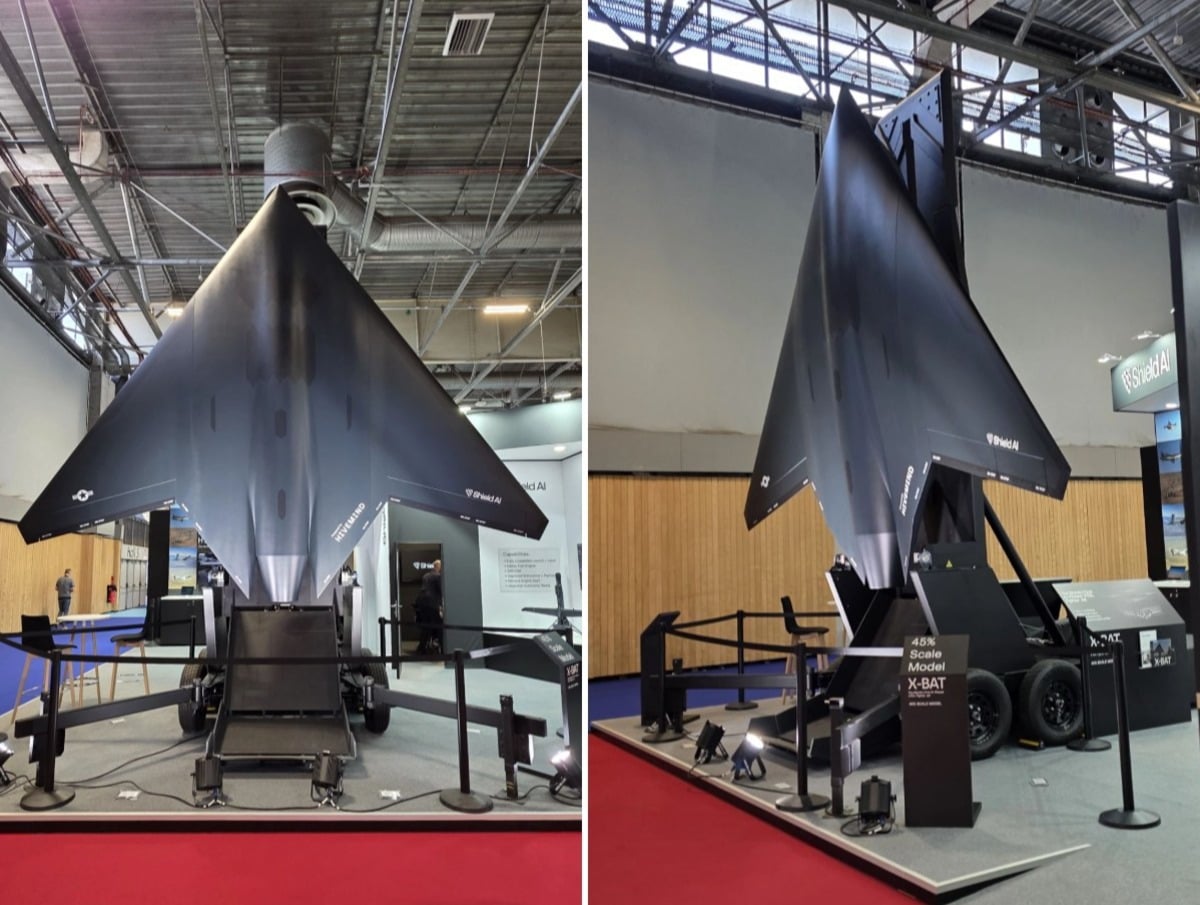
- Shield AI is showcasing the X-BAT autonomous VTOL combat jet at Eurosatory 2026 in Paris, June 15-19, with first VTOL flights scheduled for 2026 and mission capability targeted for 2028.
- X-BAT is powered by a GE Aerospace F110-GE-129 turbofan with thrust vectoring, has a claimed range exceeding 3,700 km (2,000 nautical miles), and operates autonomously without GPS or communications.
Shield AI, the San Diego-based defense technology company that has been supplying AI piloting software to U.S. military aircraft since 2019, is showcasing X-BAT at Eurosatory 2026.
Eurosatory 2026, a major international defence and security exhibition held in Paris from June 15-19, gives Shield AI one of its most prominent European stages yet for a program the company describes in the most ambitious terms available: X-BAT is billed as the world’s first AI-piloted VTOL fighter jet, designed to make runways optional for combat air power in the way that aircraft carriers once made coastlines optional for naval aviation.
The X-BAT’s defining capability is the combination of vertical takeoff and landing with genuine combat performance at jet speeds and long range. Shield AI says the aircraft has a range exceeding 3,700 km (2,000 nautical miles) with a full mission payload, a service ceiling of 15,240 m (50,000 ft), and the ability to take off vertically from ships, remote islands, or austere forward bases, eliminating the dependency on traditional runway infrastructure that makes conventional air power vulnerable to attack. Shield AI says three X-BATs can fit in the deck space of one legacy fighter, which means a ship or forward operating base that previously supported one crewed combat aircraft could potentially support three autonomous ones. The aircraft takes off vertically using its main jet engine and thrust-vectoring nozzle, transitions to horizontal flight for its mission, and returns to land vertically engine-down, descending tail-first back onto its launch rail.
The propulsion system powering that VTOL cycle is a modified GE Aerospace F110-GE-129 turbofan, the same engine family that powers many F-16 and F-15 fighters, equipped with thrust-vectoring capability to redirect exhaust during vertical flight. Shield AI selected the F110 for its size, thrust output, and fuel economy, and the program has obtained several certified pre-owned engines as well as new-build units to support development and testing. The aircraft’s folding wing design reduces its storage footprint to roughly one-third that of a conventional fighter, making it easier to transport aboard ships, trucks, or cargo aircraft. Those design choices reflect a mission concept built around distributed operations, where many autonomous aircraft launch from many dispersed locations simultaneously rather than concentrating combat power at fixed bases that adversaries can target with long-range missiles.
At the core of X-BAT’s autonomous capability is Shield AI’s Hivemind software, an AI piloting system the company has been developing and deploying on real military aircraft since 2019, giving it operational validation that most autonomous aircraft programs lack. Hivemind enables X-BAT to operate in GPS and communications-jammed environments, executing missions with no GNSS, no comms, and no human input required when those conditions are denied, while also allowing a single human commander to direct a team of multiple X-BATs simultaneously rather than requiring a dedicated operator for each aircraft. Shield AI says its Hivemind software has been deployed on more than 30 platforms and validated in operationally contested environments since 2019, which gives the company’s performance claims a foundation in real-world testing rather than simulation alone.
X-BAT is designed as a multirole aircraft capable of air-to-air combat, air-to-surface strike, electronic warfare, and intelligence, surveillance, and reconnaissance missions, a combination that makes it more directly comparable to a crewed multirole fighter than to the dedicated strike drones or surveillance platforms that have defined the unmanned aircraft market until now. Shield AI describes it as affordable and attritable, meaning it is built to deliver fighter-class performance at a cost low enough that losing one in combat is not the catastrophic loss that losing a crewed fifth-generation aircraft represents. That positioning places X-BAT alongside the emerging Collaborative Combat Aircraft programs the U.S. Air Force is developing, where General Atomics’ YFQ-42A and Anduril’s YFQ-44A both use conventional runways, creating a gap that a VTOL-capable autonomous aircraft could fill.
Shield AI says X-BAT has progressed through wind tunnel, pole, and engine testing over 18 months, with a structural pathfinder in fabrication and first VTOL flights scheduled for 2026 and mission capability targeted for 2028. That timeline, moving from unveiled concept to flying prototype in under a year and to mission-capable status in three years, is aggressive by any standard of military aircraft development. Whether it holds depends on how the VTOL transition flight testing proceeds and whether the structural and software challenges of combining jet-speed performance with autonomous vertical landing prove as solvable in practice as Shield AI’s engineering team believes they are on paper.