

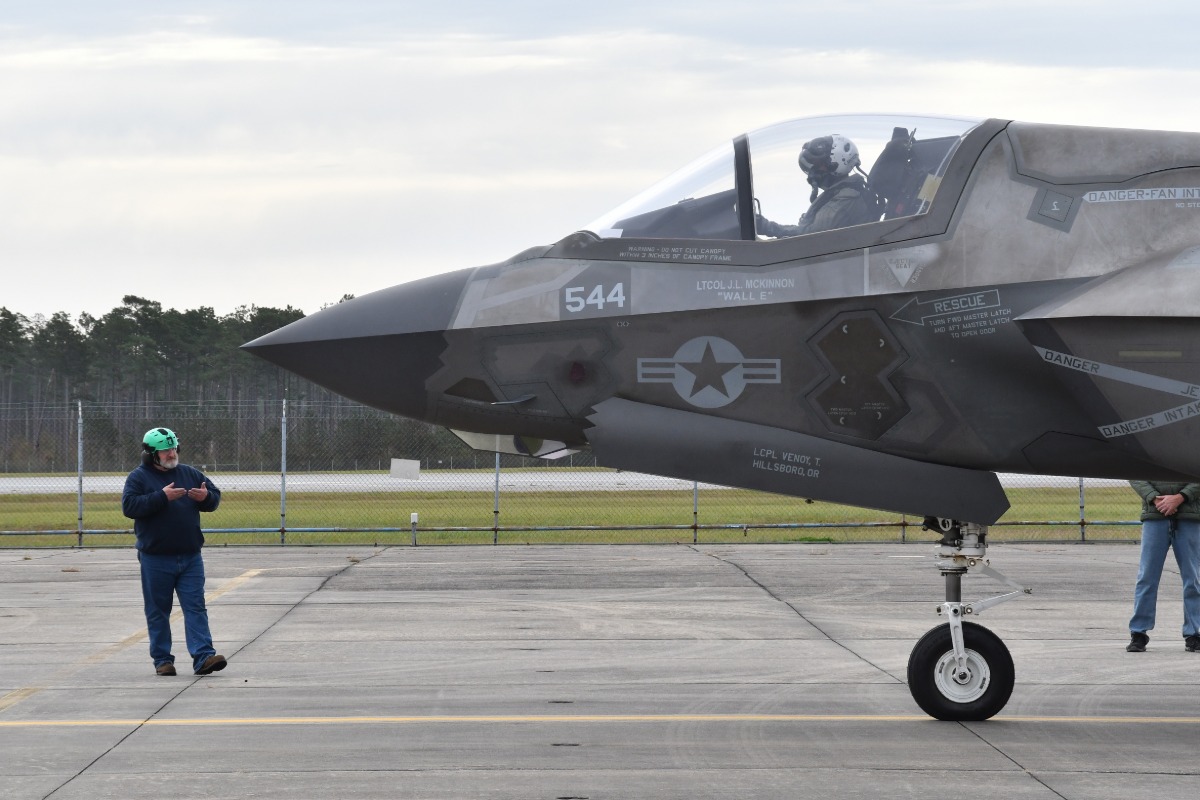
- The U.S. Navy awarded Lockheed Martin a $2.3 billion contract on June 12, 2026 to establish new F-35 operating sites and sustainment infrastructure through December 2028.
- Work will be performed 85% in Fort Worth, Texas and 15% in Orlando, Florida, supporting U.S. Air Force, Marine Corps, Navy, foreign military sales customers, and cooperative partners.
The U.S. Navy has awarded Lockheed Martin a $2.3 billion contract to establish and sustain new operating sites for the F-35 Lightning II, the American-built stealth multirole fighter that has become the backbone of air power for the United States and allied operators across the global F-35 fleet, covering site activation, interim contractor support, fleet management, and reliability improvement efforts for the Air Force, Marine Corps, Navy, foreign military sales customers, and cooperative partner nations.
The contract was awarded on June 12, 2026, and runs through December 2028, with work split between Lockheed Martin’s primary facility in Fort Worth, Texas, which handles 85% of the effort, and its Orlando, Florida location for the remaining 15%.
The F-35 Lightning II is the largest and most complex international military aircraft program in history, with more than 1,325 aircraft built as of March 2026. Lockheed Martin said in January 2026 that the global F-35 fleet had grown to almost 1,300 aircraft across 12 operating nations, a number that continues to climb as new deliveries arrive and additional countries bring their fleets online. Three variants serve different mission profiles across that global fleet: the F-35A is a conventional takeoff and landing aircraft operated by air forces, the F-35B can take off from short runways and land vertically, making it suitable for smaller ships and expeditionary airfields, and the F-35C is a carrier-based variant with a larger wing and reinforced landing gear for catapult launches and arrested recoveries from aircraft carrier decks. Sustaining a fleet of that size and variety, spread across multiple countries and operating environments, requires dedicated infrastructure at every location where the aircraft flies, and building that infrastructure is precisely what this contract funds.
Rather than committing to a fixed scope of work upfront, the award is structured as an indefinite delivery, indefinite quantity contract, a procurement vehicle under which the government commits a ceiling value and then issues individual task orders as specific requirements are identified. The $2.3 billion represents the ceiling across the contract’s life, not an immediate expenditure, and no funds were obligated at the time of award. The contract was not competed, meaning Lockheed Martin received it without a competitive bidding process, which is standard practice for this category of F-35 sustainment work. Lockheed Martin as the original equipment manufacturer holds proprietary technical data and system knowledge that no other company possesses, making sole-source awards the default for initial site setup work that requires integrating software, logistics systems, training infrastructure, and maintenance procedures only Lockheed Martin fully controls.
The F-35 program had a record-breaking year in 2025, with Lockheed Martin delivering 191 aircraft, surpassing the previous delivery record of 142 jets, with annual production now running at a pace five times faster than any other allied fighter currently in production. That delivery rate means new F-35 operating sites are continuously being established around the world as additional aircraft join national fleets, and each new site requires the same initial setup work covered by this contract: facilities configured for the aircraft’s maintenance requirements, software update infrastructure, supply chain pipelines for spare parts, and trained maintenance crews who understand the F-35’s integrated systems. Without that foundation in place, a delivered aircraft cannot be properly maintained, and an improperly maintained F-35 is a combat capability gap regardless of how capable the jet itself is.
In 2025, F-35s played a key role in suppressing air defenses during Operation Midnight Hammer, and NATO F-35s eliminated Russian drones over Poland, marking the first time NATO F-35s engaged threats in allied airspace, according to Lockheed Martin. Those two combat events, one an offensive strike operation and one a defensive intercept, demonstrated the breadth of what the F-35 is actually being asked to do in current operations, and they underscore why keeping the global fleet properly sustained carries direct operational consequences rather than simply administrative ones.
The F-35 program’s international dimension adds complexity that purely domestic aircraft programs do not face. Cooperative partner nations, the eight countries that participated in the program’s development and share certain industrial work and cost benefits, operate their fleets under different national regulations, basing conditions, and operational requirements than the U.S. military. Foreign military sales customers, who purchased F-35s through the government-to-government channel without being program partners, have their own support arrangements that must be integrated into the broader sustainment architecture. Each new operating site established under this contract represents a piece of that global puzzle, whether it is a U.S. Navy carrier air wing preparing to embark F-35Cs, a Marine Corps expeditionary unit standing up F-35B support aboard an amphibious ship, or an allied nation expanding its fleet to additional domestic bases.