

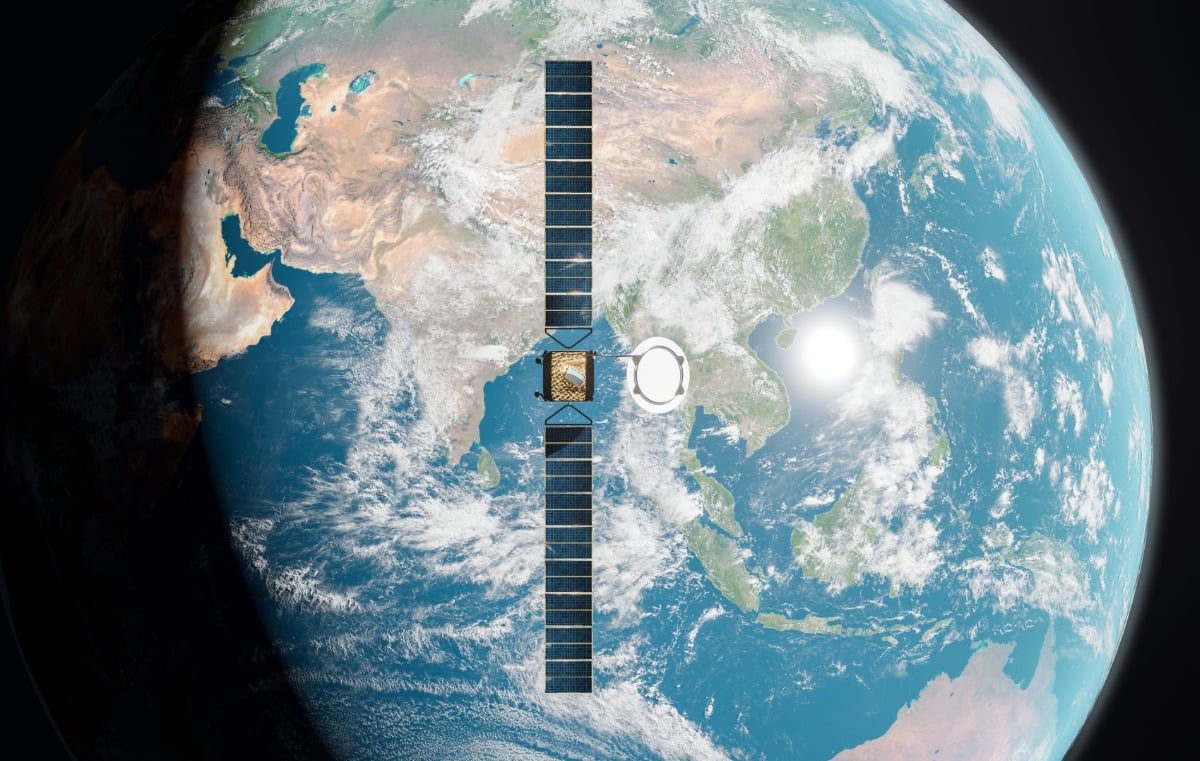
- Viasat received a contract from Space Systems Command on June 11, 2026 to build and deliver a dual-band X/Ka-band mini-GEO satellite under the PTS-G Swarm 1 delivery order.
- The two Swarm 1 contracts awarded to Viasat and Intelsat are collectively worth $437.7 million, with Viasat's satellite supporting initial operating capability no earlier than 2029.
The U.S. Space Force has selected Viasat and Intelsat to produce the first two operational PTS-G Swarm 1 satellites, with Viasat delivering one dual-band X/Ka-band mini-GEO satellite designed to add a smaller, maneuverable GEO layer to protected tactical SATCOM.
Viasat, a California-based satellite communications company, announced on June 11, 2026 that it received a prime contract from Space Systems Command to build, launch, and operate its satellite under the Protected Tactical SATCOM-Global program, known as PTS-G. The satellite will operate in geosynchronous Earth orbit; geostationary satellites at about 35,786 km (22,236 miles) above the equator can appear fixed over one point on Earth, which makes that orbital band ideal for continuous wide-area communications coverage.
The smaller, maneuverable architecture is what sets this generation apart from its predecessors and explains why the Space Force is spending money to build it now. The PTS-G satellites will take over the encrypted tactical communications portion of the Advanced Extremely High Frequency system, known as AEHF, a constellation of six large satellites that currently provides secure, jam-resistant communications for high-priority military ground, sea, and air assets, a mission that has served U.S. and allied forces since the first AEHF satellite launched in 2010. Those satellites each weigh roughly 6,168 kg (13,598 lb) and cost several billion dollars apiece to build and launch. They are enormously capable, but they are also large, expensive, and parked in known orbital positions, which means adversaries who have invested in electronic warfare and directed-energy capabilities know exactly where to aim. Smaller, maneuverable satellites distributed across the same orbital band present a meaningfully harder problem.
The two contracts awarded to Viasat and Intelsat under the Swarm 1 delivery order are collectively worth $437.7 million, covering manufacturing, integration, testing, launch, and on-orbit checkout of the two satellites, with Viasat’s share representing one of the two spacecraft. The contract Viasat announced on June 11 adds further detail about its specific contribution: a dual-band X/Ka-band satellite, meaning a spacecraft that communicates simultaneously across two separate military frequency bands. X-band is used broadly for military tactical communications and radar; Ka-band provides higher data throughput for military broadband applications. Operating across both bands in a single maneuverable spacecraft gives ground forces more flexibility than a system locked to a single frequency that can be jammed or spoofed more easily.
The contract also includes five years of operations and sustainment services, covering tracking, telemetry and command functions, satellite and network operations, and cybersecurity requirements. That package matters because it addresses the full operational lifecycle rather than just the hardware delivery. A satellite that no one is actively managing and defending from cyber intrusion is a security vulnerability regardless of how well it was built, and embedding those responsibilities into the production contract forces the manufacturer to think about operations from the design stage rather than treating security as an afterthought.
Viasat’s path to this award runs through its existing commercial satellite program. The company completed the design maturation phase of PTS-G in 2025, when it developed the system architecture for a small, low-weight satellite platform under the program’s first delivery order. That design work drew directly on technology developed for the ViaSat-3 satellite fleet, the company’s commercial broadband constellation, which uses similar frequency bands and high-throughput payload architectures. Leveraging commercial heritage for a defense program compresses the development timeline and reduces technical risk, because the underlying components and software have already logged real-world operational hours rather than existing only on paper. Craig Miller, President of Viasat Government, pointed directly to that lineage. “This production award recognizes Viasat’s technical and operational expertise designing and rapidly delivering resilient, and high-performance dual-use satellite solutions in a multi-orbit environment, as well as our deep understanding of USSF mission needs and how to effectively deliver secure communications for DoW and partner missions,” Miller said.
The broader PTS-G program carries a total ceiling value of $4 billion across all awardees, structured as an indefinite delivery indefinite quantity contract, a procurement vehicle that commits the government to a pool of money and allows it to issue specific task orders to multiple vendors as requirements are defined. The Space Force selected five companies for the program’s initial design phase in July 2025: Boeing, Viasat, Northrop Grumman, Astranis Space Technologies, and Intelsat, then competed Swarm 1 production contracts among that pool, ultimately selecting Viasat and Intelsat to each deliver one satellite. The competitive structure is intentional: it maintains an industrial base of multiple qualified suppliers rather than creating a single-vendor dependency, which mirrors the distributed resilience philosophy behind the satellite architecture itself.
John Reeves, Vice President of Space and Mission Systems at Viasat Government, described the operational intent plainly. “Our flexible dual-band X/Ka-band satellite is designed to enable critical DoW operations and mission outcomes — supporting global connectivity, increasing resilience and improving warfighters’ ability to combat emerging threats,” Reeves said.
The Space Force previously projected the first PTS-G launch for 2028, while Viasat says its delivery supports initial operating capability no earlier than 2029. The Space Force’s fiscal year 2026 research and development budget included nearly $237 million for PTS-G, with $150 million planned in the fiscal year 2027 request, a funding profile that shows the program moving from development investment toward production spending as the hardware transitions from design to manufacturing.
The older AEHF constellation that PTS-G will eventually supplement was built for a different threat environment. When those satellites were designed in the late 1990s and early 2000s, the prospect of an adversary actively jamming, spoofing, or attempting to physically threaten a U.S. military communications satellite in geosynchronous orbit was a theoretical concern rather than a documented operational reality. That calculus has changed significantly. China and Russia have both demonstrated satellite-killing and electronic warfare capabilities that have forced a fundamental rethink of how the Space Force structures its communications architecture. Smaller, cheaper, maneuverable satellites that can be produced in numbers and replaced when lost are the answer that PTS-G is built around. Viasat just signed up to build one of the first.