

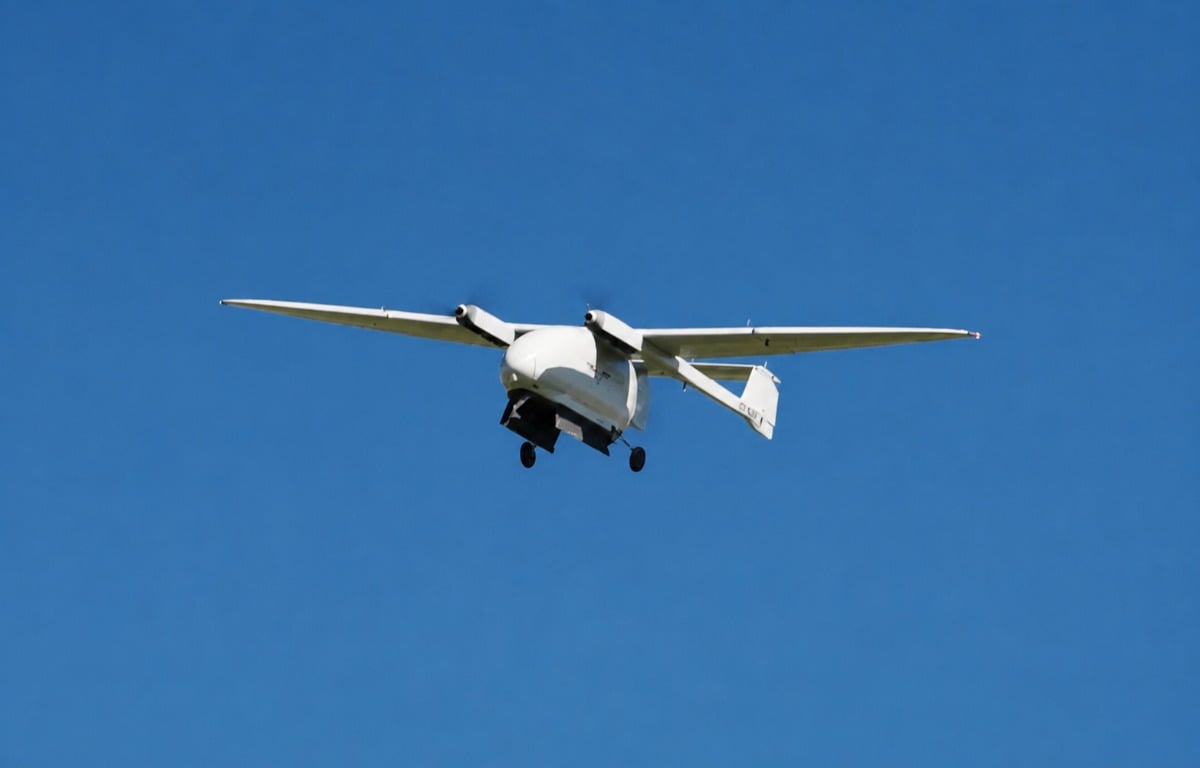
- Pyka's DropShip drone autonomously delivered multiple 200-pound payloads from 300 feet altitude, landing within 50 feet of targets during a June 2026 demonstration.
- DropShip progressed from concept to autonomous precision airdrop in eight months, with a range exceeding 3,500 miles (5,633 km) and 550-pound (249 kg) payload capacity.
A California aerospace firm demonstrated something the U.S. military has been trying to solve for years: getting critical supplies to exactly the right place, in denied or dangerous territory, without putting a pilot in harm’s way. Pyka, an autonomous aircraft manufacturer based in Alameda, California, announced on June 11, 2026 that its DropShip heavy-lift drone had successfully delivered multiple 200-pound (91 kg) payloads from an altitude of 300 feet (91 m), landing each one within 50 feet (15 m) of the intended target, entirely without a human at the controls.
The precision matters as much as the autonomy. Landing a parachuted cargo package within 50 feet of a target from low altitude is not a trivial engineering problem. Parachute airdrop accuracy degrades rapidly with wind, speed, and altitude variability, and most conventional military airdrops operate from thousands of feet higher, accepting much larger error margins. DropShip was designed as a heavy-lift autonomous platform capable of operating where conventional logistics networks cannot, and the 300-foot drop altitude reflects a deliberate design choice to minimize drift and maximize accuracy, trading the standoff distance that keeps manned aircraft safe for the precision that makes an airdrop operationally useful at the tactical edge.
DropShip carries a maximum takeoff weight of 1,400 pounds (635 kg) and is engineered around a hybrid propulsion system, modular open architecture, and precision airdrop capability, a combination intended to give operators the flexibility to adapt the platform across logistics, sustainment, and evolving mission sets without swapping aircraft. The aircraft has a ferry range of over 3,500 miles (5,633 km) and can carry payloads of up to 550 pounds (249 kg), numbers that place it in a category well above small quadcopter delivery drones and well below manned cargo aircraft, filling a gap that military planners have struggled to address with existing equipment. That range figure means a single DropShip, operating from a rear staging base, could theoretically deliver supplies to any location within a 2,000-mile (3,218 km) radius on the same day it was loaded.
Eight months elapsed between Pyka’s first design sketch and a working autonomous precision airdrop demonstration. DropShip achieved its first flight just six months after concept initiation, and the program progressed from concept to first flight to autonomous precision airdrop in eight months total, a timeline that would be remarkable for any aircraft program and is genuinely unusual for a defense-relevant autonomous system. The explanation lies in what Pyka brought to the program before it started. The company’s autonomous platform has already logged more than 10,000 flights across agriculture and logistics operations, meaning the flight control software, propulsion architecture, and autonomy stack that power DropShip were not developed from scratch but transferred from a commercial fleet already proven in demanding real-world conditions. Building a defense aircraft on a commercial foundation that has ten thousand flights of operational data behind it is a fundamentally different engineering proposition than starting from a blank page.
Pyka CEO and co-founder Michael Norcia framed the capability’s significance directly. “Until now, there hasn’t been a safe, economical, or practical way to autonomously deliver critical supplies directly to a specific location hundreds or even thousands of miles away,” Norcia said. “Whether it’s fuel, water, medical supplies, repair parts, or other mission-essential cargo, DropShip gives operators the ability to get what they need exactly where they need it, same day.”
The operational problem Norcia described is well-documented across military planning circles. Defense leaders have warned that future conflicts may challenge access to established transportation networks, creating demand for flexible and autonomous alternatives, and the wars of the past several years have provided concrete evidence of why. Logistics convoys in contested territory attract attack. Manned resupply flights into areas covered by modern air defenses carry real risk to aircrews and expensive aircraft. Small quadcopter drones can deliver medicine or ammunition in limited quantities, but they cannot move the volumes of fuel, repair parts, or bulky medical equipment that sustain real military operations. DropShip is designed to occupy the space between those two options, carrying meaningful payload at meaningful range without a human pilot aboard.
DropShip’s reconfigurable mission system also allows integration of intelligence, surveillance, and reconnaissance sensors, waveform-agnostic communications suites, mothership support for small unmanned ISR or communications vehicles, and expeditionary power supply, which means the platform’s utility extends beyond cargo delivery. An aircraft that can be reconfigured in the field for communications relay, surveillance, or small drone deployment from the same airframe represents a different value proposition than a dedicated cargo drone, and the modular architecture is central to how Pyka is pitching the system to military customers.
DropShip features an all-electric mode with a low noise signature, allowing covert infiltration, loiter, or exfiltration of desired airspace, a capability that matters significantly in contested environments where acoustic detection of incoming aircraft can compromise a mission before the cargo lands. The hybrid propulsion system provides range on the internal combustion side and quiet operation on the electric side, giving operators the ability to switch modes based on the tactical situation along the route.
Pyka has scheduled customer evaluations and operational exercises with the U.S. Government later in 2026, and the company says it will continue expanding the DropShip flight envelope and mission capabilities in subsequent test flights. The autonomous precision airdrop demonstration was not the end of a development program.