

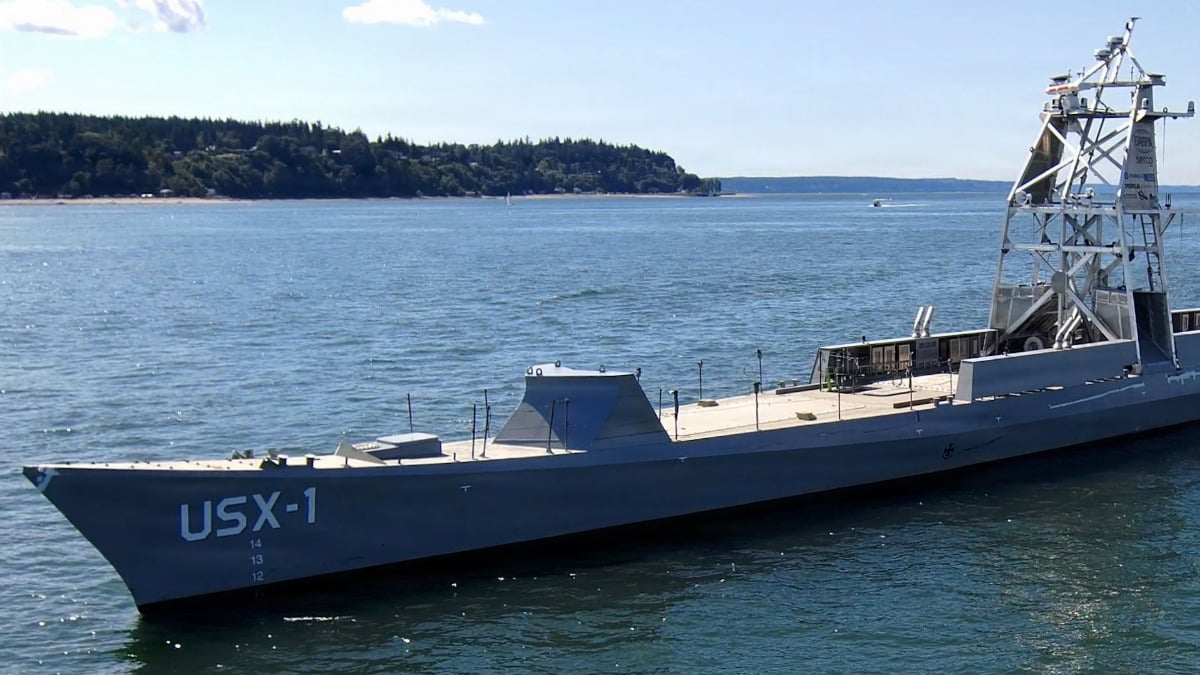
- The Defense Innovation Unit issued a solicitation for the Autonomous Resupply Vehicle program, seeking autonomous sea drones with 1,600 nautical mile round-trip range and two-container capacity for Army logistics.
- The solicitation states that dozens or more ARV-S vessels may be required and that any bid must demonstrate a realistic capability to scale production quickly.
The Pentagon is seeking to buy dozens of autonomous cargo boats to resupply U.S. Army units scattered across the Pacific islands in any future conflict with China, Naval News reported, citing a Defense Innovation Unit solicitation that calls for sea drones capable of delivering shipping containers through some of the most contested waters on earth without a single sailor aboard.
The Defense Innovation Unit, the Department of War organization that accelerates commercial technology into military use, issued the solicitation last month under a program called the Autonomous Resupply Vehicle, or ARV-S. The requirement calls for an unmanned surface vessel that can make a round trip of 1,600 nautical miles (2,963 km) in sea states ranging from moderate to rough, carry at least two 20-foot (6.1-meter) shipping containers, and navigate autonomously without human direction. The solicitation does not specify an exact fleet size but states that end strength may require dozens or more vessels to be produced quickly, and that any proposal must demonstrate a realistic capability to scale production, according to Naval News reporter Aaron-Matthew Lariosa.
The underlying operational problem the ARV-S is designed to solve has been building for years. The U.S. Army’s current maritime formations, the watercraft units that move supplies and equipment by sea to support ground forces, lack the capacity to move the volume of supplies that operational forces in the Pacific would require in a wartime scenario. Those formations operate aging vessels with trained crews, and in a conflict with China they would face an adversary whose modernized navy, missiles, and air forces are specifically designed to find, track, and destroy exactly the kind of logistics shipping that keeps forward-deployed units supplied. An unmanned vessel carrying container cargo changes the targeting calculus: it has no crew to risk, it is relatively inexpensive compared to crewed ships, and a dispersed fleet of autonomous resupply boats is far harder to systematically destroy than a concentrated convoy of crewed vessels.
“For Indo-Pacific Contested Logistics, USVs can provide significant operational advantages by eliminating risk to onboard personnel and reducing the need for trained mariners. Additionally, their dispersed and relatively inexpensive nature complicates adversary targeting, enhancing survivability in contested environments,” the solicitation reads, as cited by Naval News.
The geography of the Indo-Pacific makes logistics the central challenge of any military scenario there. The first island chain, the string of islands running from Japan through Taiwan and the Philippines to the South China Sea, is where any U.S.-China conflict would likely be most intense, and it is also where the distances from American bases in Guam, Japan, and the continental United States are longest and the number of usable ports and airfields is most constrained. Resupplying soldiers and Marines fighting on or near those islands during active hostilities requires moving cargo across open ocean within range of Chinese anti-ship missiles, submarines, and combat aircraft. A fleet of autonomous cargo vessels that can navigate independently, hold position offshore while avoiding threats, and deliver containers to beaches or small piers without requiring a crewed ship to enter the danger zone provides a logistics option that the current Army watercraft inventory cannot replicate.
The importance of Army watercraft to Pacific strategy has been demonstrated repeatedly in recent exercises. Since 2023, Army and Marine Corps units have used watercraft to land missile launchers at strategic archipelagos across the Philippines during the annual Balikatan exercise, as Naval News has reported. Those missile systems, including the Navy-Marine Expeditionary Ship Interdiction System, give U.S. commanders the ability to threaten Chinese naval forces from dispersed island positions rather than from fixed bases that China has already targeted in its planning. Getting those launchers to their positions requires watercraft that can operate in contested coastal environments, and sustaining them requires a continuous resupply chain that the current fleet strains to provide.
The House Armed Services Committee’s chairman’s mark of the Fiscal Year 2027 defense legislation included recommendations for the procurement of unmanned surface vessels to escort Army watercraft, according to the U.S. Naval Institute. “The committee believes that manned Army watercraft may be aided by dedicated unmanned surface vessels providing enhanced force protection, early warning, sensing and defensive effects while reducing risk to personnel,” the draft bill reads. The legislative push addresses a complementary problem to the cargo resupply mission: protecting the crewed vessels that do need to operate in harm’s way by surrounding them with cheaper autonomous escorts that can provide surveillance, warning, and defensive capability without putting additional sailors at risk.
The ARV-S requirement arrives as the broader unmanned surface vessel market is expanding rapidly, driven partly by the U.S. Navy’s Task Force 59 operations in the Persian Gulf and the demonstrated use of autonomous surface vessels in Ukraine’s maritime operations against Russian naval forces in the Black Sea. Saronic Technologies, which this week confirmed its Corsair autonomous vessel recovered two U.S. Army aviators off Oman in the first publicly reported personnel rescue by an unmanned surface vessel, is among the commercial companies developing platforms that could compete for programs like the ARV-S. The practical question the DIU solicitation is designed to answer is which companies can build autonomous cargo vessels at the scale, speed, and cost that an Indo-Pacific wartime logistics requirement would demand.