

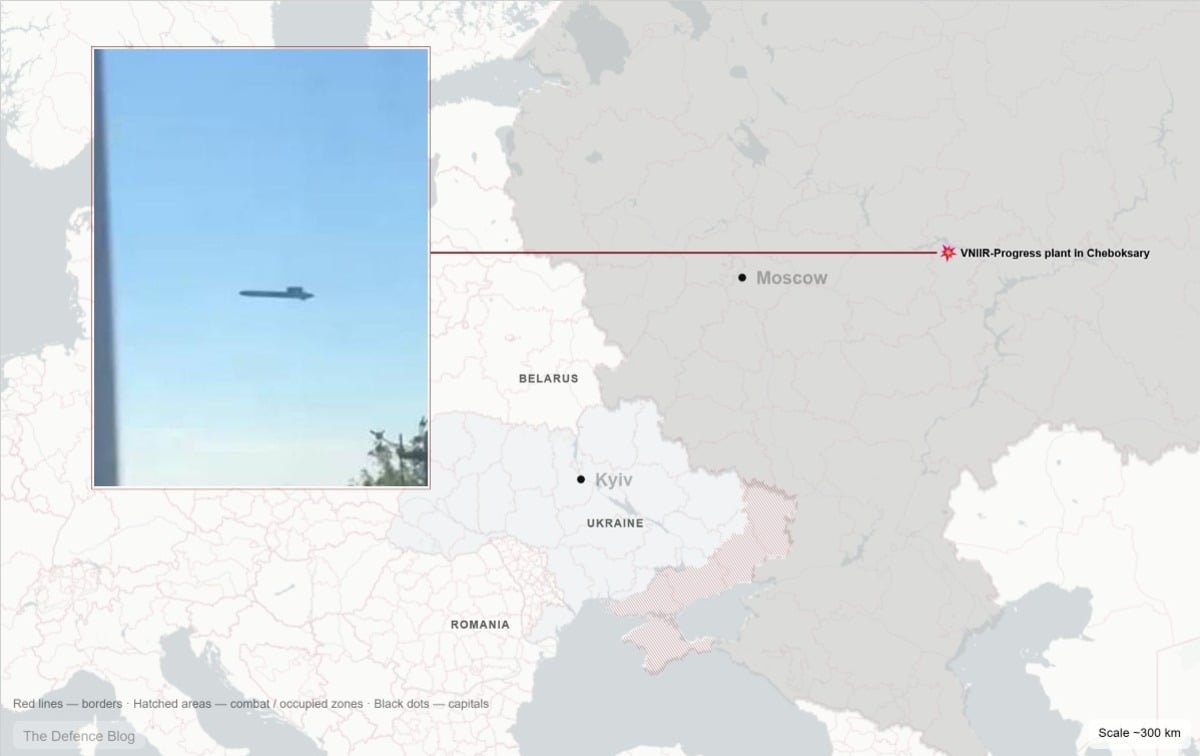
- Ukraine struck the VNIIR-Progress defense factory in Cheboksary on June 10, 2026, with FP-5 Flamingo cruise missiles, the second attack on the same facility in five weeks.
- The plant produces Kometa-M anti-jamming navigation modules for Shahed drones and guided bombs; streets surrounding the facility were blocked and the building was still burning.
Ukraine struck a Russian defense electronics factory for the second time in five weeks on Tuesday, hitting the same Cheboksary facility with domestically developed Flamingo cruise missiles, demonstrating both the growing reach of Ukrainian long-range weapons and the persistent vulnerability of Russian military industry to attacks that Moscow’s air defenses cannot reliably stop.
The target was the VNIIR-Progress in Cheboksary, the capital of Russia’s Chuvash Republic, located approximately 1,000 km (620 miles) from the Ukrainian border. Monitoring channel Exilenova+ identified the weapons used as Ukrainian FP-5 Flamingo cruise missiles. Denys Shtilerman, co-owner and chief designer of Fire Point, published a launch image on X on June 10 without further details.
Streets surrounding the facility were reportedly blocked on the morning of June 10, and the factory building was still burning. The June 10 strike followed a May 5 attack on the same facility in which Flamingo missiles struck the administrative building of the plant, a strike confirmed by President Volodymyr Zelensky, who released video of the launches and described the operation as part of Ukraine’s Deep Strike campaign.
Ukraine’s General Staff has described the facility as a producer of components for Russia’s high-precision weapons systems, including Kometa-M anti-jamming satellite navigation antenna modules used in Shahed-type drones, missiles, and guided bomb kits — the precise weapons Russia uses to strike Ukrainian cities and infrastructure on a near-nightly basis. The facility also produces electronics for Russian naval platforms including Yasen-M class nuclear submarines, and according to prior reporting supplies components for S-300, S-400, and S-500 air defense systems, T-90M tanks, and Armata armored platforms. Striking it repeatedly is not incidental — it is a direct attempt to degrade the production lines that sustain Russia’s capacity to wage the war.
The FP-5 Flamingo is a cruise missile developed by Fire Point, a Ukrainian defense firm whose founders came from non-military backgrounds including construction, game design, and architecture. The missile was first publicly revealed in August 2025, when Associated Press photographer Efrem Lukatsky documented a test launch at a hidden facility in southern Ukraine. President Zelensky announced serial production had begun at the time and described it as “the most successful missile we have.” Fire Point has since exhibited the system internationally, presenting a mockup alongside its trailer-based launcher at SAHA Expo 2026 in Istanbul, signaling intent to enter the export market alongside its combat use. The Flamingo’s road-mobile launch concept, designed to allow strike units to operate without fixed infrastructure, is directly suited to the kind of dispersed, survivable strike operations that Ukraine has been developing to stay ahead of Russian counter-battery and precision strike campaigns against its own military assets.
The June 10 strike is the latest in a series of escalating Ukrainian attacks on Russian defense industrial targets deep inside the country. Previous Flamingo strikes have included the Votkinsk Machine Building Plant in Udmurtia, a facility involved in the production of Russia’s most strategically sensitive ballistic missiles, struck in February 2026 with a missile carrying a 1,000 kg (2,200 lb) warhead. Each successful deep strike adds to a documented pattern that forces Russian military planners to consider moving critical production further east, adding logistics costs and complexity, or accepting that factories they previously considered safe are now legitimate targets reachable by Ukrainian weapons.