

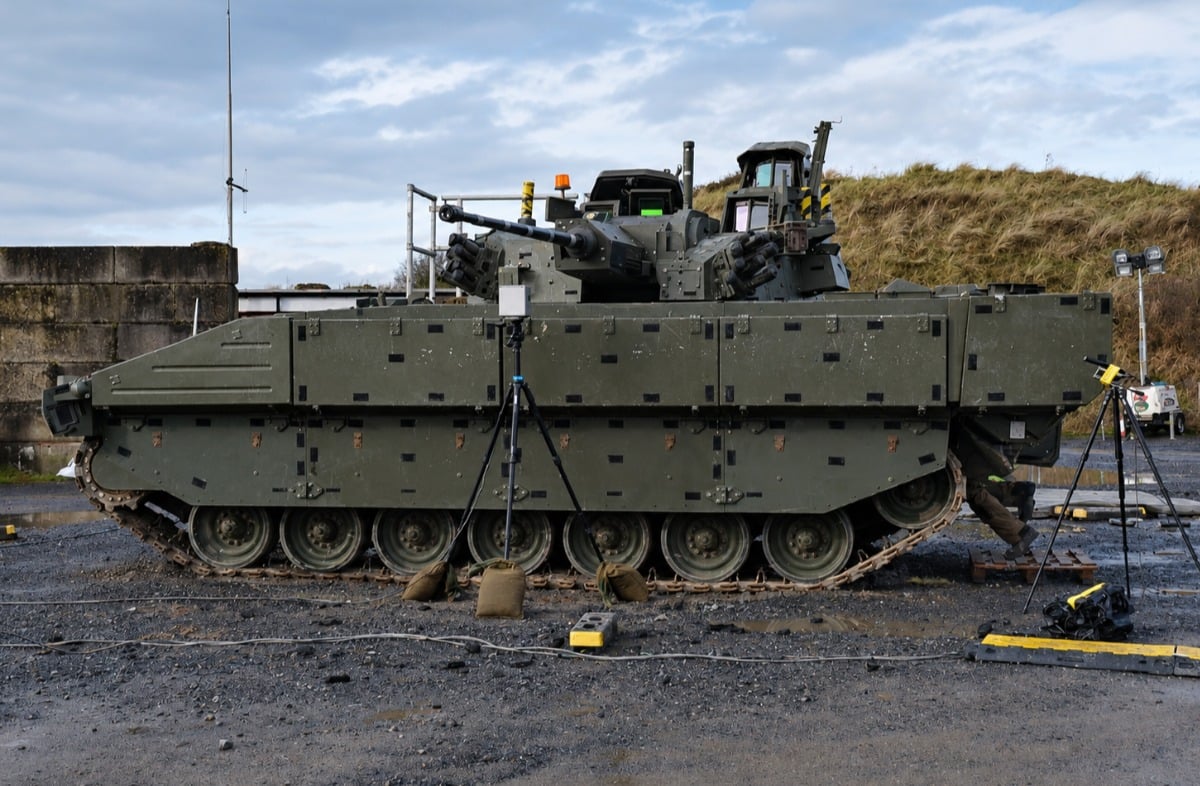
- UK Defence Minister Luke Pollard told Parliament the MoD is pursuing a two-phase approach to deliver an improved Ajax vehicle, beginning with restarted trials under tightly controlled conditions.
- Phase 2 will deliver improvements to air filtration, crew heating, and electrical power generation within months, identified as priorities following Exercise Titan Storm.
Britain’s long-troubled Ajax armored reconnaissance vehicle is being put back into trials under tightly controlled conditions as the Ministry of Defence pursues a two-phase plan to deliver a fixed version of the program, the UK Defence Journal reported.
Minister Luke Pollard set out the approach in a written answer to Conservative MP Ben Obese-Jecty, who represents the Huntingdon constituency and had asked what progress had been made on what he described as Ajax 2. Pollard told Parliament the department was “working on a phased approach to delivering an improved Ajax vehicle,” beginning with a first phase that restarts trials on the current platform with a limited number of vehicles operating “under tightly controlled conditions and maintenance regimes.” The second phase, Pollard said, would deliver “a number of significant enhancements within months,” including improvements to air filtration, crew-compartment heating, and the electrical power generation system, which he described as “key themes identified and prioritised following Exercise Titan Storm.”
Ajax has been one of the most publicly embarrassing procurement failures in recent British defense history, a story of repeated delays, serious injuries, and spiraling costs that has occupied parliamentary scrutiny committees for the better part of a decade. The vehicle is a 42-tonne (92,600 lb) tracked armored reconnaissance platform, built by General Dynamics UK as the centerpiece of a program that was contracted in 2014 to replace aging Scimitar and Warrior vehicles in the British Army’s reconnaissance role. From the outset, Ajax was ambitious: it was supposed to deliver a family of six variants, all sharing a common hull, with the Ajax reconnaissance variant leading the family. Initial deliveries and service milestones were originally expected much earlier, before the programme was hit by repeated delays.
The specific problems that brought Ajax’s trials to a halt in the early 2020s were not abstract procurement failures. Soldiers operating the vehicles during trials reported noise and vibration so severe that multiple crew members suffered hearing loss and other physical injuries, prompting the Army to suspend trials entirely while investigations attempted to identify the root cause. The National Audit Office, which scrutinizes government spending, and the Commons Defence and Public Accounts Committees both launched inquiries and issued critical reports. The noise and vibration issue proved frustratingly difficult to isolate and resolve, in part because it was not a single identifiable fault but a combination of factors across the vehicle’s systems. That complexity is reflected in the current two-phase approach, which separates the immediate resumption of limited trials from the delivery of hardware fixes that will take months to develop and implement.
Exercise Titan Storm, the large-scale British Army exercise that Pollard referenced as the basis for identifying the key improvement themes, was a significant test of the Army’s ability to conduct armored operations at scale. The identification of air filtration, crew-compartment heating, and electrical power generation as priority improvement areas following that exercise gives a clearer picture of the gaps the enhanced Ajax variant will need to close. Air filtration affects crew endurance in dusty or contaminated environments, crew-compartment heating is a fundamental requirement for sustained operations in cold climates including Northern Europe where the British Army trains and would fight, and electrical power generation capacity determines what sensors, communications systems, and electronic equipment the vehicle can support in the field. None of these are exotic requirements. All of them are basic standards that a modern armored vehicle should meet from the outset.
The British Army has been waiting for a capable organic armored reconnaissance capability for years while Ajax worked through its problems. Scimitar, the Cold War-era tracked reconnaissance vehicle that Ajax was meant to replace, has served far longer than intended, with the vehicles that conducted reconnaissance in the Gulf War and Bosnia now significantly aged. The reconnaissance role is not peripheral to armored warfare: it is how commanders develop the situational awareness needed to employ the rest of the force effectively, which makes the absence of a capable replacement for the existing aging fleet a genuine operational liability rather than simply a procurement embarrassment.
General Dynamics UK, the British subsidiary of the American defense company, has been the prime contractor throughout the program’s troubled history. The company has not made a public statement in connection with Pollard’s parliamentary answer. The Ministry of Defence has not disclosed how many vehicles will participate in the restarted trials, what the specific timeline for Phase 2 hardware improvements looks like beyond the “within months” characterization Pollard provided, or what the total program cost has reached at this point. Pollard indicated he would continue updating Parliament through written ministerial statements as developments occur.
Ajax’s story is ultimately about the gap between what a defense program promises when it is contracted and what engineering reality delivers under the pressures of actual development. The British Army signed a contract for a transformative vehicle family in 2014 and is now, more than a decade later, restarting tightly controlled trials on a limited fleet while preparing hardware fixes that should have been standard features from the beginning. Pollard’s parliamentary statement is the latest in a long series. Whether the two-phase approach finally closes the chapter, or opens another one, will be determined by what happens when those vehicles go back into trials.