

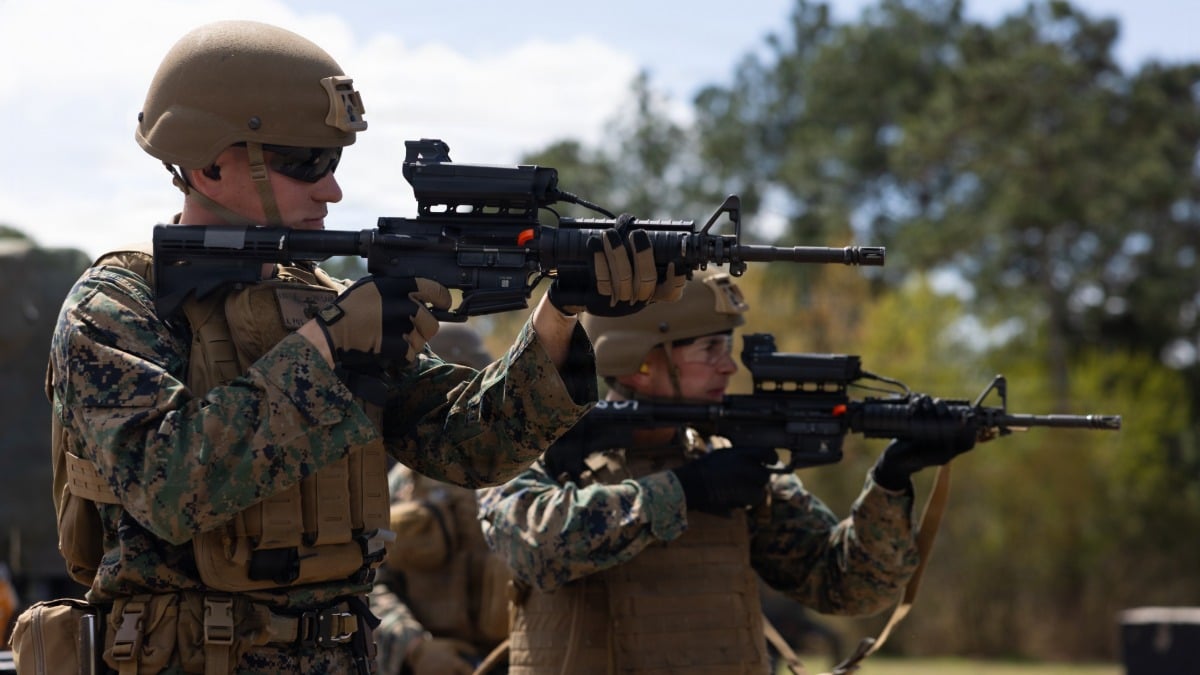
- Smart Shooter received a follow-on U.S. Marine Corps contract for SMASH 2000LE fire control systems valued at $3.4 million, with options bringing the potential total to approximately $5.8 million.
- The contract, issued by Marine Corps Systems Command, follows multiple Smart Shooter awards across four U.S. military branches in the past year: Army, Marine Corps, Air Force, and Navy.
The U.S. Marine Corps has placed a follow-on order for Israeli-made AI-powered rifle scopes that allow Marines to engage small drones with standard rifles fitted with SMASH fire control systems, awarding a contract worth up to $5.8 million to Smart Shooter.
Smart Shooter, an Israeli defense technology company specializing in fire control systems, announced the contract from Marine Corps Systems Command, the procurement organization responsible for equipping Marines with weapons and equipment. The follow-on contract is valued at $3.4 million and covers soldier-portable SMASH 2000LE systems, also designated SMASH 3000SA in some configurations, with options worth about $2.4 million for additional systems, spare parts, and training that could bring the total value to approximately $5.8 million if fully exercised. The award confirms the Corps is expanding its inventory of the system rather than conducting an initial evaluation.
Where a standard combat scope simply magnifies and illuminates a target for the shooter to aim at manually, the SMASH integrates a camera, an onboard computer, and a fire control algorithm that tracks moving targets and calculates the precise moment to fire. The shooter acquires and locks onto a target through the optic, then squeezes the trigger, but the system only releases the shot when its internal calculations confirm the weapon is correctly aligned for a hit. The result, as Smart Shooter describes it, is that the rifle fires itself at the optimal moment rather than depending on the shooter’s ability to track a moving target and pull the trigger at precisely the right instant. Against a small fast-moving drone, which can cross a shooter’s field of view in a fraction of a second and presents a radar cross-section smaller than a bird, that timing capability is the difference between a miss and a kill.
The operational significance of that capability has become increasingly clear as small commercial and military drones have proliferated across conflict zones from Ukraine to the Middle East. Traditional counter-drone options include electronic jamming, which requires specialized equipment, nets, which require the drone to fly within very short range, and dedicated interceptor missiles or kinetic systems, which are expensive relative to the cost of the threat they defeat. A software-equipped scope that allows a Marine with a standard rifle to engage and reliably hit a drone costing a few hundred dollars represents a fundamentally different cost and logistics equation. It requires no new weapon, no new ammunition, and no platform integration beyond the scope itself, which attaches to any standard Picatinny rail.
Smart Shooter noted that over the past year it has signed multiple contracts across four U.S. military branches: the Army, Marine Corps, Air Force, and Navy. That spread reflects the breadth of the counter-drone problem within the U.S. military. Every branch that operates ground forces, airbases, ships, or installations has to contend with the drone threat, and every one of them is looking for solutions that can be fielded quickly without waiting for purpose-built systems to complete lengthy development and procurement cycles. The SMASH system’s compatibility with existing weapons and its relatively low unit cost compared to dedicated counter-drone platforms makes it a candidate for rapid fielding across diverse environments and force structures.
The Marine Corps has been particularly active in seeking counter-drone capability across a range of platforms and system types, driven partly by its expeditionary mission profile. Marine units operating from amphibious ships, remote air bases, or forward positions in the Pacific cannot always rely on the layered air defense infrastructure that protects fixed installations, making organic counter-drone capability at the squad and platoon level more operationally critical than it might be for forces operating under a comprehensive air defense umbrella. A Marine who can engage a surveillance or attack drone without calling for support from a dedicated counter-drone system can act immediately on a time-sensitive threat without waiting for assets that may not be available or in range.
The SMASH system has previously been tested and used in operational environments beyond U.S. military evaluations. Israel, where Smart Shooter is headquartered, has deployed the technology with its own forces and has reportedly used it in operational conditions. Multiple allied nations have evaluated or acquired the system, and Smart Shooter has been expanding its customer base across NATO and partner countries in parallel with its U.S. military contract activity.
“We are pleased to continue expanding our collaboration with the U.S. Marine Corps,” said Michal Mor, CEO of Smart Shooter. “This follow-on contract is a testament to the operational value our SMASH systems provide, meeting the urgent need for effective counter-UAS solutions at the individual soldier level.”
The accumulation of contracts across the Army, Marine Corps, Air Force, and Navy within a single year suggests Smart Shooter has moved from a company conducting demonstrations and trials with U.S. defense organizations to one that multiple branches are now actively buying from on a repeat basis.