

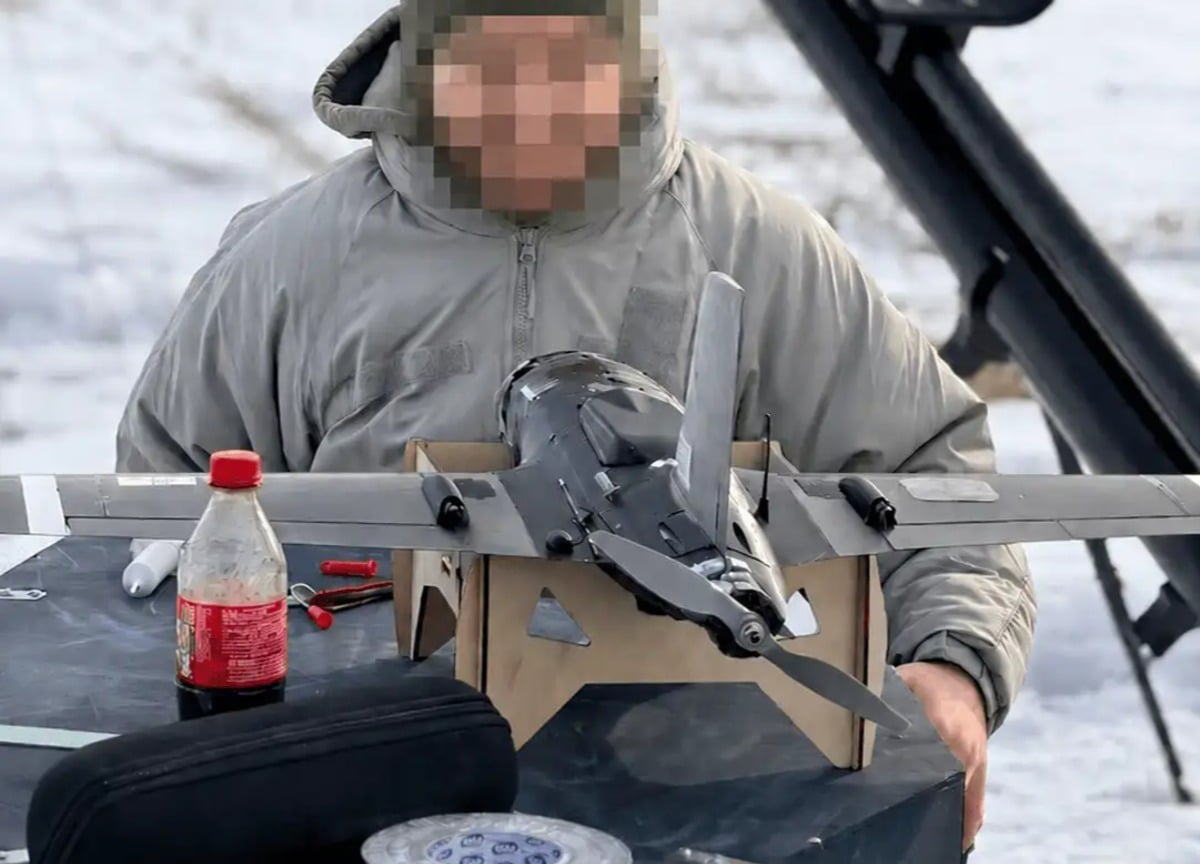
- MaXon Systems, identified by Defender Media, built the autonomous Shahed interceptor confirmed in combat by Ukraine's 12th Special Purpose Center in Kharkiv Oblast on June 8, 2026.
- The fixed-wing interceptor costs approximately $3,500, operates at up to 300 km/h, has a 30 km working radius, and uses GPS-independent navigation with AI terminal guidance from a Dutch partner.
The Ukrainian startup behind the autonomous Shahed interceptor system announced this week by Ukraine’s Defense Minister has a name, a price tag, and a detailed technical story: MaXon Systems, a Kyiv-based defense technology company, built an interceptor drone that kills Shaheds on autopilot for approximately $3,500 per unit, Defender Media reported in an exclusive interview with MaXon CEO Oleksiy Solntsev.
Ukraine’s Defense Minister Mykhailo Fedorov announced on June 8 that a developer participating in the Brave1 defense innovation cluster had developed a technology automating 95 percent of the Shahed interception cycle. Defender Media’s reporting, published the same day video confirmation was released by the Brave1 state defense technology cluster, fills in the details Fedorov’s announcement left out: the company, the technical architecture, the combat unit that conducted the test, and the roadmap for scaling production. The successful interception was carried out by Ukraine’s 12th Separate Special Purpose Center.
MaXon Systems is not a new name in Ukrainian defense circles. Defender Media first spoke with Solntsev in August 2025, when the company was developing an air-to-air interception concept in which drone interceptors would be launched from aerostats, tethered balloons used as elevated launch platforms. That concept was shelved in favor of a faster path to the battlefield. The current system, a ground-launched fixed-wing interceptor developed essentially from scratch, emerged from that strategic pivot and from lessons the team drew directly from combat testing.
During trials last year, MaXon observed that conventional interceptor drones perform well in good weather and in the hands of a skilled pilot, but that effectiveness dropped sharply under adverse conditions. The second problem was swarms: as Russia increasingly sends Shaheds in clusters arriving simultaneously from multiple directions, even a highly skilled crew cannot manually intercept more than one target at a time in FPV mode. The combination of weather dependence and swarm saturation pointed toward a single solution, an autonomous system where hardware and software eliminate the weather variable and the operator skill variable from the interception equation entirely.
The interceptor MaXon built to meet those requirements is a small fixed-wing drone capable of carrying a 1 kg (2.2 lb) warhead, sustaining cruise flight for up to 70 minutes, maintaining a pursuit speed of 200 to 250 km/h (124 to 155 mph) against a target, and reaching a maximum speed of 300 km/h (186 mph) for several minutes when needed. Its working radius is 30 km (18.6 miles), calibrated to the size of the air defense sector the system is designed to cover. Solntsev told Defender Media that the interceptor has enough energy margin to pursue one target, break off, and pursue a second within the same sortie.
The technical breakthrough, however, is not the airframe. It is the three-phase automation chain that MaXon built around it. Solntsev describes the interception process as three stages: launch, transit to the target area, and terminal guidance. Many Ukrainian developers have achieved automation of the third phase, the so-called last mile, where AI-guided terminal homing locks onto and guides the interceptor to impact. The harder problem, as the head sergeant of the 413th SBS “Raid” Regiment’s anti-drone platoon, call sign “Pegasus,” told Defender Media in a separate interview, is everything before that: getting the interceptor to the target area and into a position where terminal guidance can engage.
MaXon’s system automates all three phases. A single button press launches the interceptor and guides it autonomously to a pre-set altitude. Once stabilized, the drone waits for target assignment. The operator, watching a control station display fed by radar data, selects a target on screen and presses Start. The interceptor flies to the target on autopilot, with the operator able to select approach speed and method. On the final approach, AI-powered terminal guidance developed by a Dutch partner company handles detection, tracking, and impact guidance. Navigation throughout runs on beacons and onboard sensors rather than GPS, meaning the system maintains full situational awareness and autopilot function even when satellite navigation is jammed or unavailable. MaXon built its own autopilot solution integrating beacon data with onboard sensor feeds; the AI detection and terminal guidance system comes from a Dutch partner the company did not name publicly in this interview.
The combat result from the Kharkiv Oblast test confirmed by the Brave1 cluster showed 90 to 95 percent autonomous interceptions, with pilots making only minor manual corrections. Solntsev told Defender Media that the system already has several confirmed Shahed kills from combat testing.
At $3,500 per interceptor, the cost arithmetic against the Shahed is compelling. The Iranian-designed one-way attack drone that Russia manufactures under license and deploys in mass salvos costs Russia an estimated $40,000 to $80,000 per unit depending on the version. Ukraine has been destroying them with everything from Western air defense missiles costing tens of thousands of dollars to modified commercial drones costing a fraction of that. A purpose-built autonomous interceptor at $3,500 that operates without skilled pilot input and can be deployed in multiples by a single crew represents a meaningful shift in the cost and scalability of Ukraine’s drone defense layer.
MaXon is now moving from combat validation to early-scale production, preparing to fulfill its first unit order. The company recently closed a pre-seed funding round that included American fund Green Flag Ventures, Swedish fund Hede Capital, and Finnish fund Big Defence, in addition to previously announced investors Defence Builder Fund, Freedom Fund, and angel investors. Solntsev did not disclose the final pre-seed total but said the company plans to raise more than $1 million at seed stage to fund team and production scaling. The codification process, the formal registration of the system with Ukrainian defense authorities that precedes official military procurement, is underway.
The roadmap Solntsev described to Defender Media goes considerably further than the current system. MaXon’s R&D direction is what he calls multi-target remote control: one operator managing multiple interceptor launch stations positioned at different locations, with the crew itself located tens or hundreds of kilometers from the launch sites. Solntsev drew an explicit comparison to the Patriot air defense system, with its single command center directing multiple remote launchers. The team is also planning upgrades to handle jet-powered Shahed variants, the faster and more capable versions Russia has been developing, which demand higher interceptor performance than the current system was designed to meet.
Ukraine’s drone interception problem is ultimately arithmetic: Russia can launch more Shaheds per night than any manually operated defense can engage. The solution MaXon has built, and that the Brave1 cluster and the 12th Special Purpose Center have now validated in combat, is one that scales with the threat rather than being bounded by how many skilled pilots a unit can field.