

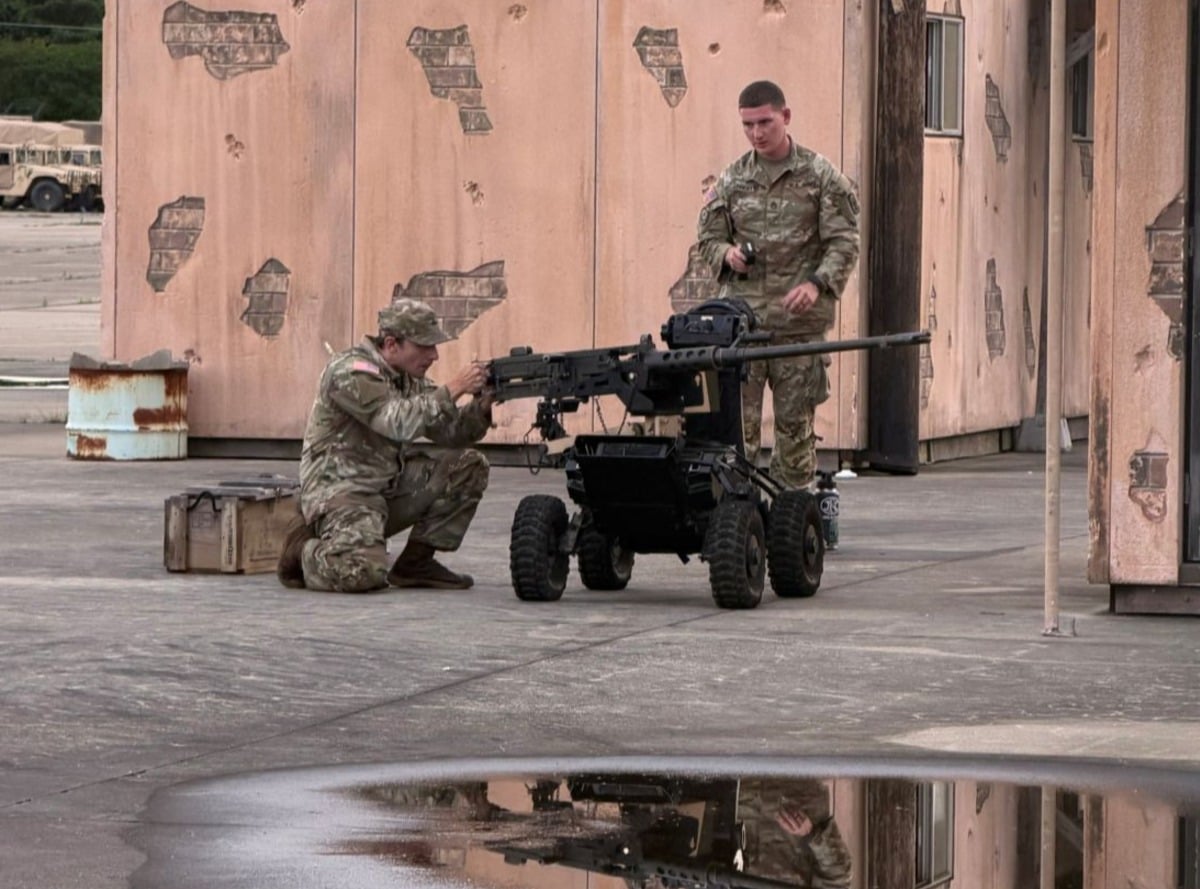
- American Rheinmetall and Marom Dolphin conducted several days of Wild Goose IMRS training with U.S. Army soldiers, the companies announced on their official channels.
- The Wild Goose weighs 68 kg (150 lb), carries up to 150 kg (330 lb) of payload, and operates at ranges up to 22 km (14 miles) across dismounted terrain.
U.S. Army soldiers recently trained alongside the Wild Goose robotic ground vehicle, a small unmanned platform designed to carry heavy weapons, ammunition, and casualties across terrain that wheeled vehicles cannot reach, according to an announcement from American Rheinmetall, the American subsidiary of the German defense giant.
The training, conducted over several days in partnership with Israeli firm Marom Dolphin, which developed the system, marks a meaningful step in the Army’s broader push to field robotic logistics platforms that reduce the physical burden on dismounted infantry without requiring a separate operator vehicle or complex supporting infrastructure.
The Wild Goose, formally designated the Infantry Modular Robotic System, weighs just 68 kg (150 lb) and can carry up to 150 kg (330 lb) of payload, a load ratio that reflects engineering choices prioritizing agility and deployability over sheer hauling capacity. A soldier carrying the standard combat load of roughly 45 to 68 kg (100 to 150 lb) in equipment, weapons, and ammunition is already operating near the physiological limits of sustained performance. In mountainous terrain, dense forests, or urban rubble, that load degrades speed, reaction time, and endurance over the course of an operation. The Wild Goose addresses that problem directly: it moves the machine guns, anti-tank missiles, mortar rounds, medical supplies, and other heavy equipment that infantry units need but cannot carry indefinitely, leaving soldiers to reach the objective with more energy and combat effectiveness.
The system’s range figures are operationally significant. American Rheinmetall describes a maximum range of approximately 22 km (14 miles), terrain dependent, with remote operation capability beyond 1.6 km (1 mile), meaning a single operator can direct the platform across a substantial distance while maintaining line-of-sight or near-line-of-sight control. That operational envelope covers the distances between a vehicle drop-off point and an objective that dismounted infantry typically cross on foot, a gap that has historically required every soldier in the patrol to carry everything they will need for the entire movement. A robot that can reliably follow the patrol, carry the heaviest items, and be controlled from over a mile away changes the logistics calculation for light infantry formations in a meaningful way.
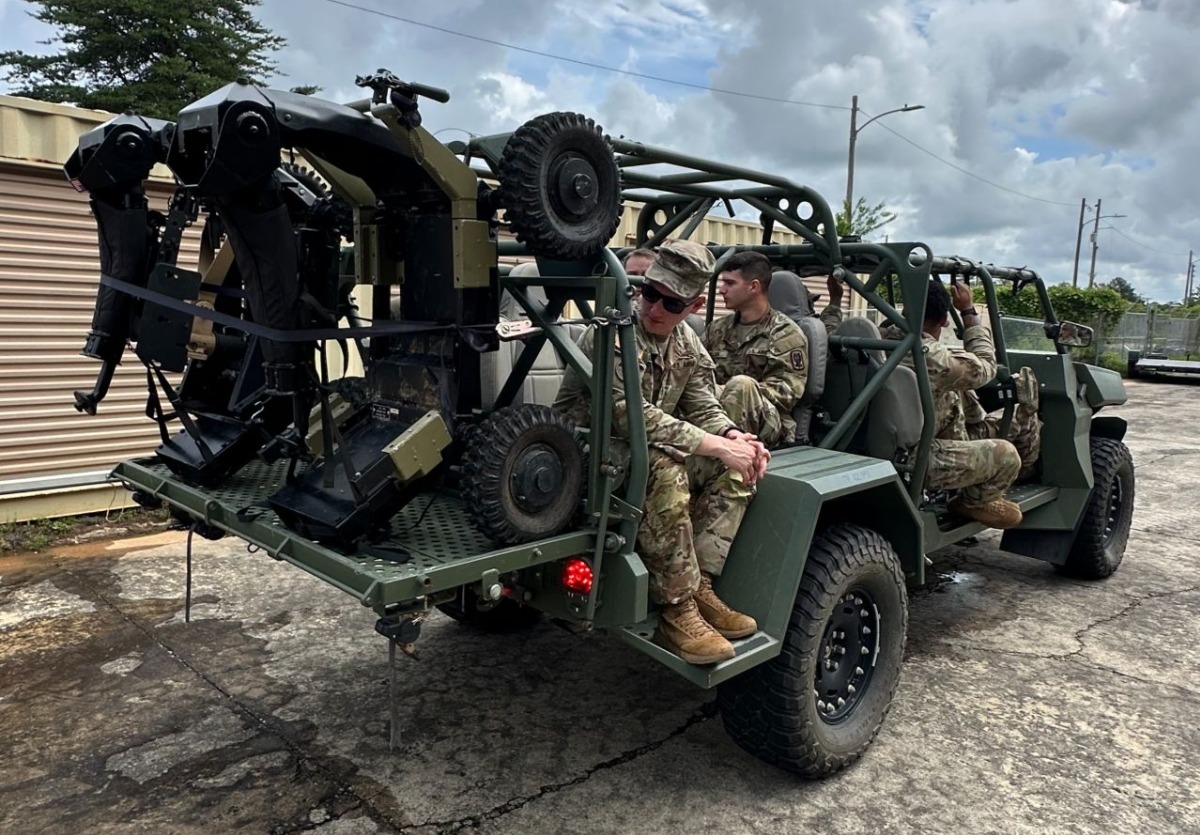
Marom Dolphin, the Israeli company that designed the underlying system, built the Wild Goose around what it describes as a patented hybrid robotic architecture featuring an elastic gooseneck joint that provides extreme agility on uneven ground and near-silent operation through reduced acoustic and thermal signatures. That silence dimension matters in contexts where noise discipline is a tactical requirement, particularly in reconnaissance missions, raids, and operations close to enemy positions where a conventional logistics vehicle’s engine noise would compromise the element. High torque at all speeds allows the system to maintain traction and pulling power across steep gradients and loose surfaces without the rpm surge and noise that accompanies conventional drivetrains under load.
The system’s modular design allows field reconfiguration without tools, and its transport compatibility is broad: it fits on the UH-60 Black Hawk utility helicopter, the Infantry Squad Vehicle, the HMMWV, and the Stryker armored personnel carrier, meaning it can be brought forward by a range of platforms already in the Army’s inventory without requiring dedicated transport. That interoperability is a recurring theme in American Rheinmetall’s pitch for the system, because a robotic platform that requires its own specialized transport vehicle solves one logistics problem while creating another. The Wild Goose’s ability to mount on existing Army platforms without modification addresses that concern directly.
The Defence Blog has previously reported on American Rheinmetall showcasing the Wild Goose alongside its Mission Master Silent Partner Hotel amphibious autonomous ground vehicle at Modern Day Marine in April 2026, where the company presented a broader portfolio of unmanned ground systems aimed at both Army and Marine Corps buyers. In February 2026, The Defence Blog reported that Italy’s 187th Paratroopers Regiment “Folgore” had begun operational integration testing of the same system, evaluating how robotic transport can sustain airborne infantry formations during early phases of deployment when vehicle access is limited. The U.S. Army training exercise described in American Rheinmetall’s announcement adds a third national military to the list of Western forces actively evaluating the platform.

The infantry soldier’s load has been a recognized problem in the U.S. military for decades. Study after study, dating back to assessments from the Gulf War and accelerated by research from Afghanistan, has documented how excessive combat loads degrade performance, increase injury rates, and reduce the combat effectiveness of the soldiers carrying them. Robotic logistics is one of the few credible answers to that problem that does not require soldiers to simply carry less, which is operationally unacceptable, or to bring vehicles into terrain where vehicles cannot go, which is tactically unfeasible. The Wild Goose is a practical attempt to break that equation, and the Army is now spending training days finding out whether it actually does.