

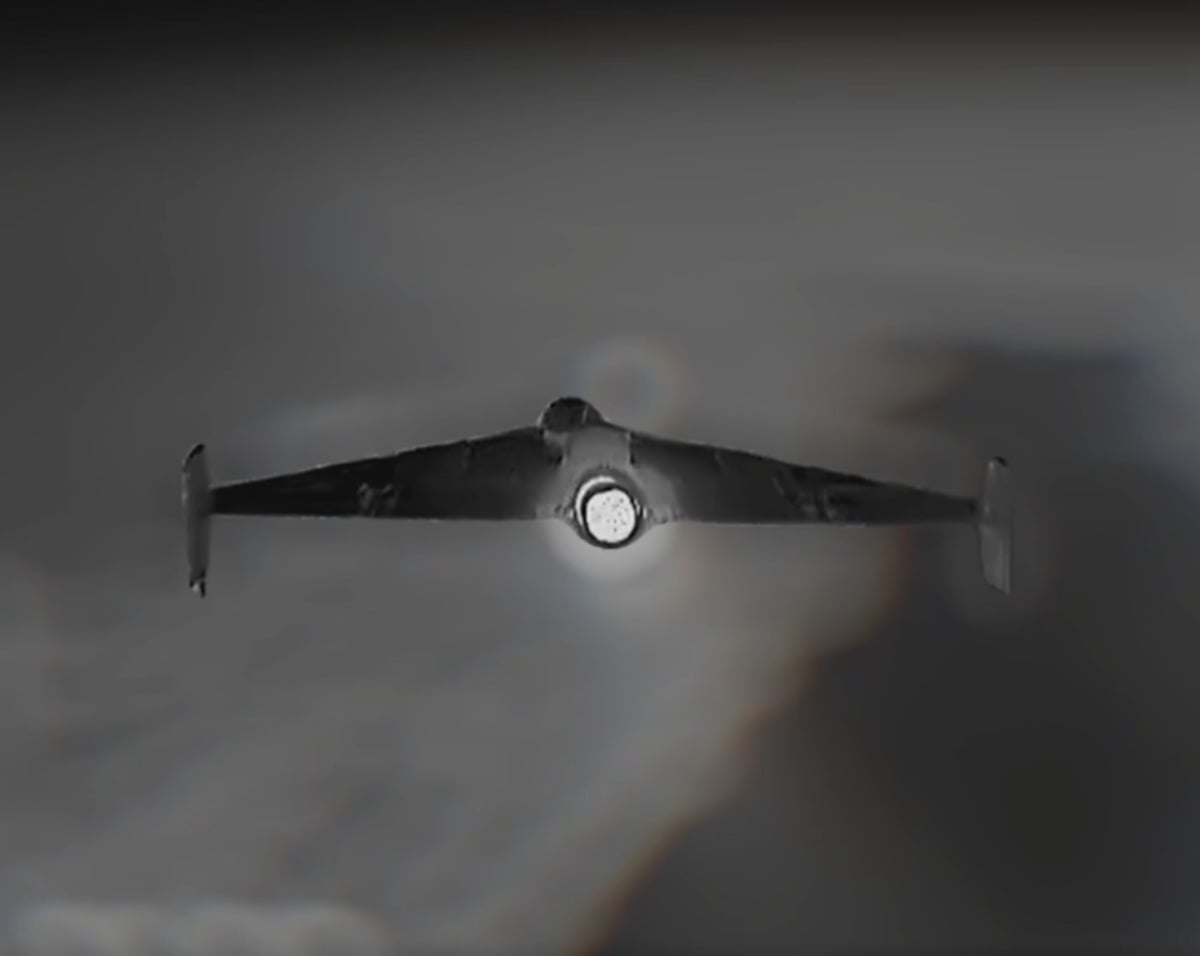
- Ukraine's Defense Minister Fedorov announced a Brave1-developed autonomous interceptor drone that automates 95% of the Shahed interception process completed successful combat tests in Kharkiv Oblast.
- The system guides itself to target autonomously after operator target selection, going from prototype to combat use in under one year with Brave1 support.
Ukraine has crossed a significant threshold in its air defense campaign against Russian drone attacks: an autonomous interceptor drone that can hunt down and destroy Shahed loitering munitions with minimal human input has now completed its first successful combat engagements in the Kharkiv region.
Ukrainian Defense Minister Mykhailo Fedorov announced the achievement, describing a system developed by a participant in the Brave1 defense technology cluster that automates 95 percent of the entire interception process, from drone launch to Shahed destruction. The operator selects a target from a real-time display of moving threats and issues a strike command. From that point, the system guides the interceptor drone to the target autonomously, recognizes the Shahed independently, and homes in without further human input. The developer went from prototype to successful combat use in under a year, supported by the Brave1 program, which connects Ukrainian defense startups with military end users, government funding, and accelerated testing pathways.
Conventional drone interception, even with capable interceptor platforms, requires a skilled pilot to manually fly the interceptor through a three-dimensional engagement, tracking a target that may be flying at night, in poor weather, at low altitude, and potentially among multiple simultaneous threats. That pilot workload creates a hard ceiling on how many interceptions a single operator can execute during a mass attack, and Russia has consistently structured its Shahed campaigns to saturate Ukrainian defenses by launching dozens or hundreds of drones simultaneously from multiple directions. A system that handles terminal guidance autonomously allows one operator to manage multiple interceptions in parallel, compressing the engagement timeline and reducing the skill threshold required at the point of firing.
The Shahed-136, the Iranian-designed one-way attack drone that Russia manufactures under license and has deployed in the thousands against Ukrainian cities and infrastructure since late 2022, has been one of the defining weapons of the conflict. With a delta-wing airframe, a piston engine producing its characteristic buzzing sound, and a warhead in the range of 40 to 50 kg (88 to 110 lb), the Shahed is cheap enough to produce at scale and difficult enough to intercept consistently that Russia has used mass salvos to overwhelm Ukrainian air defenses. Ukraine has developed and fielded a range of countermeasures including electronic jamming, mobile gun systems, and interceptor drones, with the drone-on-drone approach proving particularly cost-effective compared to using surface-to-air missiles worth many times the cost of the target.
The combat test in Kharkiv Oblast carries geographic weight. Kharkiv, Ukraine’s second-largest city, sits approximately 40 km (25 miles) from the Russian border and has been one of the most consistently struck urban areas of the war, subjected to ballistic missile, glide bomb, and drone attacks throughout the conflict. Conducting the combat validation of a new interception system in that environment rather than at a test range means the autonomous guidance was proven against real targets under real operational pressure, with electronic warfare active in the environment and the full complexity of a contested airspace around it.
Fedorov has been the driving force behind Ukraine’s Brave1 defense technology ecosystem since its establishment in 2023. Brave1 functions as a structured bridge between Ukrainian technology developers and the armed forces, providing grant funding, access to military testers, regulatory fast-tracking, and procurement connections that compress the timeline from laboratory prototype to fielded capability. The program has supported hundreds of projects across drones, electronic warfare, software, and robotics, and the interceptor drone announcement represents one of its most operationally significant outputs to date. The specific company behind the autonomous interception system was not named in Fedorov’s announcement.
The autonomy dimension is where the technology connects to a broader trajectory in air defense development worldwide. The fundamental challenge of mass drone attacks is arithmetic: a human operator can only process and engage so many targets per minute, while an attacker can flood the engagement zone with more threats than any manually operated defense can handle. Autonomous terminal guidance, where a human selects the target and authorizes the engagement but the system handles the physical interception, pushes the throughput ceiling substantially higher. It also reduces the exposure of trained operators, who remain at a safe distance from the engagement rather than physically flying near targets that may carry explosive warheads.
Ukraine is not the first country to develop autonomous drone interception capability, but it is the first to validate it in continuous large-scale combat use against a sophisticated adversary actively deploying electronic warfare. That validation gap between laboratory demonstration and proven battlefield performance is what separates theoretical capability from operational reality, and Fedorov’s announcement that the system has crossed that line in Kharkiv carries weight that a controlled test result cannot match. The minister’s explicit commitment to scaling the solution — his words were “scaling solutions that have already proven their effectiveness in combat conditions” — signals that this is not a one-off prototype announcement but an intent to push the technology into wider production and deployment.
The race between drone attack and drone defense is one of the most consequential technological competitions of the current era, playing out over Ukrainian cities every night. The side that automates faster, scales cheaper, and iterates more quickly holds the initiative.