

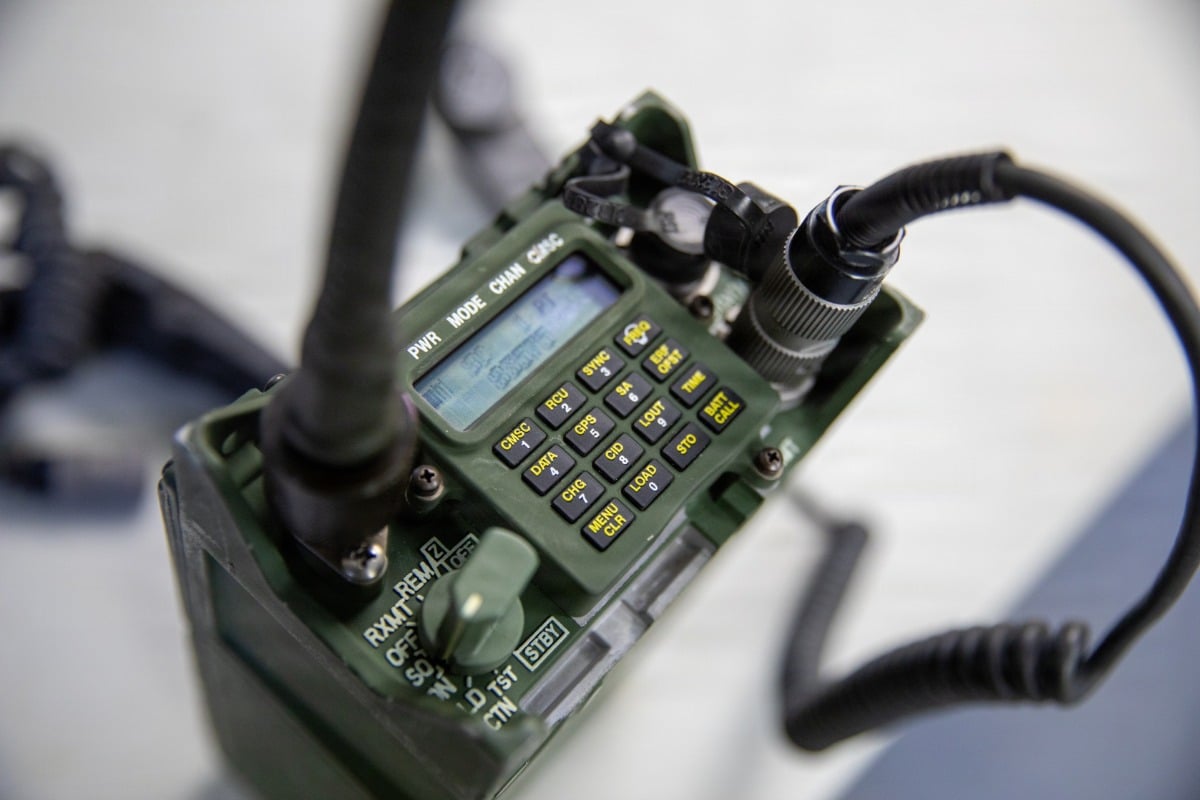
- DARPA published special notice DARPA-SN-26-86 on June 5, announcing plans for the Lightweight Universal Codec program under Program Manager Allyson O'Brien.
- The LUC program aims to develop a single adaptive codec capable of encoding and decoding any error correction standard using DARPA's GRAND noise-decoding technology.
Every radio, satellite link, and data network the military operates speaks a slightly different language, and translating between those languages in a battlefield environment where jamming, interference, and degraded conditions are the norm costs time, bandwidth, and lives. DARPA, the Pentagon’s advanced research arm, published a special notice on June 5, 2026, announcing plans for a program called the Lightweight Universal Codec, or LUC, that would build a single encoder-decoder system capable of communicating across any known error correction standard and any standard developed in the future, a capability that does not currently exist in any military or commercial communications system.
The Defense Advanced Research Projects Agency’s Information Processing Techniques Office, which manages research into computing, communications, and artificial intelligence technologies for military applications, published the notice under designation DARPA-SN-26-86, with Program Manager Allyson O’Brien leading the effort. A formal solicitation has not yet been issued, and DARPA has not committed to releasing one, but the special notice signals the agency’s intent to fund research in this area and invites potential performers to understand the program’s objectives before a formal competition opens.
To understand why a universal codec matters, it helps to understand what a codec does and what the current military communications landscape looks like without one. A codec, short for encoder-decoder, is the software and hardware layer that takes raw information, whether voice, data, sensor feeds, or video, and packages it for transmission across a communications channel by adding error correction code, a mathematical layer that allows the receiving system to detect and correct errors introduced by noise, jamming, or signal degradation during transit. Different communications systems use different error correction codes, developed over decades for specific performance characteristics, frequency bands, and threat environments. A radio designed for one standard cannot natively communicate with equipment running a different standard without additional translation hardware or software, which introduces latency, increases power consumption, and adds points of failure.
The military’s communications inventory is a patchwork of incompatible standards accumulated across decades of procurement, with different services, different platforms, and different allied nations operating systems that struggle to exchange information cleanly in joint and combined operations. Soldiers on the ground, aircraft overhead, ships at sea, and command posts in the rear all rely on communications links that were designed independently and certified to different specifications, creating seams in the joint network that adversaries can exploit and that allied forces must work around through workarounds, gateways, and relay nodes that add complexity and vulnerability.
The LUC program’s approach to solving this problem builds on a specific DARPA research breakthrough called Guessing Random Additive Noise Decoding, known as GRAND, which was developed at the Massachusetts Institute of Technology and has demonstrated the ability to decode virtually any error correction code by treating the problem as a noise-guessing exercise rather than a code-specific algorithm. Traditional decoders are built to understand one specific error correction standard, the way a translator fluent in French cannot automatically translate Spanish without separate training. GRAND approaches decoding differently, modeling the noise characteristics of the channel and using that model to guess what the original transmitted data was regardless of which error correction code was used to send it. The result, if the LUC program can translate the GRAND research into a practical military codec, would be a single decoder that works across any code without needing to know in advance which one the transmitter used.
The encoder side of the LUC system is the complementary challenge. DARPA’s concept calls for an encoder that can dynamically select from a diverse suite of error correction codes in real time, choosing the best code for the current channel conditions, the available power budget, the data throughput requirements, and the specific mission being supported. Crucially, the encoder would incorporate the GRAND decoder’s noise model directly into its code selection process, creating a feedback loop where the encoder picks codes that the paired GRAND decoder can handle most efficiently given the actual conditions on the link. That adaptive, dynamic capability, described in the notice as “on-the-fly changes to error correction codes,” would allow a military communications system to continuously optimize its performance as jamming conditions change, interference sources shift, and the radio frequency environment evolves during an operation.
The performance claims attached to the GRAND-based approach are notable. DARPA describes the resulting codec as achieving “record-setting low-power decoding,” a characteristic that matters enormously for battery-dependent dismounted communications equipment and for small unmanned systems where power budgets are tightly constrained. Lower power consumption for the same decoded data rate means longer battery life, smaller hardware footprints, and reduced thermal signatures, all of which translate directly into operational advantages for soldiers and systems operating in contested environments.
The program’s decision to execute at the unclassified level, with performers working up to but not exceeding Controlled Unclassified Information status, reflects DARPA’s intent to maximize participation from non-traditional defense companies, academic institutions, and commercial communications technology companies that would be excluded from or slowed by a classified program. The commercial telecommunications industry has invested heavily in error correction research for 5G and satellite communications, and the LUC program’s open architecture could potentially allow military communications to benefit from that commercial innovation while contributing military-grade performance improvements back to the commercial sector through the same universal codec.
Performers will be allowed to select their own target communications systems for integration, with DARPA expecting them to identify systems where LUC implementation would demonstrate the greatest or most impactful improvement. That flexibility is deliberate: the agency wants to see the codec proven across a range of real systems rather than tested against a single controlled environment, and allowing performers to choose the most compelling integration targets increases the likelihood that the resulting technology will have direct paths to military and commercial deployment.
The battlefield of 2026 runs on information, and the forces that can move information most reliably, most efficiently, and most securely across the most diverse array of systems will hold a persistent advantage over those that cannot. A universal codec that makes every radio speak to every other radio is not a narrow technical improvement. It is a foundational capability that changes what joint operations can accomplish.