

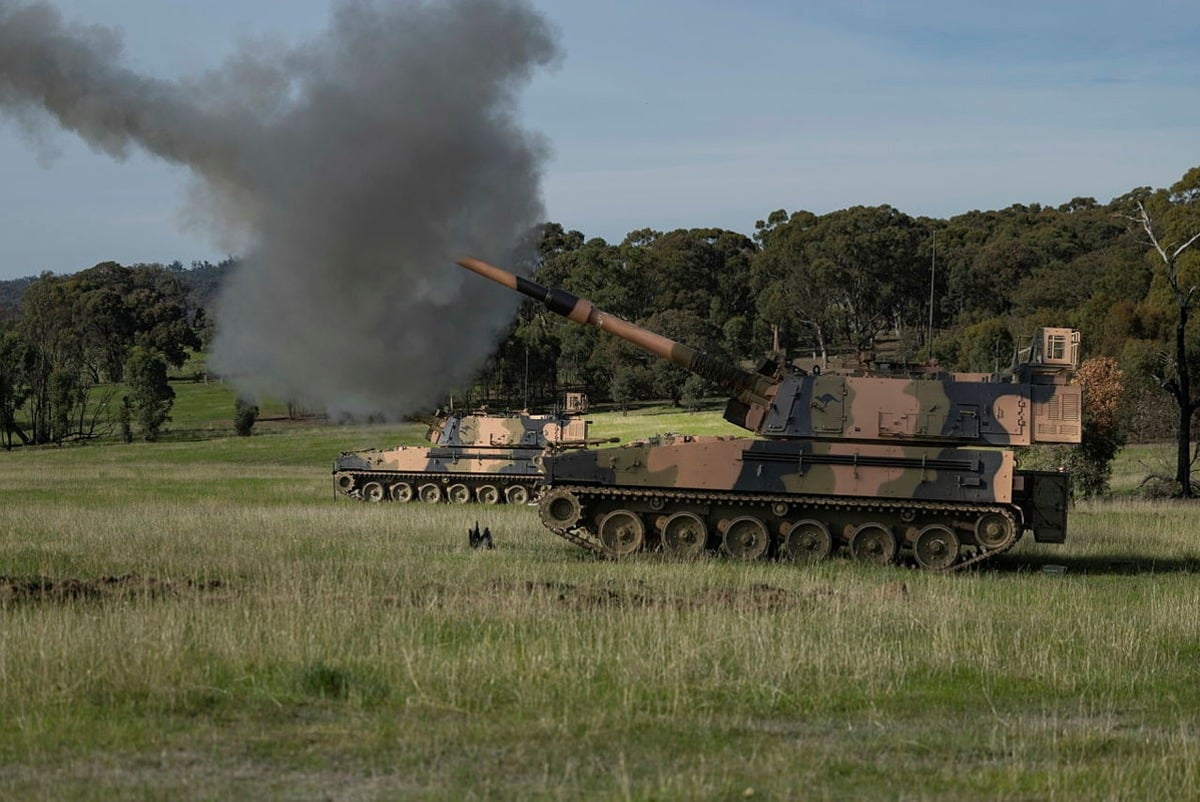
- Thirty gunners from Australia's 4th Regiment, Royal Australian Artillery, fired Australian-built AS9 Huntsman howitzers at Puckapunyal Training Area on June 4, 2026.
- The AS9 Huntsman is manufactured in Geelong, Victoria, and completed the journey from domestic production to trained live-fire crews in a matter of months.
Australia fired its first domestically built self-propelled howitzers during live-fire training last week, completing the journey from a production line in Geelong to live rounds downrange in a matter of months — a timeline that would have seemed implausible for a major weapons system just a few years ago.
Thirty gunners from Townsville’s 4th Regiment, Royal Australian Artillery, fired the new AS9 Huntsman self-propelled howitzers at the conclusion of a six-week operator course at the School of Artillery in Puckapunyal, Victoria, the Australian Defence Department announced on June 4, 2026. The live-fire serials at Puckapunyal Training Area marked the conclusion of Australia’s inaugural AS9 operator course and the first time Australian-manufactured examples of the system had fired in a training context with fully qualified crews.
The AS9 Huntsman is Australia’s domestically produced variant of the South Korean K9 Thunder, one of the most widely exported self-propelled howitzers in the world. Hanwha Defense Australia manufactures the system at a facility in Geelong, Victoria, as part of a sovereign industrial capability agreement. The K9 family is in service with more than a dozen countries including Norway, Finland, Estonia, Poland, India, and Turkey, and several of those nations have pursued varying degrees of local production or licensed assembly under bilateral industrial arrangements with South Korea. That breadth of operational use across demanding environments provides an established performance baseline that Australia can draw on rather than validating a system from scratch.
The howitzer fires 155 mm ammunition, the standard NATO artillery caliber used across Western armies in systems ranging from the towed M777 lightweight howitzer to the American M109 Paladin. At 155 mm, the K9 family can fire standard NATO artillery rounds to a maximum range of approximately 40 km (25 miles) with extended-range ammunition. The platform’s automated gun-laying system allows the howitzer to orient itself to the correct firing azimuth and elevation automatically once fire mission data is entered, removing a time-consuming manual process that towed artillery requires. The crew of five then loads and fires the weapon, with the system handling the precision positioning that previously demanded careful manual survey work before a round could leave the barrel.
The tracked platform also changes how crews operate tactically. A towed howitzer requires the vehicle towing it to stop, unhitch, and then move clear before the gun crew can prepare to fire, a process that takes time and leaves the position static and identifiable to enemy counterbattery radar for longer than commanders would prefer. The AS9 drives into position, lays itself automatically, fires, and can move again within seconds, a capability the military describes as shoot-and-scoot. On a modern battlefield where counterbattery radar and precision-guided munitions make artillery positions highly vulnerable once a gun fires and is located, the ability to relocate rapidly between firing missions is not a luxury but a survivability requirement. Ukraine has demonstrated this with brutal clarity: towed and static artillery that fails to displace after firing is routinely destroyed by Russian counterbattery fire within minutes of its first round.
The speed of the transition from production to trained crews reflects a deliberate effort to compress the timelines that have historically slowed Australian defence capability delivery. Director General Systems and Integration Brigadier James Davis framed it as a product of coordinated effort between the Army, the Capability Acquisition and Sustainment Group, and industry partners. “This live-fire shows how effectively we’re working with our industry and acquisition partners to bring new capability into service,” Brigadier Davis said. “To move from an Australian production line to trained crews conducting live-fire in a short timeframe is a significant achievement. Through strong partnerships, we are delivering modern, Australian-built capability that strengthens Army and contributes to a more self-reliant Defence Force.”
The self-reliance argument carries particular weight in Australia’s current strategic environment. Australia’s 2023 Defence Strategic Review explicitly identified the need to develop sovereign industrial capability and reduce dependence on overseas supply chains for critical military systems, a posture driven by concerns about supply chain vulnerability in a potential conflict in the Indo-Pacific. Manufacturing the AS9 domestically rather than importing finished systems from South Korea means that production and sustainment remain inside Australian borders and under Australian industrial control, an advantage that becomes acute if international logistics chains are disrupted in a crisis.
Commanding Officer of the School of Artillery Lieutenant Colonel Chris D’Aquino described the system’s advantages over what it replaces in direct terms.
“This capability enhances how we deliver firepower. It’s protected, mobile and far more responsive than what it replaces,” D’Aquino said. “For our gunners, this is about building confidence in a new system and learning how to employ it under realistic conditions. Training like this ensures we can put capability into soldiers’ hands quickly and safely.”
The 4th Regiment’s gunners, most of whom had no prior experience with the AS9 before the course, translated six weeks of classroom and simulator training into successful live-fire outcomes on the range, a result that speaks to both the quality of the training pipeline and the system’s operator-friendly design.