

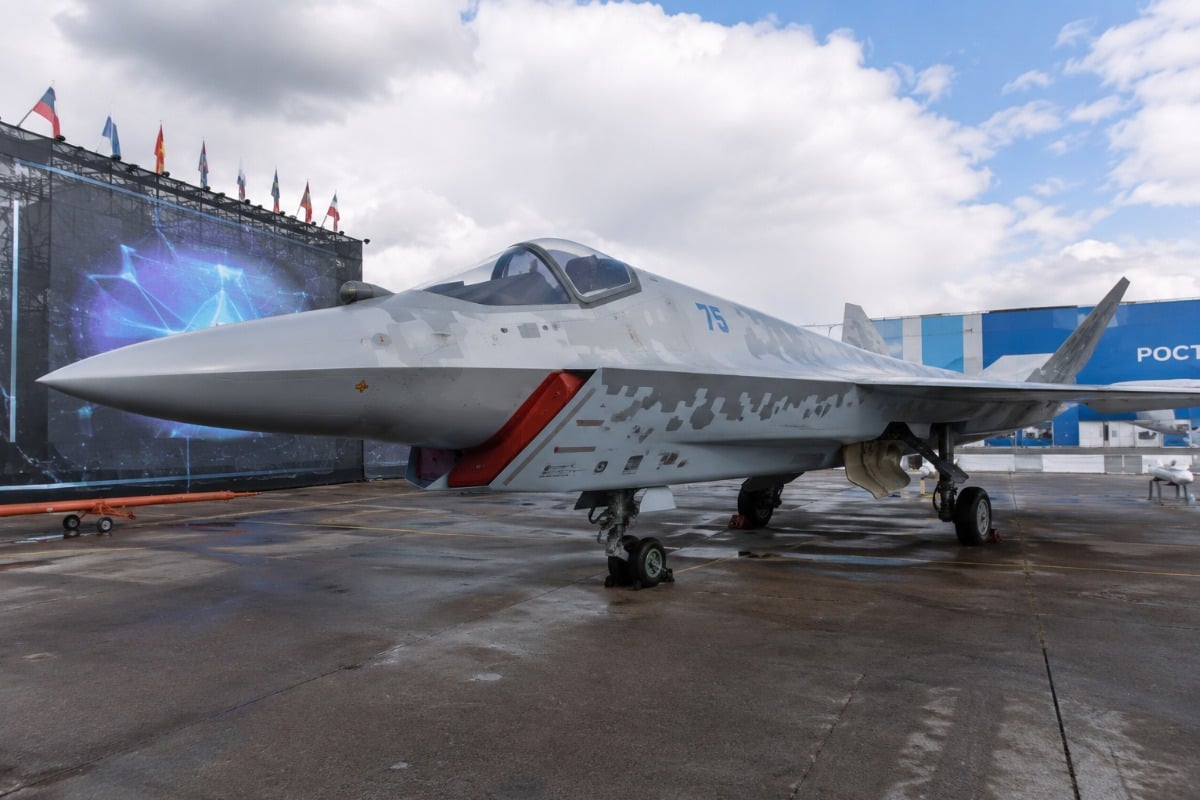
- UAC CEO Vadim Badekha confirmed on June 2, 2026, that construction of the first Su-75 Checkmate flying prototype has begun.
- The single-engine stealth fighter is rated at Mach 1.8 to 2.0, with a 2,800 to 2,900 km range and an estimated cost of approximately $30 million.
Russia’s defense industry is claiming a milestone on one of its most closely watched aviation programs, and this time the claim carries slightly more weight than usual. The United Aircraft Corporation, Russia’s state-owned aircraft manufacturing conglomerate, confirmed this week that physical construction of the first flying prototype of the Su-75 Checkmate, a single-engine fifth-generation stealth fighter designed to compete with the F-35 on price, has begun.
Vadim Badekha, General Director of the United Aircraft Corporation, told the Russian state news agency TASS that “the work on Checkmate is already at the stage of building a prototype.” The statement, made ahead of the St. Petersburg International Economic Forum, represents the most direct official confirmation to date that the program has moved beyond design work and mockup displays into the fabrication of an actual flying aircraft. Badekha said the aircraft has strong potential, though delivery timelines will depend on talks with customers, their level of interest, and the specific tasks they want the fighter to perform.
The specifications visible in official Russian promotional materials give a picture of what the Checkmate is designed to be. The aircraft carries a maximum takeoff weight of 26,000 kg (57,300 lb) and is rated for speeds between Mach 1.8 and Mach 2.0, putting it in the same velocity range as most contemporary combat aircraft. Its service ceiling reaches 16,500 meters (54,100 feet), and its practical flight range at cruise altitude and maximum Mach number runs between 2,800 and 2,900 km (1,740 to 1,800 miles). The aircraft can carry up to 7,400 kg (16,300 lb) of weapons and equipment across 13 external and 5 internal mounting points, with the internal bays critical to maintaining the low radar signature that defines a stealth aircraft. The radar system is credited with detecting air targets with a radar cross-section of 5 square meters at ranges up to 160 km (100 miles), and surface targets such as railway bridges at up to 120 km (75 miles). Engine thrust is listed between 14,500 and 16,500 kilogram-force, figures consistent with a single powerful afterburning turbofan derived from technology developed for the heavier Su-57.
The economic argument Badekha made for the program is central to understanding who the Checkmate is actually aimed at. The Checkmate has been estimated to cost approximately $30 million, compared to the basic F-35 which costs $80 million or more. That price gap is the entire marketing proposition. Russia spent decades as the dominant supplier of affordable combat aircraft to developing nations across Africa, the Middle East, Asia, and Latin America, and the Checkmate program was fundamentally designed to provide nations with an accessible path to upgrade their aging fleets of fourth-generation aircraft. Badekha framed that history explicitly in his TASS interview, noting that the Soviet Union manufactured tens of thousands of single-engine combat aircraft and that Russia had effectively abandoned that market segment for decades, a gap the Checkmate is intended to close.
The Su-75 project includes three versions: single-seat, two-seat, and unmanned, with the single-seat model expected to serve as the baseline, and the aircraft was conceived as an alternative and complement to the heavy Su-57, which entered serial production in 2020. The Russian Defense Ministry has set cost reduction as a primary requirement, and Badekha confirmed that UAC is prepared to work within those requirements, noting that for the Russian military the cost factor is now especially important.
The program’s credibility problem, however, is impossible to report around. At its unveiling in 2021, UAC said work on an actual flying Su-75 prototype was underway and that the aircraft would fly in 2023, then 2024, then 2025, and now 2026. Each year has brought a new confirmation that prototype work is proceeding and a new first-flight target that subsequently slipped. The static mockup that appeared at the MAKS 2021 airshow with Russian President Vladimir Putin in attendance generated enormous international attention and a wave of export interest, but it was a non-flying display article, not a flying prototype, and the gap between that display and an aircraft actually leaving the ground has stretched across four years of announcements. The prospect of an imminent industrial milestone comes at a time when competing offers have already established themselves and production, financial, and political constraints weigh on Russian programs, with the issue going beyond the first flight of a demonstrator to affect the credibility of an industry and access to cautious customers.
The war in Ukraine has added a dimension to the program’s difficulties that no official Russian statement addresses directly. Sanctions imposed after February 2022 have restricted Russia’s access to Western microelectronics, precision manufacturing equipment, and advanced materials that modern fighter aircraft require in substantial quantities. The Su-57, Russia’s twin-engine fifth-generation fighter that entered limited production before the invasion, has appeared in the Ukrainian theater in very small numbers, and its production rate has reportedly been constrained by component availability. Whether the Checkmate can be built to its advertised specifications using Russia’s current industrial supply chain, with Western components either absent or obtained through circuitous third-country channels, is a question that official announcements do not answer.
On the export market, contracts have multiplied over the past five years for the F-35, the F-16V, the Rafale, and the Gripen, as well as for more affordable platforms like the JF-17 and the FA-50, meaning the window of opportunity the Checkmate was designed to exploit has been narrowing as potential customers committed to Western or Western-compatible alternatives. Nations that once bought Russian aircraft in large numbers have in many cases either switched suppliers or placed orders elsewhere while waiting to see whether the Checkmate would ever actually fly.
Sukhoi chief test pilot Sergei Bogdan stated in November 2025 on Russian state television that the Su-75’s first flight would take place in 2026, saying “the aircraft is already on the shop floor, it is already being finalized, and there are already certain timelines.” Badekha’s June 2026 confirmation that prototype construction is underway is consistent with that statement, and together they represent the most operationally specific set of claims the program has produced since the 2021 mockup debut.