

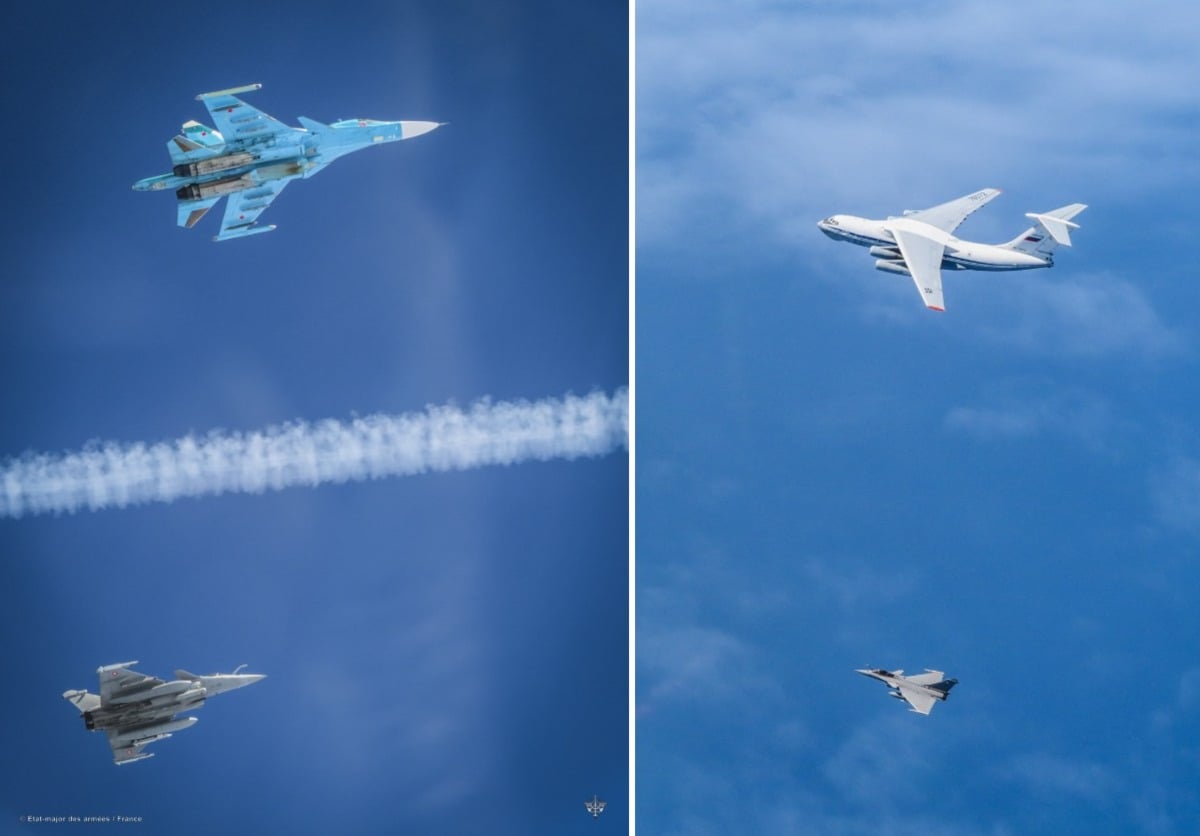
- On June 2, French and Swedish fighters scrambled from Šiauliai Air Base to intercept six Russian aircraft in the Baltic Area of Responsibility.
- The six Russian aircraft included an Su-35, Su-24, Su-34, Il-76, An-12, and An-30, spanning fighter, strike, transport, and reconnaissance roles.
Six Russian military aircraft operating in Baltic airspace in a single day triggered a joint NATO scramble involving French and Swedish fighter jets, the latest reminder that the skies above one of Europe’s most sensitive stretches of territory remain an active theater of aerial friction between the alliance and Moscow.
NATO Air Command confirmed that on June 2, two French Air and Space Force fighters operating as part of the Baltic Air Policing mission scrambled from Šiauliai Air Base in northern Lithuania to intercept multiple Russian aircraft operating within the Baltic Area of Responsibility. The interceptions were conducted jointly with two Swedish Air Force Gripen fighters, marking a coordinated allied response that drew on both a NATO member and Sweden, which joined the alliance in March 2024 after more than 200 years of military non-alignment. The six Russian aircraft involved spanned multiple mission types, including a fighter, a strike aircraft, a transport, and dedicated reconnaissance platforms, a combination that suggested coordinated Russian activity across several capability categories simultaneously.
The aircraft intercepted covered a broad spectrum of Russian military aviation. The mix included a Sukhoi Su-35, Russia’s most capable fourth-generation air superiority fighter, a heavily upgraded aircraft equipped with thrust-vectoring engines and advanced radar that represents the top of Russia’s non-stealth fighter lineup.
Also intercepted was a Sukhoi Su-24, a twin-engine supersonic strike aircraft designed to deliver bombs and missiles against ground targets at low altitude, and a Sukhoi Su-34, a dedicated strike bomber that Russia has used extensively in Ukraine for precision and unguided munitions delivery. On the transport and reconnaissance side, the intercepts involved an Ilyushin Il-76, a large four-engine military transport aircraft roughly equivalent in size and role to the American C-17, along with an Antonov An-12 turboprop transport and an Antonov An-30, a specialized airborne survey and reconnaissance aircraft equipped with cameras and sensors for collecting imagery intelligence.
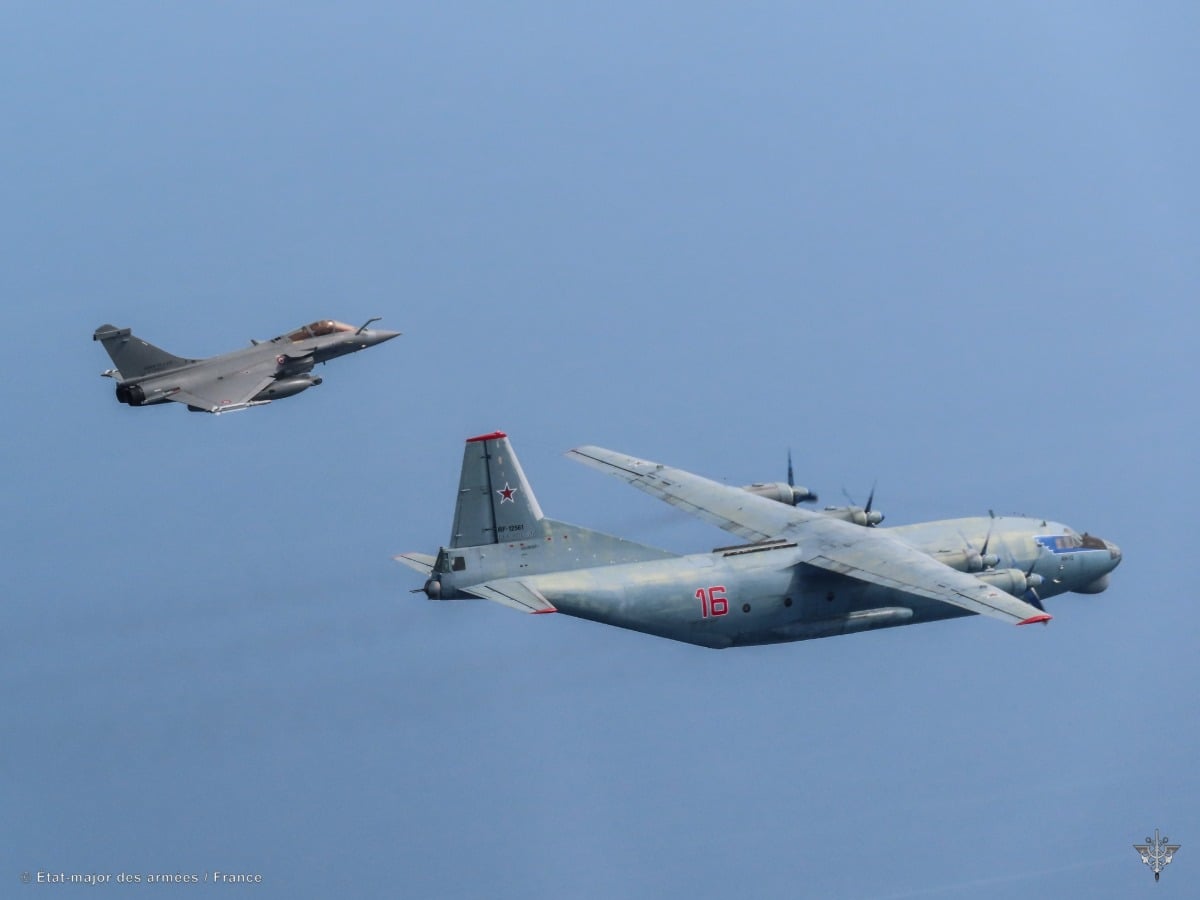
The French fighters scrambled from Šiauliai, Lithuania’s fourth-largest city and home to the primary NATO Baltic Air Policing base, where allied nations rotate fighter detachments on a quarterly basis to maintain continuous coverage of the three Baltic states, Estonia, Latvia, and Lithuania, none of which operate fast jet combat aircraft capable of policing their own airspace. France’s current rotation contributes Rafale or other French combat aircraft to that mission, with the Šiauliai detachment serving as the primary quick-reaction alert force for the northern sector of Baltic airspace. The Swedish Gripens that joined the intercept represent Stockholm’s increasingly integrated role in NATO air defense operations following accession, with Swedish aircraft now participating in alliance missions that would have been politically impossible just a few years ago.
Baltic Air Policing, which NATO has maintained continuously since the Baltic states joined the alliance in 2004, has evolved considerably in both scale and intensity since Russia’s full-scale invasion of Ukraine in February 2022. What began as a relatively routine peacetime mission involving small rotations of allied fighters has expanded into a more robust presence with larger detachments, more capable aircraft, and a higher operational tempo driven by increased Russian military aviation activity in and around the Baltic region. NATO has also added a complementary Baltic Air Surveillance and Interception mission, distinct from the original policing mission, to provide enhanced coverage of the airspace over the Baltic Sea and its approaches.
The Su-35 involved in the June 2 intercepts is a platform that NATO pilots and analysts track with particular attention. Developed by Russia’s Sukhoi design bureau and introduced into Russian Air Force service around 2014, the Su-35S variant features a powerful N035 Irbis-E passive electronically scanned array radar capable of tracking multiple targets simultaneously at long range, along with AL-41F1S engines with three-dimensional thrust vectoring that give the aircraft exceptional maneuverability at low speeds. Russia has deployed the Su-35 in Ukraine, where it has been used for both air superiority patrols and strike escort missions, and has exported the type to China, where the People’s Liberation Army Air Force operates a squadron of the aircraft. Encountering one over the Baltic in the same package as reconnaissance and transport aircraft points to a deliberate Russian effort to test allied response times and procedures across multiple mission profiles at once.
The An-30, one of the less widely recognized aircraft in the Russian package, deserves particular attention. Derived from the An-24 regional turboprop, the An-30 is a dedicated aerial survey platform equipped with multiple camera stations in the fuselage and a glazed nose section that gives observers forward and downward visibility. Russia has used the An-30 for both cartographic survey work and intelligence collection, and its presence alongside strike aircraft and a large transport in a single day’s Baltic activity suggests the Russians were conducting a broad-spectrum assessment of NATO dispositions and response patterns rather than simply exercising specific aircraft types in isolation.
The intercepts were conducted under Operation Eastern Sentry, NATO’s standing framework for air policing and quick-reaction alert operations across the alliance’s eastern flank, a mission that has taken on sharply elevated significance since Russia demonstrated in Ukraine that it views European borders as negotiable and allied airspace as a pressure point worth probing. Every scramble, every intercept, and every photograph taken by a NATO pilot of a Russian aircraft at close range is both a tactical data collection event and a message, delivered in the universal language of airpower, that the alliance is watching, ready, and not inclined to look away.