

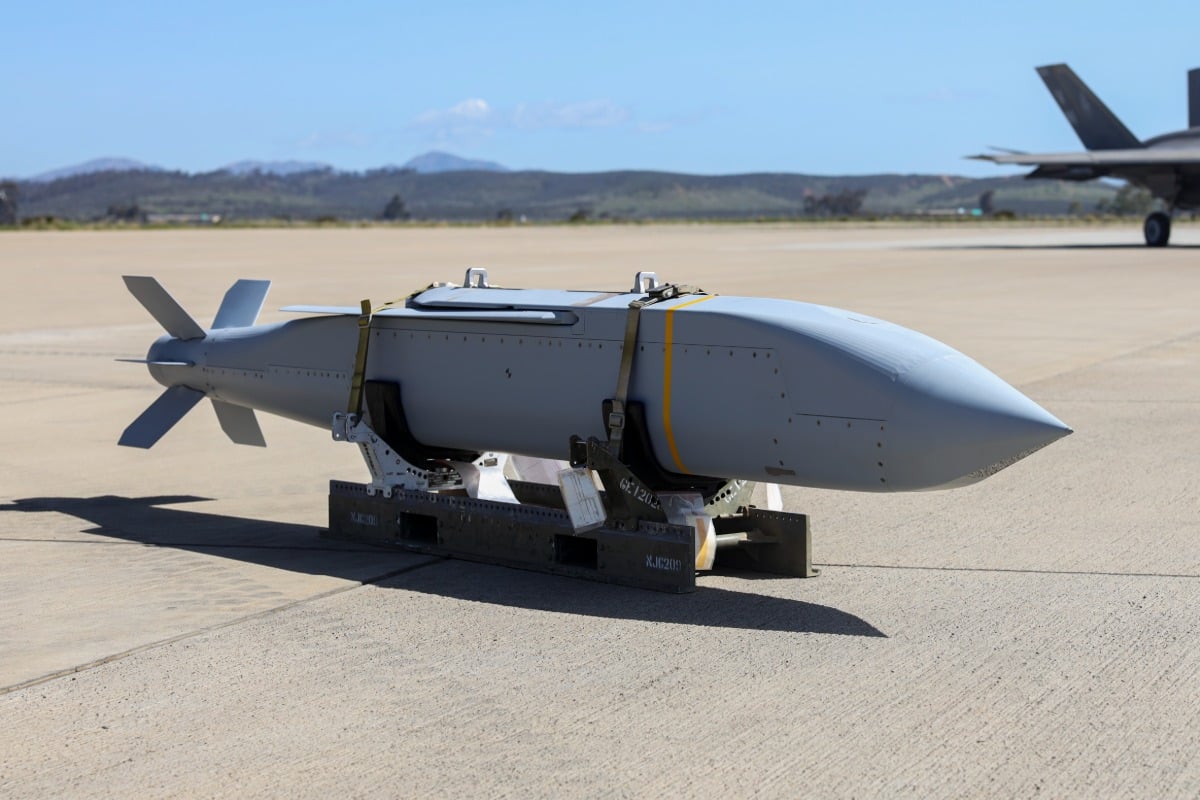
- NAVAIR intends to issue a sole-source contract to Raytheon Missiles and Defense to repair four JSOW Block II all-up-rounds for the Hellenic Air Force.
- The presolicitation was published June 4, 2026, with a response deadline of June 19, 2026, under Basic Ordering Agreement N0001925G0009.
Four of Greece’s American-made standoff missiles need fixing, and the U.S. Navy is about to pay the only company on Earth capable of repairing them to do exactly that.
The procurement notice, published June 4, 2026, signals that Greece’s air force is keeping its American-supplied precision strike arsenal in fighting shape at a moment when NATO’s southeastern flank is watching the region more carefully than it has in years.
The Naval Air Systems Command, the U.S. Navy’s main acquisition organization for aircraft and airborne weapons headquartered at Patuxent River, Maryland, published a presolicitation notice indicating its intent to issue a sole-source delivery order to Raytheon Missiles and Defense, the weapons division of RTX Corporation based in Tucson, Arizona, for the repair of four Joint Stand-Off Weapon Block II all-up-rounds belonging to the Hellenic Air Force, Greece’s national air arm. The contract vehicle is a Basic Ordering Agreement already in place between the Navy and Raytheon, and the work covers inspection, testing, troubleshooting, missile repair, and associated technical documentation. A response deadline of June 19, 2026, applies to any interested parties, though the government has made clear this is not a competitive solicitation and the work will go to Raytheon regardless.
The Joint Stand-Off Weapon, universally known as JSOW and carrying the military designation AGM-154, is a glide bomb, a precision-guided munition that a pilot releases from an aircraft and that then glides unpowered toward its target using GPS and inertial navigation to find its way. Unlike a traditional bomb that falls straight down after release, the JSOW can travel significant distances after launch, allowing the aircraft carrying it to stay well clear of enemy air defenses while still hitting targets with precision. The Block II variant that Greece operates adds a two-way data link, allowing operators to update targeting information or even redirect the weapon after it has already been released, a capability that matters enormously when targets move or the situation on the ground changes between the moment a pilot commits to a strike and the moment the weapon arrives.
The notice states explicitly that RTX is the sole designer, developer, manufacturer, and integrator of the JSOW weapon system, and that it is the only company possessing the requisite knowledge, technical expertise, production tooling, facilities, and technical data needed to service the weapon. That monopoly on technical knowledge is a structural feature of how complex precision weapons get developed: the contractor that designs a system from scratch accumulates proprietary data, specialized tooling, and institutional expertise that cannot simply be transferred to a competitor. When a JSOW needs repair, there is exactly one place in the world equipped to do it.
Greece has operated the JSOW as part of a broader effort to modernize the Hellenic Air Force’s precision strike inventory. The HAF flies the F-16 Fighting Falcon, the backbone of its combat fleet, in variants that are compatible with the JSOW, giving Greek pilots the ability to deliver precision strikes from beyond the reach of many surface-to-air missile systems. That standoff capability has taken on renewed relevance as Greece navigates a security environment that includes ongoing tensions with Turkey, a complicated relationship with a war on the European continent to its north, and NATO commitments that demand credible combat power rather than aging Cold War-era munitions. Keeping four JSOW rounds in serviceable condition may seem like a narrow logistical task, but it reflects a deliberate effort to maintain every available precision weapon at operational readiness.
The repair requirement covers what the military calls all-up-rounds, meaning complete assembled weapons rather than individual components. Inspecting, testing, and troubleshooting a complete JSOW involves verifying the integrity of the guidance electronics, the GPS receiver, the data link hardware in the Block II configuration, the wing deployment mechanisms that allow the weapon to glide after release, and the warhead and fuzing systems. Any one of those subsystems can develop faults through storage, handling, or the normal aging of sensitive electronics, and a weapon with a degraded guidance system is not a weapon an air force can rely on when it matters.
The JSOW program has a long history with multiple international customers. Beyond Greece, the weapon has been sold to Finland, Turkey, Australia, and several other U.S. allies under Foreign Military Sales arrangements, the U.S. government program through which American defense equipment moves to partner nations with American technical and logistical support built into the relationship. That support structure is precisely what this contract represents: the United States maintaining the combat effectiveness of a weapon it sold to an ally, ensuring that the investment Greece made in precision strike capability does not degrade on a hangar shelf.